

- 250 Views
- 15 Min Read
- (1) Comment
When travellers begin planning a Kenya safari, the names that usually come first are the Maasai Mara, Amboseli and Tsavo.
And for good reason.
The Maasai Mara is internationally famous for its extraordinary wildlife and the annual Great Migration. Amboseli is renowned for its elephants and spectacular views of Mount Kilimanjaro, while Tsavo offers enormous landscapes, famous red elephants and the feeling of exploring one of Kenya’s great wildernesses.
But Kenya’s safari story does not end there.
Travel north of Mount Kenya and you enter a remarkably different world — one of dry savannah, dramatic mountains, doum palms, ancient cultures, private conservancies, endangered wildlife, desert landscapes and the extraordinary Lake Turkana.
A Northern Kenya safari through destinations such as Samburu, Laikipia and Lake Turkana can add an entirely different dimension to a Kenya holiday.
Kenya’s official tourism portal itself highlights the country’s diversity, specifically identifying Samburu for its rare northern species and the northern regions for their distinctive desert landscapes and cultures.
The important point is that Northern Kenya should not simply be viewed as a quieter alternative to the Maasai Mara.
It offers experiences that are genuinely different.
Why Include Northern Kenya in Your Kenya Safari?
A first-time visitor might reasonably ask:
“If I am already visiting Maasai Mara, Amboseli or Tsavo, why should I go north?”
The answer is diversity.
A Kenya safari combining the southern and northern circuits allows you to experience several very different ecosystems, wildlife species, cultures and styles of safari.
Southern Kenya is famous for:
- Great Migration experiences in the Maasai Mara
- Huge concentrations of plains game
- Big cats
- Elephants beneath Mount Kilimanjaro
- Tsavo’s enormous wilderness
- Classic vehicle-based game viewing
Northern Kenya adds:
- Samburu’s “Special Five”
- Grevy’s zebra
- Reticulated giraffe
- Gerenuk
- Beisa oryx
- Somali ostrich
- Extraordinary dry-country landscapes
- Black rhino conservation
- African wild dog conservation
- Walking safaris
- Horseback and camel experiences in selected conservancies
- Night drives in suitable private conservancies
- Community conservation experiences
- Samburu, Turkana, Rendille and other northern cultures
- Desert landscapes
- Chalbi Desert
- Lake Turkana
- Remote wilderness and exceptionally low-density tourism
Samburu County identifies the Beisa oryx, Somali ostrich, reticulated giraffe, gerenuk and Grevy’s zebra as its famous “Samburu Five.”
This is one of the strongest reasons to add the north to a Kenya safari.
Northern Kenya Safari vs Maasai Mara, Amboseli and Tsavo
It is important not to present these destinations as competitors. They complement one another.
| Destination | What it is particularly famous for | What Northern Kenya adds |
|---|---|---|
| Maasai Mara | Great Migration, big cats, open grasslands, abundant wildlife | Dry-country species, conservancy experiences and desert landscapes |
| Amboseli | Elephants and Mount Kilimanjaro | Samburu’s Special Five, rugged northern scenery and different cultures |
| Tsavo | Huge wilderness, elephants, red soil and diverse landscapes | Endemic northern species, conservancy experiences and Lake Turkana |
| Samburu | Special Five, elephants, dry river landscapes | A very different ecological and cultural experience |
| Laikipia | Conservancies, rhinos and conservation | Walking, horseback, camel and specialist conservation experiences |
| Lake Turkana | Desert scenery, lake, remote communities and archaeological landscapes | An expedition-style experience unlike the classic safari parks |
Kenya’s tourism authorities specifically describe Samburu as a destination for rare northern species, while its desert tourism information highlights Lake Turkana, the Chalbi Desert and northern communities as distinctive attractions.
1. Samburu National Reserve – Where Kenya’s Northern Safari Begins

For many travellers, Samburu National Reserve is the gateway to Northern Kenya.
The landscape immediately feels different.
Instead of the expansive green grasslands associated with the Maasai Mara, Samburu is characterised by rugged hills, rocky outcrops, dry savannah, acacia vegetation and the life-giving Ewaso Nyiro River.
The river creates a ribbon of wildlife habitat through an otherwise arid environment.
Samburu National Reserve is relatively small at about 165 km², but its wildlife diversity is remarkable. The county government highlights its elephants, big cats, birdlife and the five distinctive dry-country species for which the reserve is particularly famous.
The Samburu Special Five
One of the strongest reasons to visit Samburu is the opportunity to search for:
1. Grevy’s zebra
Grevy’s zebra is larger and has much narrower, more numerous stripes than the common plains zebra frequently seen in the Mara and Amboseli.
For wildlife enthusiasts and photographers, finding a herd of Grevy’s zebra can be one of the highlights of a northern safari.
2. Reticulated giraffe
The reticulated giraffe has an extraordinarily distinctive geometric coat pattern.
It is strongly associated with northern Kenya and provides photographers with opportunities for images that look very different from the classic giraffe photographs taken in the southern safari parks.
3. Gerenuk
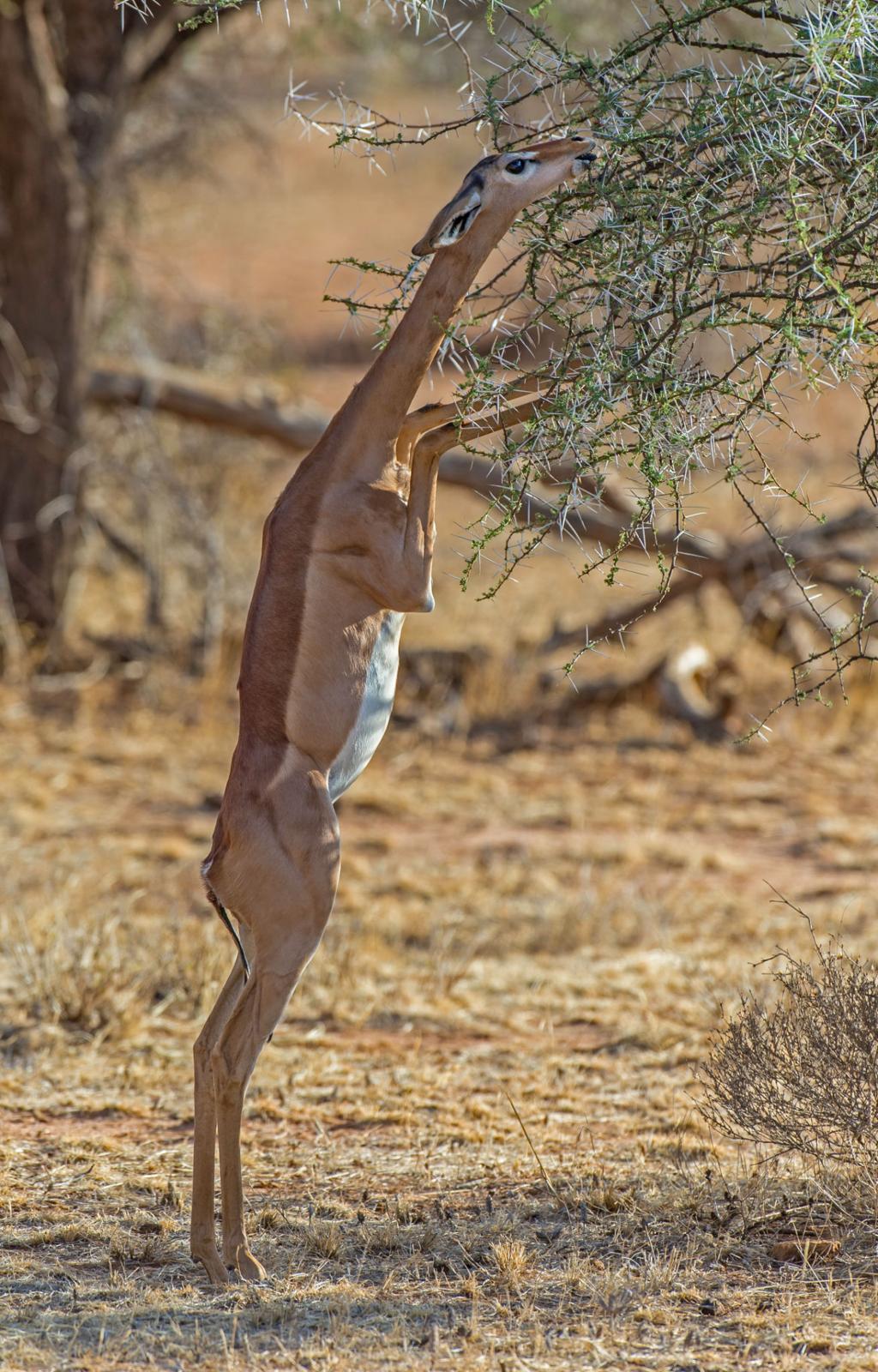
Perhaps the most unusual sighting is the gerenuk, also known as the giraffe-necked antelope.
The animal can stand upright on its hind legs to browse from trees.
That behaviour makes it one of the most memorable animals to encounter in Samburu.
4. Beisa oryx
The elegant Beisa oryx is another northern specialist and is particularly well adapted to the region’s dry environment.
5. Somali ostrich
The Somali ostrich is another distinctive northern species.
What Makes Samburu Different from Maasai Mara?
The Maasai Mara is superb for classic African savannah wildlife.
Samburu offers something else.
You are not simply seeing fewer vehicles on the same wildlife.
You are looking for a different collection of animals in a different ecosystem.
The landscape itself is dramatically different: doum palms beside the river, rocky hills, dry plains and striking northern light.
And there is an important cultural dimension.
Samburu communities have maintained strong pastoral traditions, making carefully arranged community experiences an important complement to game drives.
For families, this can be particularly rewarding because children can learn about livestock, traditional lifestyles, beadwork, food, conservation and life in a semi-arid environment.
2. Laikipia – Where Safari Meets Conservation

If Samburu is about northern wildlife and landscapes, Laikipia is about conservation, private conservancies and extraordinary safari flexibility.
Laikipia is one of the most interesting safari regions in Kenya because it is not simply a traditional national park.
Much of its wildlife habitat is managed through private and community conservation models.
This creates opportunities for safari experiences that are restricted or unavailable in conventional national parks.
Laikipia tourism sources highlight activities such as walking, horseback riding, camel excursions and off-road and night drives in appropriate conservancies.
Rhinos: One of Laikipia’s Great Attractions
Laikipia is particularly important for rhino conservation.
Ol Pejeta Conservancy, for example, is a major rhino conservation destination and is home to the world’s last two northern white rhinos.
For families, this can turn a game drive into an educational experience.
Instead of simply seeing a rhino from a safari vehicle, guests can learn about:
- Rhino conservation
- Anti-poaching initiatives
- Wildlife monitoring
- Community conservation
- Endangered species
- The challenges facing African wildlife
That conservation story can become one of the most meaningful parts of a family safari.
Laikipia’s Wildlife Experience
Depending on the conservancy selected, visitors may encounter:
- Black rhino
- White rhino
- Lion
- Leopard
- Elephant
- Buffalo
- Giraffe
- Grevy’s zebra
- African wild dog
- Hyena
- Antelope
- Numerous bird species
Laikipia’s importance extends beyond individual animals.
It demonstrates how wildlife conservation can operate alongside livestock production and local communities.
This makes the region particularly interesting for travellers who want their safari to include conservation rather than simply wildlife viewing.
What Can You Do in Laikipia That Is Different?
This is where Laikipia becomes especially interesting.
In suitable private conservancies, you may be able to experience:
Walking safari
Instead of remaining inside a safari vehicle, guests can explore the bush on foot with trained guides.
You begin noticing things that are easy to miss from a vehicle:
- Animal tracks
- Dung and spoor
- Birds
- Insects
- Plants
- Animal calls
- Small mammals
- Traditional uses of plants
Horseback safari
For experienced riders, horseback safaris can provide an extraordinary way of moving through the wilderness.
Camel safari
Camel excursions provide another distinctly northern experience.
Night drives
Selected conservancies permit night drives, opening up a completely different world of nocturnal wildlife.
Conservation experiences
Some conservancies offer opportunities to learn directly about wildlife conservation and monitoring.
These activities give Laikipia a different character from the classic vehicle-based safari experience.
3. Lake Turkana – Kenya’s Remote Northern Frontier

If Samburu and Laikipia are adventurous, Lake Turkana is expedition-style Kenya.
Located deep in northern Kenya, Lake Turkana is famous for its extraordinary jade-green colour and stark volcanic desert surroundings.
Kenya’s tourism portal describes Lake Turkana as the world’s largest permanent desert lake and identifies the surrounding region as one of the country’s major desert-tourism destinations.
This is not the place to visit simply because you want another game drive.
You come here because you want to experience a completely different side of Kenya.
What Makes Lake Turkana Unique?
Imagine leaving the familiar safari landscapes behind and entering a world of:
- Volcanic mountains
- Desert plains
- Lava landscapes
- Rugged escarpments
- A vast jade-coloured lake
- Remote communities
- Fishing villages
- Ancient archaeological landscapes
- Extraordinary sunsets
- Vast open skies
The experience is closer to an African wilderness expedition than a conventional safari holiday.
The People of Northern Kenya
One of the most important reasons to travel north is the cultural diversity.
Depending on your itinerary and location, you can encounter communities including:
- Samburu
- Turkana
- Rendille
- Borana
- El Molo
- Gabbra
Kenya’s tourism authority specifically highlights the Samburu, Rendille, Turkana and Borana among the communities whose traditions form an important part of northern Kenya’s tourism experience.
A well-designed cultural visit should focus on respectful interaction rather than staged entertainment.
For families, this can be particularly valuable.
Children who have spent several days watching wildlife can suddenly discover another side of Africa: how communities live, raise livestock, build homes, make crafts, obtain food and adapt to one of the continent’s harshest environments.
Lake Turkana for the Adventurous Traveller
Lake Turkana is particularly suitable for travellers who want:
Remote Kenya
rather than simply
luxury Kenya.
The two can sometimes be combined, but Turkana requires a different mindset.
Road conditions, logistics, weather and accommodation infrastructure are more challenging than in destinations such as the Maasai Mara or Laikipia.
Therefore, Turkana should be planned carefully with an experienced local safari operator.
Chalbi Desert – Add a True Desert Experience

For travellers extending a northern Kenya adventure, the Chalbi Desert can provide one of the most dramatic landscape experiences in the country.
Kenya’s National Tourism Service describes Chalbi as the country’s only true desert, with vast open landscapes and a distinctive desert environment.
This is a completely different photographic environment from the Maasai Mara.
Instead of:
- Green plains
- Herds of wildebeest
- Acacia-dotted grassland
you experience:
- Salt and sand
- Open horizons
- Volcanic scenery
- Desert colours
- Remote settlements
- Camels
- Extraordinary night skies
Why Northern Kenya Works So Well for Repeat Safari Travellers
For someone visiting Kenya for the first time, the Maasai Mara may naturally be the starting point.
But someone returning to Kenya often wants something different.
They may already have experienced:
- The Big Five
- Mara game drives
- Amboseli elephants
- Kilimanjaro views
- Tsavo landscapes
Northern Kenya can then provide the second chapter of the Kenya safari story.
Instead of repeating the same type of experience, you can introduce:
new wildlife + new landscapes + new cultures + new activities + new conservation stories.
That is the real value of adding the north.
The Ideal Northern Kenya Combination
For most travellers, I would structure the northern safari around:
Laikipia + Samburu
This provides a very strong combination.
Laikipia: conservation, rhinos, private conservancies and specialist safari activities.
Samburu: dry-country wildlife, the Special Five, dramatic landscapes and Samburu culture.
Then add:
Lake Turkana
if the traveller wants a much more remote expedition.
Suggested Private Luxury Family Safari – 10 Days (Get Free Quote)
Day 1 – Nairobi
Arrive in Nairobi.
Overnight at a luxury hotel.
Use the day to relax after the international flight.
Day 2 – Nairobi → Laikipia
Fly or drive to Laikipia.
Settle into a luxury conservancy lodge.
Afternoon game drive.
Possible experiences include:
- Rhino viewing
- Elephant viewing
- Lion
- Giraffe
- Conservation activities
Overnight: Laikipia
Day 3 – Laikipia Conservation Experience
Morning game drive or walking safari.
After breakfast, enjoy a family-friendly conservation activity.
Depending on the conservancy:
- Rhino tracking
- Conservation talk
- Horseback riding
- Nature walk
- Cultural experience
Afternoon game drive.
Overnight: Laikipia
Day 4 – Laikipia → Samburu
Fly or drive north toward Samburu.
After lunch, enjoy your first Samburu game drive.
Look for:
- Reticulated giraffe
- Grevy’s zebra
- Gerenuk
- Beisa oryx
- Somali ostrich
- Elephant
- Lion
- Leopard
Overnight: Samburu
Day 5 – Full-Day Samburu Safari
Early morning game drive.
Return for breakfast.
Relax around camp or lodge.
Afternoon game drive along the Ewaso Nyiro River.
Evening cultural experience.
Overnight: Samburu
Day 6 – Samburu Family Adventure
Morning nature activity.
Depending on the lodge and community arrangements:
- Guided bush walk
- Samburu cultural visit
- Beadwork experience
- Birdwatching
- Photography
- Camel experience
Afternoon game drive.
Overnight: Samburu
Day 7 – Samburu → Nairobi
Fly back to Nairobi.
This can either be the end of the safari or the beginning of the beach portion of the holiday.
Luxury Family Safari Extension: Add Maasai Mara
For first-time visitors, an excellent strategy is:
Nairobi → Laikipia → Samburu → Maasai Mara → Diani Beach
This gives the family:
- Conservation
- Northern wildlife
- Cultural experiences
- Classic Big Five safari
- Great Migration potential during the relevant season
- Indian Ocean beach relaxation
This is considerably more diverse than spending the entire safari in one ecosystem.
Private Mid-Luxury Family Northern Kenya Safari – 8 Days
For families who want comfort and a private safari vehicle without choosing the highest-priced lodges, consider:
Day 1
Nairobi
Day 2
Nairobi → Laikipia
Afternoon game drive.
Day 3
Full-day Laikipia safari.
Include rhinos and a conservation experience.
Day 4
Laikipia → Samburu.
Afternoon game drive.
Day 5
Full-day Samburu safari.
Day 6
Samburu cultural experience + game drive.
Day 7
Samburu → Nairobi.
Day 8
Departure or onward beach holiday.
This is an excellent introduction to Northern Kenya without making the itinerary too exhausting for children.
10–12 Day Northern Kenya Adventure for Families
For adventurous families, extend beyond Samburu and Laikipia.
Days 1–2
Nairobi
Days 3–4
Laikipia
Days 5–7
Samburu
Days 8–9
Marsabit / northern Kenya
Days 10–11
Lake Turkana
Day 12
Return journey / onward connection
This itinerary requires substantially more logistical planning.
It is better suited to families with older children and teenagers who enjoy adventure, photography, geography and cultural exploration.
Luxury Kenya Safari: Northern Circuit + Maasai Mara
For international families visiting Kenya for the first time, a longer itinerary can combine the famous destinations with the north.
12-Day Suggested Itinerary
Days 1–2: Nairobi
Days 3–4: Laikipia
Days 5–6: Samburu
Days 7–9: Maasai Mara
Days 10–12: Diani Beach
This is arguably the most useful structure for a traveller who wants to experience both Kenya’s famous safari destinations and its less-explored northern landscapes.
The idea isn’t to replace the Maasai Mara.
It is to make the Mara part of a much broader Kenyan experience.
Northern Kenya for Photographers
Northern Kenya is especially attractive to photographers because the landscapes and wildlife produce images that look distinctly different from classic Mara photography.
Consider photographing:
Samburu
- Gerenuk standing on two legs
- Reticulated giraffe
- Grevy’s zebra
- Elephants against rocky hills
- Doum palms along the river
- Samburu cultural portraits
Laikipia
- Rhino
- African wild dog
- Elephants
- Lions
- Conservancy landscapes
- Horseback safari
- Conservation activities
Turkana
- Lake reflections
- Desert landscapes
- Volcanic scenery
- Turkana communities
- Boats and fishermen
- Sunset over the lake
- Stars and night skies
 Northern Kenya for Birdwatchers
Northern Kenya can also add an entirely different birding dimension.
Samburu’s dry-country habitat supports bird species that are less characteristic of the classic Mara landscape.
The combination of:
- Riverine habitat
- Dry savannah
- Acacia woodland
- Rocky terrain
- Semi-desert environments
creates considerable habitat diversity.
Serious birdwatchers may therefore want to spend more time in the north rather than treating Samburu as simply a two-night stop.
Northern Kenya for Children
A Northern Kenya safari can be especially educational for families.
Children can learn about:
Wildlife
How animals adapt to drought and heat.
Conservation
Why rhinos and other endangered species require protection.
Geography
How landscapes change from highlands to savannah to desert.
Culture
How pastoral communities live in semi-arid environments.
Astronomy
How dramatically different the night sky feels away from major cities.
Ecology
How rivers such as the Ewaso Nyiro sustain life in an otherwise dry landscape.
This makes the northern circuit more than a wildlife holiday.
It becomes an African education adventure.
When Is the Best Time for a Northern Kenya Safari?
Northern Kenya can work throughout much of the year, but travel conditions vary.
The drier periods are generally attractive for wildlife viewing because vegetation is thinner and animals concentrate around available water.
June to October is widely regarded as a strong period for safari, while January to March can also offer rewarding conditions. Green-season travel can provide beautiful landscapes but may bring more challenging road conditions in remote areas.
For Lake Turkana and the far north, itinerary planning should take local weather and road conditions particularly seriously.
How Many Nights Should You Spend in Each Destination?
A useful rule of thumb is:
| Destination | Recommended nights | Main reason |
|---|---|---|
| Laikipia | 2–3 | Wildlife + conservation + activities |
| Samburu | 2–3 | Special Five + landscape + culture |
| Lake Turkana | 2–4 | Remote adventure + lake + culture |
| Chalbi Desert | 1–2 | Desert expedition |
| Maasai Mara | 3–4 | Classic wildlife + migration season |
| Amboseli | 2–3 | Elephants + Kilimanjaro |
For a first-time family safari, Laikipia + Samburu is probably the easiest Northern Kenya combination to integrate.
For adventurous repeat visitors, add Turkana and/or the Chalbi Desert.
Northern Kenya Is Not Just About “Fewer Tourists”
One common way of marketing Northern Kenya is to say it is “less crowded.”
That is true in many areas and is an important benefit.
But it undersells the destination.
The real selling point is:
Northern Kenya gives you a different Kenya.
You see different animals.
You encounter different landscapes.
You meet different communities.
You participate in different activities.
You encounter conservation projects.
You can experience walking, horseback and camel-based activities in suitable areas.
And eventually you can reach one of the most extraordinary landscapes in the country — Lake Turkana.
Laikipia tourism sources similarly emphasise the region’s private conservancies, off-road opportunities and active safari experiences as distinctions from conventional national-park tourism.
Should You Choose Northern Kenya Instead of Maasai Mara?
The better question is:
Why choose one when you can combine them?
For a first Kenya safari, the classic destinations can provide the iconic experiences travellers expect.
Northern Kenya then adds the experiences they did not know they were missing.
A well-planned itinerary could therefore be:
Nairobi → Laikipia → Samburu → Maasai Mara → Diani Beach
or, for adventurous repeat visitors:
Nairobi → Laikipia → Samburu → Chalbi Desert → Lake Turkana
These are two completely different Kenya holidays.
Leave a comment:
You must be logged in to post a comment.
Comment 01
Astute Africa Safaris,
09 September, 2026REF: Crafting Your Bespoke African Safari Experience with Astute Africa Safaris
Jambo,
Thank you for your interest in exploring the wonders of Africa with Astute Africa Safaris. We pride ourselves on creating immersive, tailor-made journeys that align perfectly with your personal interests, pace, and travel aspirations.
Because every safari is a unique narrative, we do not believe in “one-size-fits-all” pricing. To ensure we provide you with an accurate and competitive quotation that reflects the specific lodges, wildlife experiences, and logistical arrangements you desire, we invite you to connect with our team for a personalized consultation.
Please contact us at info@astuteafricasafaris.com, Whatsapp +254762663272 or fill the inquiry form with a few details regarding your preferred travel dates, group size, and specific interests (e.g., photography, luxury relaxation, or adventure trekking). Once we have these details, we will curate a comprehensive proposal designed specifically for you.
We look forward to the possibility of helping you plan an unforgettable journey.
Warm regards,
Team Astute Africa Safaris