

- 367 Views
- 13 Min Read
- (1) Comment
Introduction: Pack Smart, Travel Light and Enjoy the Wild
An African safari is unlike an ordinary beach holiday, city break or resort vacation. Your days may begin with a chilly sunrise game drive, continue through warm afternoon temperatures and finish around a campfire under a cool evening sky.
You could be travelling through the Maasai Mara, Amboseli or Tsavo in Kenya, the Serengeti or Ngorongoro in Tanzania, Bwindi or Queen Elizabeth National Park in Uganda, Volcanoes National Park or Akagera in Rwanda, or combining a safari with a beach holiday in Zanzibar.
Each destination can present different weather, terrain and activities.
That is why knowing what to pack for an African safari before leaving home can make a major difference to your comfort and enjoyment.
The good news is that you do not need to pack your entire wardrobe. In fact, one of the biggest mistakes safari travellers make is packing too much.
Current East African safari packing guidance consistently emphasizes lightweight layers, neutral colours, practical footwear, sun and insect protection, binoculars, important documents and—where light aircraft are involved—soft-sided luggage and strict weight limits.

This comprehensive African safari packing list gives you 10 important things to understand before you start packing.
1. Understand Your Safari Destination and Itinerary First
Before putting anything into your suitcase, look carefully at your itinerary.
An African safari is not one single type of holiday.
A traveller doing a luxury road safari in Kenya may need a different packing list from someone flying between remote camps in Tanzania. Likewise, someone combining a Uganda gorilla trek with a savannah safari needs different footwear and rain protection from someone spending most of their holiday in the Serengeti.
Ask these questions before packing:
- Which countries are you visiting?
- Which national parks and reserves are included?
- Will you travel by road, light aircraft or both?
- Are you doing walking safaris?
- Are you trekking gorillas or chimpanzees?
- Will you visit the coast or Zanzibar?
- Are you travelling during the dry or rainy season?
- Are you staying in luxury lodges, tented camps or budget camps?
- Will laundry be available?
- Are there bush flights with luggage restrictions?
For example:
Kenya safari: Maasai Mara, Amboseli, Tsavo and Samburu can involve early-morning game drives and considerable temperature changes.
Tanzania safari: Serengeti, Ngorongoro, Tarangire and other northern-circuit destinations may require layers because early mornings can feel considerably cooler than afternoons.
Uganda safari: If your itinerary includes Bwindi Impenetrable National Park, add proper hiking footwear and rain protection.
Rwanda safari: Gorilla trekking in Volcanoes National Park requires more trekking-oriented clothing than a conventional vehicle safari.
Zanzibar: Add swimwear, sandals, lightweight beach clothing and sun protection if your safari ends on the coast.
The golden rule
Pack for your activities, not simply for the country.
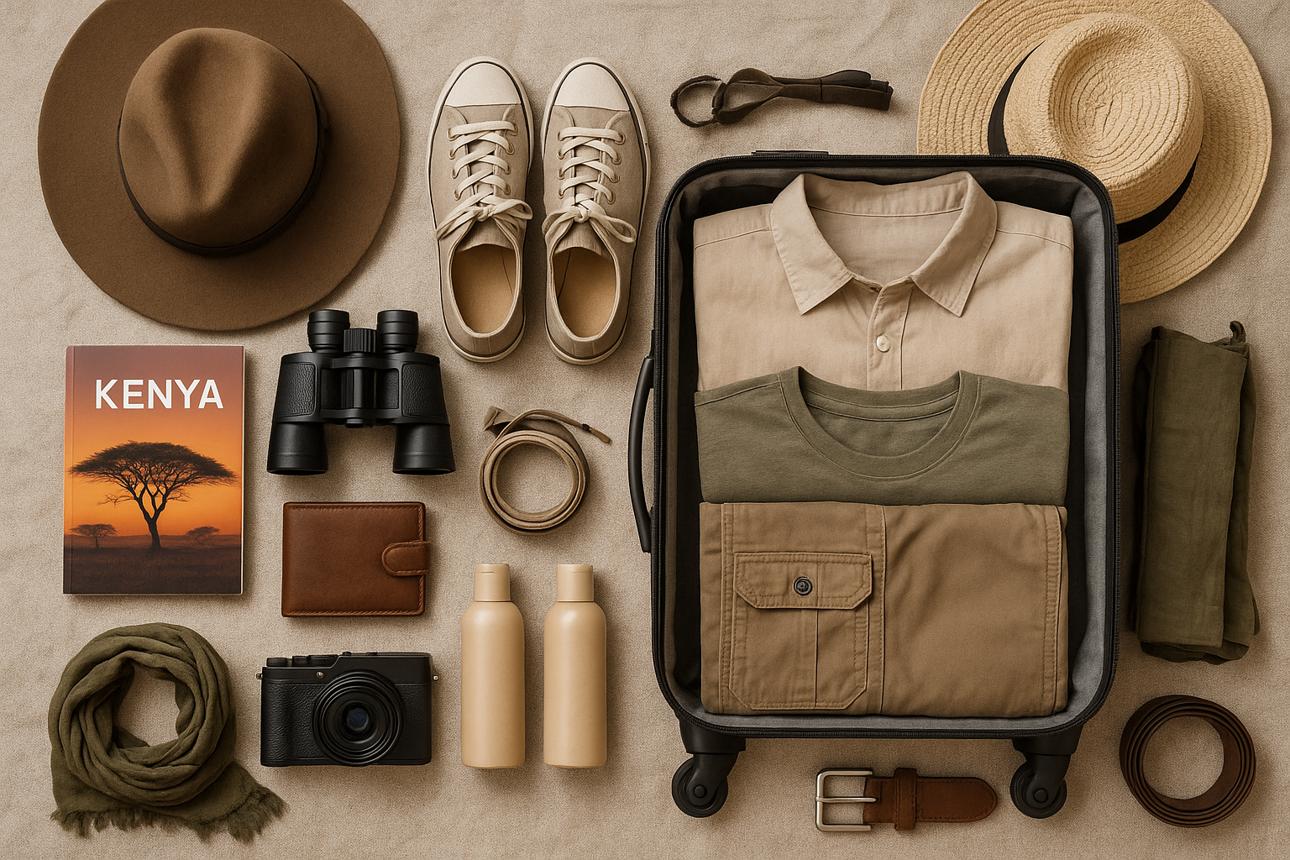
2. Choose Lightweight, Neutral-Coloured Safari Clothing
One of the most common questions travellers ask is:
What should I wear on an African safari?
The answer is simple: choose comfortable, breathable and practical clothing that can be layered.
Neutral colours such as:
- Khaki
- Beige
- Tan
- Olive
- Brown
- Grey
- Muted green
are practical choices for safari environments. Current safari packing guides also commonly recommend neutral colours and lightweight layers.

Recommended clothing
For approximately one week, a practical starting point could be:
- 3–4 lightweight T-shirts
- 2–3 lightweight long-sleeved shirts
- 2–3 pairs of comfortable trousers
- 1–2 pairs of shorts
- 1 fleece or lightweight warm jacket
- 1 lightweight waterproof jacket
- Underwear
- Socks
- Sleepwear
- Comfortable evening clothing
- Swimwear if your accommodation has a pool or you are visiting Zanzibar/coastal Kenya
You do not necessarily need a different outfit for every day.
Many safari lodges and camps provide laundry services, allowing you to wash and reuse clothing.
Why long sleeves are useful
Long-sleeved shirts can provide:
- Protection from the sun
- Protection from insects
- Protection from dust
- Protection from vegetation during walking activities
- Extra warmth during cool mornings
What about bright colours?
Bright colours are generally unnecessary on safari. Practical earth tones are easier to keep looking clean and are more appropriate for wildlife viewing.
Also remember that safari clothing is about comfort and practicality—not looking like a professional wildlife ranger.
3. Prepare for Cold Mornings and Hot Afternoons
Many first-time safari travellers make the mistake of assuming:
“Africa is hot, so I only need shorts and T-shirts.”
Not necessarily.
Safari temperatures can change significantly during the day.
An early morning game drive can be surprisingly cold, particularly when travelling in an open vehicle or at higher elevations. By midday, the same destination can become hot and sunny.
This is why layering is one of the most important principles of an African safari packing list.

A good layering system
Early morning:
- T-shirt
- Long-sleeved shirt
- Fleece/light jacket
- Scarf or buff if needed
Midday:
- T-shirt or lightweight shirt
- Hat
- Sunglasses
- Sunscreen
Evening:
- Long trousers
- Long-sleeved shirt
- Lightweight jacket or fleece
The advantage of layering is that you can add or remove clothing without carrying a large amount of luggage.
4. Pay Attention to Your Luggage Allowance
This is one of the most important things to know before you pack.
If your safari involves scheduled or chartered bush flights, luggage restrictions can be significantly more restrictive than on your international flight.
Many East African safari operators advise travellers using light aircraft to use soft-sided luggage, with 15 kg often being a common limit, although the exact allowance varies by airline, aircraft and itinerary. Some road safaris allow considerably more.
Why soft luggage?
Soft duffel bags are easier to fit into the limited luggage compartments of small aircraft.
A large rigid suitcase may be unsuitable even if your international airline permits it.
Before departure, ask your safari operator:
- What is my maximum luggage weight?
- Is hand luggage included in the weight?
- Must the bag be soft-sided?
- Are wheeled bags permitted?
- Is camera equipment included in the allowance?
- What are the dimensions allowed?
- Can excess luggage be stored in Nairobi, Arusha or another gateway city?
Never assume that your international airline’s baggage allowance applies to your safari flight.
If your itinerary includes several internal flights, confirm the baggage restrictions for every flight.
5. Pack the Right Footwear
You don’t need five pairs of shoes.
In fact, footwear can quickly become one of the heaviest parts of your luggage.
For a standard vehicle safari
Consider:
- Comfortable walking shoes or trainers
- Lightweight closed shoes
- Sandals or flip-flops for the lodge
For walking safaris
Consider:
- Comfortable closed walking shoes
- Lightweight hiking boots where appropriate
- Good socks
For gorilla trekking
If you are travelling to Uganda or Rwanda for gorilla trekking, footwear becomes considerably more important.
You may encounter:
- Mud
- Steep slopes
- Wet vegetation
- Forest trails
- Uneven terrain
For these activities, properly broken-in hiking boots or suitable trekking footwear, rain protection and appropriate long clothing are strongly recommended.

Important tip
Never take brand-new hiking boots on a demanding trek.
Wear them beforehand so you know they are comfortable and do not cause blisters.
6. Don’t Forget Sun and Insect Protection
The African sun can be intense, particularly during long days outdoors.
Your safari essentials should therefore include:
Sun protection
- High-SPF sunscreen
- Sunglasses
- Wide-brimmed hat or cap
- SPF lip balm
- Lightweight long-sleeved shirts
- Refillable water bottle
Insect protection
Depending on your destination and season:
- Insect repellent
- Long-sleeved clothing
- Long trousers
- Personal medication recommended by your healthcare professional
A good safari packing list should account for both daytime sun exposure and evening insect activity.
Consider a wide-brimmed hat
A good hat is one of the simplest pieces of safari equipment you can take.
It helps protect your:
- Face
- Ears
- Neck
- Eyes
from strong sunlight.

7. Bring Binoculars—Don’t Rely Only on Your Camera
A camera is exciting, but binoculars can be even more useful on safari.
Wildlife is not always close to the vehicle.
A lion may be resting hundreds of metres away. A leopard may be hidden in a tree. An elephant may be visible across a large plain. Birds may be perched high in distant trees.
Binoculars allow you to see details that your eyes alone may miss.
Many current safari packing guides recommend bringing binoculars, with 8×42 commonly suggested as a versatile all-round configuration.
Safari optics checklist
- Binoculars
- Camera
- Spare batteries
- Memory cards
- Camera charger
- Phone
- Phone charger
- Power bank
- Lens-cleaning cloth
- Protective camera bag
Photography tip
Do not spend the entire safari looking through your camera screen.
Sometimes the most memorable experience is simply watching the animal with your own eyes.
8. Protect Your Important Documents, Money and Medication
Your passport should be among the first things you pack—not something you remember at the last minute.
Create a small travel-document pouch containing:
- Passport
- Visa/eVisa documentation where applicable
- Travel insurance details
- Flight information
- Safari itinerary
- Accommodation confirmations
- Emergency contacts
- Copies of important documents
- Credit/debit cards
- Some appropriate local or foreign currency
- Driving licence if you intend to drive
- Relevant vaccination/health documentation where required
A current safari checklist from African Safaris also recommends keeping passport, visas, travel insurance, flight details, copies of documents, cash and cards among the core travel essentials.
Keep digital copies
Save copies securely on:
- Your phone
- Cloud storage
- A secure travel folder
If your phone is lost, having an additional backup can be extremely useful.
Medication
Pack your regular medication in your hand luggage, rather than putting everything in checked luggage.
For destination-specific health requirements, consult an appropriate travel-health professional before departure.
9. Pack Smart for Dust, Rain, Power and Connectivity
A safari can be dusty.
It can also be wet.
And remote camps may not have the same charging facilities you are accustomed to at home.
Consider packing:
- Power bank
- Universal travel adapter
- Phone charger
- Camera batteries
- Spare memory cards
- Small flashlight/headlamp
- Dry bag
- Dust-resistant camera protection
- Lightweight daypack
- Reusable water bottle
- Small microfiber towel
- Travel laundry bag
Kenya, for example, uses Type G electrical sockets, while the exact charging arrangements at safari camps can vary. Current East African safari guidance recommends checking charging arrangements and carrying suitable adapters and spare batteries.
Protect your electronics
Safari vehicles can generate considerable dust on some roads.
Keep cameras, phones and other electronics protected when they are not being used.
A small waterproof/dustproof pouch can be particularly useful.
10. Know What NOT to Pack For An African Safari
Sometimes the best safari packing advice is knowing what to leave behind.
Avoid overpacking
You probably don’t need:
- Multiple formal outfits
- Several pairs of heavy shoes
- Large amounts of jewellery
- A huge collection of cosmetics
- Bulky hair equipment
- Excessive denim
- Large hard-shell suitcases for bush flights
- Excessive electronic equipment
Don’t pack for every possible scenario
Instead, build your luggage around your actual itinerary.
Think:
Essential → Useful → Optional
If an item is neither essential nor useful, leave it at home.
Your Complete African Safari Packing Checklist
Use this checklist as you prepare for departure.
🧳 Luggage
☐ Soft-sided duffel bag where required
☐ Small daypack
☐ Packing cubes
☐ Laundry bag
☐ Waterproof/dustproof pouch
☐ Luggage tags
👕 Clothing
☐ 3–4 lightweight T-shirts
☐ 2–3 long-sleeved shirts
☐ 2–3 lightweight trousers
☐ 1–2 pairs of shorts
☐ Lightweight fleece/jacket
☐ Rain jacket
☐ Underwear
☐ Socks
☐ Sleepwear
☐ Comfortable evening clothes
☐ Swimwear
👟 Footwear
☐ Comfortable walking shoes
☐ Closed shoes/boots
☐ Sandals
☐ Hiking boots if trekking
☀️ Sun Protection
☐ Sunscreen
☐ Sunglasses
☐ Wide-brimmed hat
☐ Lip balm with SPF
☐ Lightweight long-sleeved clothing
🦟 Insect Protection
☐ Insect repellent
☐ Long trousers
☐ Long-sleeved shirts
☐ Personal health supplies
📷 Photography
☐ Camera
☐ Camera charger
☐ Spare batteries
☐ Memory cards
☐ Binoculars
☐ Lens-cleaning cloth
☐ Protective camera bag
🔌 Electronics
☐ Smartphone
☐ Phone charger
☐ Power bank
☐ Universal travel adapter
☐ Headlamp/flashlight
🛂 Travel Documents
☐ Passport
☐ Visa/eVisa documentation where required
☐ Travel insurance
☐ Flight tickets
☐ Safari itinerary
☐ Hotel/lodge confirmations
☐ Copies of important documents
☐ Emergency contacts
☐ Bank cards
☐ Appropriate cash
🩺 Personal and Health Items
☐ Personal medication
☐ Basic first-aid supplies
☐ Prescription documentation if applicable
☐ Toiletries
☐ Hand sanitiser
☐ Personal hygiene products
☐ Moisturiser/lip balm
☐ Travel tissues/wipes
What to Pack for Different African Safari Experiences
Kenya Safari Packing List
For Kenya, your packing list can depend heavily on whether you are visiting the Maasai Mara, Amboseli, Tsavo, Samburu, Laikipia or the coast.
For a conventional game-drive safari, prioritize:
Lightweight layers + neutral colours + comfortable shoes + hat + sunscreen + binoculars + camera + insect repellent.
If you are combining safari with Diani, Mombasa, Watamu, Malindi or Lamu, add beachwear.
Tanzania Safari Packing List
For a Tanzania safari involving destinations such as Serengeti, Ngorongoro, Tarangire or Lake Manyara, focus on:
- Lightweight layers
- Warm clothing for early mornings
- Neutral colours
- Comfortable footwear
- Binoculars
- Camera equipment
- Sun protection
- Insect protection
If your safari ends in Zanzibar, add:
- Swimwear
- Beach sandals
- Lightweight beach clothing
- Sun hat
- Reef-conscious sunscreen
Uganda Safari Packing List
Uganda can require a more varied packing strategy because your itinerary could combine savannah wildlife with forest trekking.
For gorilla or chimpanzee trekking, consider:
- Long trousers
- Long-sleeved shirts
- Good trekking footwear
- Waterproof jacket
- Daypack
- Insect repellent
- Gloves suitable for trekking
- Extra socks
For vehicle safaris, lightweight safari clothing and comfortable footwear are sufficient for many activities.
Rwanda Safari Packing List
Rwanda is particularly important to consider carefully if your trip includes gorilla trekking in Volcanoes National Park.
Pack:
- Broken-in hiking boots
- Long trousers
- Long-sleeved shirt
- Waterproof jacket
- Daypack
- Insect repellent
- Gloves
- Water bottle
- Comfortable trekking socks
The weather in forest and mountain environments can be very different from a warm savannah game drive.
What to Wear on an African Safari: Quick Guide
| Situation | Recommended clothing |
|---|---|
| Early morning game drive | T-shirt + long sleeve + fleece/jacket |
| Hot afternoon | Lightweight shirt + trousers/shorts + hat |
| Evening | Long trousers + long sleeve + light jacket |
| Walking safari | Long trousers + closed shoes/boots |
| Gorilla trekking | Hiking boots + long trousers + waterproof jacket |
| Beach/Zanzibar | Swimwear + sandals + lightweight clothing |
| Rainy season | Quick-dry clothing + waterproof layer |
| Photography | Neutral clothing + comfortable layers |
10 Things to Remember Before You Close Your Suitcase
Before leaving home, ask yourself:
1. Is my luggage suitable for my safari flights?
Check the operator’s exact requirements.
2. Have I packed layers?
You may need warm clothing at dawn and lighter clothing later.
3. Are my clothes practical?
Comfort matters more than fashion in the bush.
4. Do I have binoculars?
You will probably use them more than you expect.
5. Have I protected my electronics?
Dust, moisture and limited charging can create problems.
6. Do I have sun protection?
Hat, sunglasses and sunscreen should be easily accessible.
7. Do I have insect protection?
Pack appropriate repellent and clothing.
8. Are my documents secure?
Keep passports, insurance and travel information accessible.
9. Have I packed appropriate shoes?
Especially important for walking safaris and gorilla trekking.
10. Can I remove anything?
If your bag is too heavy, start removing non-essential items.
Final Thoughts: The Best African Safari Packing List Is a Smart One
Preparing for an African safari should not mean filling a giant suitcase.
The best approach is to pack light, pack practically and pack according to your itinerary.
Think in layers rather than individual outfits. Choose breathable and neutral-coloured clothing. Take comfortable footwear, sun and insect protection, binoculars, essential electronics and your important travel documents.
Most importantly, check your safari operator’s luggage requirements before you travel—particularly if your itinerary includes light aircraft.
A well-planned African safari packing list means less time worrying about your luggage and more time enjoying what you came to Africa to experience: incredible wildlife, spectacular landscapes, unforgettable cultures and extraordinary moments in the wilderness.
Ready for your African adventure? Start planning your safari, check your itinerary, confirm your luggage allowance and use this checklist before you zip up your bag.
Leave a comment:
You must be logged in to post a comment.
Comment 01
Astute Africa Safaris,
10 October, 2026REF: Crafting Your Bespoke African Safari Experience with Astute Africa Safaris
Jambo,
Thank you for your interest in exploring the wonders of Africa with Astute Africa Safaris. We pride ourselves on creating immersive, tailor-made journeys that align perfectly with your personal interests, pace, and travel aspirations.
Because every safari is a unique narrative, we do not believe in “one-size-fits-all” pricing. To ensure we provide you with an accurate and competitive quotation that reflects the specific lodges, wildlife experiences, and logistical arrangements you desire, we invite you to connect with our team for a personalized consultation.
Please contact us at info@astuteafricasafaris.com, Whatsapp +254762663272 or fill the inquiry form with a few details regarding your preferred travel dates, group size, and specific interests (e.g., photography, luxury relaxation, or adventure trekking). Once we have these details, we will curate a comprehensive proposal designed specifically for you.
We look forward to the possibility of helping you plan an unforgettable journey.
Warm regards,
Team Astute Africa Safaris