

- 1.4k Views
- 4 Min Read
- (1) Comment
Planning a trip to the African continent requires a deep understanding of its diverse climates, which are dictated by the movement of the Intertropical Convergence Zone (ITCZ). Because Africa spans both the Northern and Southern Hemispheres, seasons are often inverted depending on your latitude. Generally, the best time to visit Africa for wildlife viewing is during the dry season, which typically runs from June to October for East and Southern Africa, as animals congregate around dwindling water sources and vegetation is sparse, making sightings more frequent.
Understanding African Seasons and Climate Dynamics
To determine the optimal travel window, one must consider the specific region. Africa is not a monolith; it contains Mediterranean climates in the north and south, vast deserts, and tropical rainforests. The timing of your visit can be mathematically modeled by looking at precipitation averages. If P represents monthly precipitation and T represents temperature, the “Comfort Index” C for a traveler might be expressed as:
C=Tideal−|Tactual−Tideal|P+1
Where Tideal is approximately 24∘C. When P is low and T is near the ideal, the index is highest, typically occurring in the winter months of the Southern Hemisphere.
East Africa: The Land of the Great Migration
Kenya and Tanzania For many, the primary goal is witnessing the Great Wildebeest Migration. This cyclical event follows the rains.
- July to September: This is the peak window. The herds are in the Masai Mara (Kenya) and northern Serengeti (Tanzania), performing dramatic river crossings.
- January to February: This is the “short dry season.” It is the best time for the calving season in the southern Serengeti, where thousands of wildebeest are born daily, attracting high predator action.
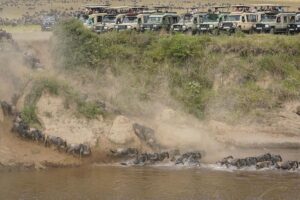
Best time to visit Africa: A vast herd of wildebeest crossing the Mara River with crocodiles lying in wait
Southern Africa: Safaris and Natural Wonders
South Africa, Botswana, and Namibia Southern Africa experiences its winter from May to August. This is the prime time for the Okavango Delta (Botswana) and Kruger National Park (South Africa).
- May to October: The weather is dry and cool. In the Okavango Delta, floodwaters from the Angolan highlands reach the delta during the dry season, creating a unique lush oasis in a parched landscape.
- November to March: This is the “Green Season.” While it is rainier and hotter, it is the best time for birdwatching and seeing newborn animals.
Victoria Falls (Zambia/Zimbabwe) The “Smoke that Thunders” is best viewed between April and June when the Zambezi River is at full flow following the summer rains.
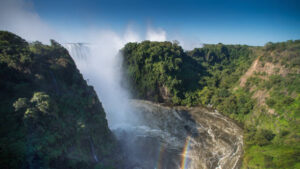
Best time to visit Africa: The mist rising from Victoria Falls under a clear blue sky.
North Africa: Desert Sands and Ancient History
Egypt and Morocco Traveling to the Sahara or the Pyramids in mid-summer (July/August) can be dangerously hot, with temperatures often exceeding 40∘C.
- March to May and September to November: These shoulder seasons offer the most temperate weather for exploring the souks of Marrakech or the Valley of the Kings.
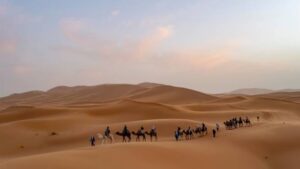
Best time to visit Africa: A camel trek across the golden dunes of the Erg Chebbi in Morocco at sunset.
Regional Breakdown Table on the best time to visit Africa
| Region | Best Months | Primary Attraction |
|---|---|---|
| East Africa | June – October | Great Migration, Trekking |
| Southern Africa | May – September | Big Five Safaris, Delta Floods |
| North Africa | March – May | Cultural Sites, Desert Tours |
| Indian Ocean Islands | May – October | Beach Resorts, Diving |
The Impact of Climate Change on 2026 Travel
As of March 2024, meteorological data indicated a shift in traditional rain patterns due to a prolonged El Niño-Southern Oscillation (ENSO) cycle. Travelers in 2026 should note that the “short rains” in East Africa (traditionally November) have become more unpredictable, sometimes extending into December, which can affect road accessibility in remote parks.
Gorilla Trekking in Rwanda and Uganda
Trekking to see Mountain Gorillas is a year-round activity, but the dry seasons of June to September and December to February are preferred. The forest floors are less slippery, and the physical demand of the hike is slightly mitigated by the lack of mud.
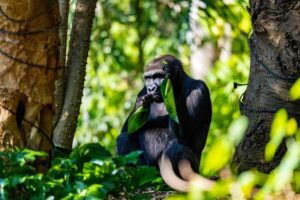
Best time to visit Africa: A silverback gorilla sitting in the dense greenery of Volcanoes National Park.
Conclusion about the best time to visit Africa
Whether you are seeking the thundering hooves of the Serengeti or the quiet majesty of the Namib Desert, timing is everything. By aligning your visit with the dry seasons of your chosen region, you ensure the highest probability of spectacular wildlife encounters and comfortable trekking conditions. Always consult local guides at Lonely Planet or National Geographic Travel for real-time weather updates before departure.
Leave a comment:
You must be logged in to post a comment.
Comment 01
Astute Africa Safaris,
05 May, 2026REF: Crafting Your Bespoke African Safari Experience with Astute Africa Safaris
Jambo,
Thank you for your interest in exploring the wonders of Africa with Astute Africa Safaris. We pride ourselves on creating immersive, tailor-made journeys that align perfectly with your personal interests, pace, and travel aspirations.
Because every safari is a unique narrative, we do not believe in “one-size-fits-all” pricing. To ensure we provide you with an accurate and competitive quotation that reflects the specific lodges, wildlife experiences, and logistical arrangements you desire, we invite you to connect with our team for a personalized consultation.
Please contact us at info@astuteafricasafaris.com, Whatsapp +254762663272 or fill the inquiry form with a few details regarding your preferred travel dates, group size, and specific interests (e.g., photography, luxury relaxation, or adventure trekking). Once we have these details, we will curate a comprehensive proposal designed specifically for you.
We look forward to the possibility of helping you plan an unforgettable journey.
Warm regards,
Team Astute Africa Safaris