

- 591 Views
- 6 Min Read
- (1) Comment
Nairobi, the only city in the world with a national park within its borders, serves as the undisputed gateway to East Africa’s most iconic wildlife destinations. As of March 2026, the infrastructure connecting the capital to the remote wilderness has reached unprecedented levels of efficiency, with the expanded Standard Gauge Railway (SGR) and increased domestic flight routes making the transition from urban bustle to savannah silence seamless. Whether you are seeking the “Big Five,” the Great Migration, or rare northern species, the best Kenya safaris from Nairobi typically include the Maasai Mara National Reserve, Amboseli National Park, Lake Nakuru, and Ol Pejeta Conservancy, offering a diverse range of ecosystems accessible within a 3-to-5-hour drive or a 45-minute flight.
Planning Your Departure: Why Nairobi is the Perfect Hub
Nairobi’s Jomo Kenyatta International Airport (NBO) and the regional Wilson Airport (WIL) form the logistical backbone of Kenyan tourism. Wilson Airport is particularly vital for “fly-in” safaris, where light aircraft transport guests directly to bush airstrips, bypassing the bumpy roads.
The geographical positioning of Nairobi allows for a “circuit” approach to travel. You can head south to the shadow of Kilimanjaro, west to the Great Rift Valley and the Mara, or north toward the rugged landscapes of Samburu. The efficiency of a safari is often calculated by the ratio of travel time to game-viewing time. If Ts is the total safari time and Td is the driving/flight duration, the efficiency E can be represented as:E=Ts−TdTsIn 2026, with improved road networks like the Nairobi-Mau Summit Expressway, Td has significantly decreased, maximizing your time in the wild.
1. Maasai Mara National Reserve: The Crown Jewel
No Kenya safari from Nairobi is complete without the Maasai Mara. Located approximately 250 km west of the city, it is world-renowned for the Great Wildebeest Migration.
- What to See: The “Big Five” (Lion, Leopard, Elephant, Buffalo, and Rhino). Between July and October, over 1.5 million wildebeest and zebras cross the Mara River.
- Travel Time: 5–6 hours by road or 45 minutes by flight.
- 026 Update: New conservancy models have expanded the protected area, allowing for more private, low-vehicle-density game drives.
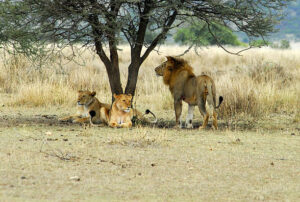
Male and two female lions resting in the shade of an acacia tree seen on Kenya safaris from Nairobi
2. Lake Nakuru National Park: A Birdwatcher’s Paradise
Part of the Great Rift Valley, Lake Nakuru was once famous primarily for its millions of flamingos. While water level changes have shifted flamingo populations, it remains one of the best places in Kenya to see both Black and White Rhinos.
- Key Wildlife: Rhinos, Rothschild’s giraffes, and leopards.
- Proximity: Only 3 hours from Nairobi, making it an ideal 1-night or 2-night addition to a Mara circuit.
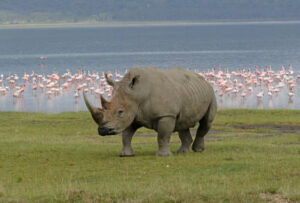
A must see while on a Kenya Safaris from Nairobi is White Rhinoceros walking along lake shore
2. Amboseli National Park: In the Shadow of Kilimanjaro
Amboseli is famous for two things: massive herds of “tuskers” (elephants) and the best views of Mount Kilimanjaro, located just across the border in Tanzania.
- The Experience: The park’s swamps, fed by underground meltwater from the mountain, are a magnet for wildlife during the dry season.
- Travel Time: 4 hours by road or a 35-minute flight.
- Photography Tip: The iconic shot of an elephant with the snow-capped peak of Kilimanjaro is best captured at dawn.
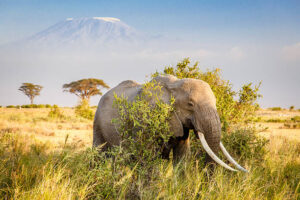
A bull African Bush Elephant with Mount Kilimanjaro standing in the distance; Kenya Safaris from Nairobi
-
4. Ol Pejeta Conservancy: Conservation in Action
Located on the Laikipia Plateau north of Nairobi, Ol Pejeta is a trailblazer in wildlife conservation. It is home to the last two remaining Northern White Rhinos on Earth.
- Unique Features: The Sweetwaters Chimpanzee Sanctuary and the opportunity for night game drives, which are restricted in most national parks.
- Travel Time: 3.5 to 4 hours from Nairobi.
-
5. Nairobi National Park: The “World’s Wildlife Capital”
If you have only a few hours, you don’t even need to leave the city limits. Nairobi National Park offers a surreal experience where you can photograph a rhino or lion with the city’s skyscrapers in the background.
- Best Time: 6:00 AM for the most active predator sightings.
- Accessibility: 15–30 minutes from the Central Business District.
Logistics and Budgeting for 2026 Kenya Safaris from Nairobi
The cost of a Kenya safari depends on the level of luxury and the mode of transport.
- Budget Safaris: Utilize customized safari vans with pop-up roofs. Prices typically range from $150 to $250 per person per day.
- Mid-Range: Often involve 4×4 Land Cruisers and tented camps, ranging from $300 to $600 per day.
- Luxury: Fly-in safaris to high-end lodges can exceed $1,000 per night.
The total cost C for a group of n people over d days can be estimated by:C=n×d×(A+L+T)
Where A is the average park entrance fee, L is the lodging cost, and T is the transport/guide fee. In 2026, park fees have been restructured to support local community conservancies, so it is vital to check the latest Kenya Wildlife Service (KWS) rates at https://www.kws.go.ke.
Best Time to Visit
While Kenya is a year-round destination, the weather patterns dictate the wildlife experience:
- Dry Season (June to October): Best for general wildlife viewing as animals congregate around water holes. This coincides with the Great Migration.
- Short Rains (November to December): Great for birdwatching and lower prices.
- Long Rains (March to May): The “Green Season.” While some roads can be challenging, the landscape is lush, and it is the best time for photography due to the lack of dust.
Essential Packing List for 2026 Kenya Safaris from Nairobi
- Clothing: Neutral colors (khaki, olive). Avoid blue/black as they attract tsetse flies.
- Tech: High-zoom camera (at least 300mm lens), power banks, and binoculars.
- Health: Yellow Fever certificate (required for some travelers) and malaria prophylactics.
Conclusion
A Kenya safari from Nairobi is more than just a holiday; it is an immersion into one of the most vibrant ecosystems on the planet. By 2026, the balance between high-tech travel infrastructure and raw, untamed nature has made Kenya more accessible than ever. Whether you choose the thundering hooves of the Mara or the quiet dignity of the Ol Pejeta rhinos, the journey begins in Nairobi.
Top Rates Kenya safaris from Nairobi includes:
- 3 days Exploring Kenya Masai Mara Safari from Nairobi
- 4 days Masai Mara Lake Nakuru Safari: Experience Serenity and Adventure
- 4-Day Nairobi to Mombasa Safari: Dive into Kenya’s Culture & History
- 7-Day Safari and Beach Holiday in Kenya Adventures: Safari Thrills & Beach Bliss
- 7-Day Unlimited Bush Safari: Masai Mara Amboseli safari Kenya
- 7-Day Kenya Wildlife Safari: Nature Wonders & Cultural Delights
- 7-Day Kenya Safari Tour: Ultimate Adventure Experience
- 10-Day Kenya and Tanzania Safari: Ultimate Wildlife Immersion
Leave a comment:
You must be logged in to post a comment.

Comment 01
Astute Africa Safaris,
05 May, 2026REF: Crafting Your Bespoke African Safari Experience with Astute Africa Safaris
Jambo,
Thank you for your interest in exploring the wonders of Africa with Astute Africa Safaris. We pride ourselves on creating immersive, tailor-made journeys that align perfectly with your personal interests, pace, and travel aspirations.
Because every safari is a unique narrative, we do not believe in “one-size-fits-all” pricing. To ensure we provide you with an accurate and competitive quotation that reflects the specific lodges, wildlife experiences, and logistical arrangements you desire, we invite you to connect with our team for a personalized consultation.
Please contact us at info@astuteafricasafaris.com, Whatsapp +254762663272 or fill the inquiry form with a few details regarding your preferred travel dates, group size, and specific interests (e.g., photography, luxury relaxation, or adventure trekking). Once we have these details, we will curate a comprehensive proposal designed specifically for you.
We look forward to the possibility of helping you plan an unforgettable journey.
Warm regards,
Team Astute Africa Safaris