

- 789 Views
- 19 Min Read
- (1) Comment
Uganda, famously dubbed the “Pearl of Africa” by Winston Churchill in his 1908 travelogue, remains one of the most ecologically and culturally diverse destinations on the planet with Uganda’s wildlife safaris, gorilla trekking and cultural heritage taking center stage. Situated at the intersection of the East African savanna and the West African rainforest, the nation offers a unique tapestry of biodiversity that is unmatched in the region. From the snow-capped peaks of the Rwenzori Mountains—the fabled “Mountains of the Moon”—to the vast, shimmering expanse of Lake Victoria, Uganda provides a sanctuary for rare wildlife and a living museum of ancient traditions.
Ugandas Wildlife Safaris, Gorilla Trekking, and Cultural Heritage
The crown jewel of Ugandan tourism is undoubtedly the opportunity to encounter the endangered mountain gorilla (Gorilla beringei beringei). Bwindi Impenetrable National Park, a UNESCO World Heritage site, protects nearly half of the world’s remaining mountain gorilla population. Trekking through the dense, mist-covered canopy of Bwindi is a transformative experience; as noted in primatological literature, the habituation of these gentle giants has allowed for a profound understanding of their complex social structures and conservation needs.
Beyond the primates, Uganda’s safari circuits—particularly Murchison Falls and Queen Elizabeth National Parks—offer the “Big Five” in landscapes that range from acacia-dotted plains to riverine forests where the Nile River forces its way through a narrow seven-meter gap, creating one of the most powerful waterfalls in the world.
Uganda’s cultural heritage is as vibrant as its natural landscape. As the most culturally diverse country in Africa, it hosts over 52 indigenous tribes, many of which maintain traditional kingdoms that date back to the 13th century. The Buganda Kingdom, the largest of these, offers visitors a glimpse into a sophisticated historical society. The Kasubi Royal Tombs, a UNESCO World Cultural Heritage site, serve as the burial ground for the four Kabakas (kings) of Buganda and stand as a masterpiece of traditional architecture, constructed primarily from organic materials like wood, thatch, and bark cloth. These sites are not merely historical relics; they are active centers of cultural identity, where traditional dance, royal regalia, and oral histories continue to thrive.
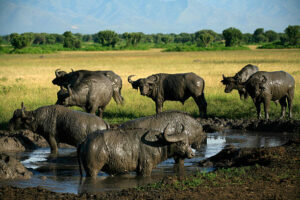
Uganda’s Wildlife Safaris Gorilla Trekking and Cultural Heritage; Cape buffalo in a waterhole in Queen Elizabeth National Park in Uganda. (Photo by: Jeremy Jowell/Majority World/Universal Images Group via Getty Images)
For the traveler seeking to understand the “Pearl,” one must appreciate the synergy between conservation and community. The integration of local indigenous knowledge into wildlife management has been a cornerstone of Uganda’s success in protecting its natural heritage. Whether you are navigating the Kazinga Channel to observe hippopotamus pods or exploring the royal palaces of the Buganda, the experience is defined by the warmth of the Ugandan people and the sheer scale of the country’s natural wonders.
The Pearl of Africa: An Odyssey Through Uganda’s Untamed Wilderness
Uganda, famously christened the “Pearl of Africa”, remains one of the most ecologically diverse destinations on the planet. Situated at the intersection of the East African savanna and the West African rainforest, the country offers a unique tapestry of habitats that support an extraordinary density of wildlife. For the discerning traveler, a safari in Uganda is not merely a vacation; it is an immersion into a landscape where the prehistoric meets the pristine, offering encounters with iconic megafauna and rare primates that exist nowhere else on Earth.
The Primates of the Mist: Bwindi Impenetrable National Park
No discussion of Ugandan wildlife is complete without mentioning the mountain gorilla (Gorilla beringei beringei). Bwindi Impenetrable National Park, a UNESCO World Heritage site, protects nearly half of the world’s remaining mountain gorilla population. Trekking through the dense, mist-shrouded canopy of this ancient forest is a transformative experience.
As noted in authoritative primatological studies, the social structures and behavioral complexities of these great apes provide a profound window into our own evolutionary history. The park’s steep, rugged terrain requires physical stamina, yet the reward—spending an hour in the silent, watchful presence of a silverback—is widely considered the pinnacle of African wildlife tourism.
Gorilla Trekking: An Encounter with the Great Apes
Gorilla trekking in Bwindi is a highly regulated activity managed by the Uganda Wildlife Authority. Because the mountain gorilla is an endangered species, the number of permits issued daily is strictly limited to minimize human-gorilla contact and prevent the transmission of respiratory diseases, to which gorillas are highly susceptible. Trekkers are typically divided into small groups and accompanied by expert trackers and rangers who navigate the dense vegetation to locate the habituated families. The trek can range from thirty minutes to several hours, depending on the movement of the gorillas, who are constantly foraging for bamboo shoots, celery, and various fruits.
The Best Time to Visit
The optimal time for trekking in Bwindi is during the two dry seasons: from June to August and from December to February. During these months, the forest trails are less muddy and significantly easier to navigate, which is crucial given the steep, rugged terrain of the park. While the rainy seasons (March–May and September–November) offer lower prices on accommodation, the heavy precipitation can make the forest floor treacherous, and visibility for photography is often reduced by persistent mist.
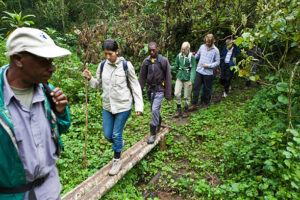
Uganda’s Wildlife Safaris, Gorilla Trekking, and Cultural Heritage; A group of travellers trekking Mountain Gorilla in Bwindi Impenetrable Forest
Social Structure and Behavior
Mountain gorillas are highly social, intelligent primates that live in stable, cohesive groups known as troops or bands. A typical troop is led by a “silverback”—a mature male characterized by the distinctive patch of silver hair on his back—who is responsible for the protection and decision-making of the group. The social structure is patriarchal, yet the silverback’s authority is maintained through displays of strength and social bonding rather than constant aggression.
These primates exhibit complex behaviors, including the use of vocalizations, facial expressions, and grooming, which serve to reinforce social hierarchies and maintain group harmony. Research indicates that their daily activity budget is heavily influenced by the need to consume large quantities of vegetation to sustain their massive body mass, which can be modeled by the energy intake requirements.
The Significance of Gorilla Chest-Beating: Communication and Social Dynamics
The iconic image of a gorilla beating its chest is one of the most recognizable behaviors in the animal kingdom, yet it is frequently misunderstood as a simple act of aggression. In reality, chest-beating is a complex, multi-faceted form of communication that serves as a cornerstone of social cohesion within gorilla groups. Primatologists have long observed that this behavior is not merely a prelude to violence, but a sophisticated signaling mechanism used by silverbacks to maintain group order, assert dominance, and navigate social hierarchies without the need for physical combat.
The mechanics of chest-beating are as fascinating as their social function. Research indicates that the sound produced during this display is directly correlated to the size of the individual; larger males possess larger air sacs, which produce a lower-frequency sound, effectively communicating their physical stature to rivals and potential mates over long distances.
This acoustic signaling allows gorillas to assess the “fighting ability” of an opponent without engaging in high-risk physical altercations. For the group, this display acts as a cohesive force; a silverback may beat his chest to signal a change in direction or to rally the group, ensuring that the troop remains unified while foraging through dense vegetation.
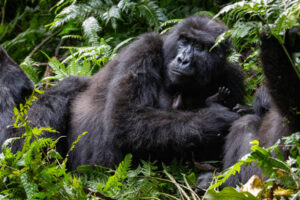
Uganda’s Wildlife Safaris, Gorilla Trekking, and Cultural Heritage: A family of mountain gorillas lives under protection as the species face the threat of extinction at Bwindi Impenetrable National Park
For human trekkers, encountering a chest-beating gorilla is a profound experience that requires careful interpretation. While the behavior is often a display of confidence or a reaction to perceived intrusion, it is rarely an invitation to conflict. When a silverback beats his chest in the presence of observers, it is frequently a warning sign—a request for space and a demonstration of his role as the protector of his family.
Trekkers are instructed to remain calm, avoid direct eye contact, and maintain a respectful distance, as the display is intended to intimidate rather than initiate an attack. Understanding that this behavior is a form of “social language” rather than mindless rage allows for a safer and more respectful interaction between humans and these endangered primates.
What is the gestation period and gorilla life span is?
The biological life cycle of the gorilla is characterized by a slow reproductive rate and a lifespan that, while varying between wild and captive populations, reflects their status as long-lived primates. In authoritative primatological literature, the gestation period for a gorilla is consistently documented as approximately 8.5 months, or roughly 250 to 270 days. This period is remarkably similar to that of humans, reflecting the close evolutionary relationship between the two species.
Regarding their lifespan, gorillas in the wild typically live between 30 and 40 years, though individuals in protected environments or zoos have been recorded living into their 50s. The aging process in gorillas is marked by the transition from infancy to juvenile stages, followed by sub-adulthood, and finally reaching full maturity. In the wild, factors such as habitat loss, disease, and social dynamics—including the risk of infanticide by dominant silverbacks during group takeovers—significantly influence mortality rates.
Female gorillas reach sexual maturity around 7 to 8 years of age, but they typically do not give birth until they are slightly older, and they produce offspring at intervals of approximately 4 to 6 years. The reproductive output of a female is limited, often resulting in only 2 to 6 offspring over the course of her entire life.
The growth of a gorilla follows a distinct trajectory: infants are dependent on maternal care for several years, breastfeeding until age 3 or 4. As they transition into the juvenile stage (ages 4 to 8), they begin to gain independence, though they remain within the social structure of the troop for protection. The slow maturation process and low birth rate are critical factors in the conservation status of gorillas, as populations cannot recover quickly from environmental or anthropogenic disturbances.
The Savanna Giants: Murchison Falls and Queen Elizabeth National Parks
For those seeking the classic “Big Five” experience, Murchison Falls National Park stands as Uganda’s largest protected area. The park is bisected by the Victoria Nile, which forces its way through a narrow seven-meter gap, creating the most powerful waterfall in the world. The surrounding savanna is teeming with elephants, lions, leopards, and massive herds of Cape buffalo.
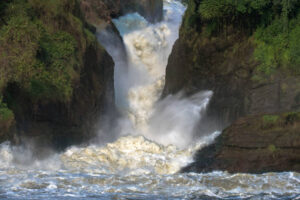
Uganda’s Wildlife Safaris, Gorilla Trekking, and Cultural Heritage; Murchison Falls, at Murchison Falls National park, Uganda.
Queen Elizabeth National Park offers a different allure, characterized by its volcanic craters and the famous Kazinga Channel. This natural waterway acts as a magnet for wildlife, hosting one of the world’s highest concentrations of hippopotamuses and Nile crocodiles. The park is also renowned for the tree-climbing lions of the Ishasha sector, a behavioral anomaly that continues to fascinate zoologists and safari-goers alike.
What unique wildlife species can be found in Uganda’s national parks?
The unique Uganda convergence creates a biological melting pot that supports an extraordinary array of endemic and rare species. The country’s national parks serve as critical sanctuaries for animals that are either absent or extremely rare in neighboring East African nations.
The most iconic species found within Uganda’s borders is the mountain gorilla (Gorilla beringei beringei). Bwindi Impenetrable National Park and Mgahinga Gorilla National Park are home to more than half of the world’s remaining population of these great apes. Unlike the lowland gorillas found in other parts of Africa, mountain gorillas are adapted to high-altitude, mist-covered forests, possessing thicker fur and a distinct social structure.
Beyond the primates, Uganda’s Queen Elizabeth National Park is world-renowned for its population of tree-climbing lions. While lions are found across the continent, the specific behavioral trait of regularly climbing and resting in large fig trees is a unique adaptation observed primarily in the Ishasha sector of this park. Furthermore, the country hosts the highest concentration of chimpanzees (Pan troglodytes) in Africa, particularly within the Kibale Forest National Park, which is often cited as the primate capital of the world due to its density of habituated chimpanzee communities.
Uganda’s avian diversity is equally distinct, with over 1,000 species recorded, representing roughly half of Africa’s bird species. Among the most unique is the Shoebill stork (Balaeniceps rex), a prehistoric-looking bird found in the expansive wetlands and marshes of Murchison Falls and Mabamba Swamp. This species is highly sought after by ornithologists for its massive, shoe-shaped bill and solitary, patient hunting behavior.
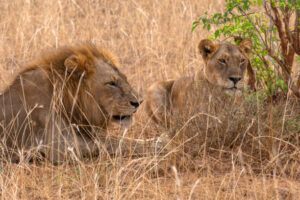
Uganda’s Wildlife Safaris, Gorilla Trekking, and Cultural Heritage: Lion and lioness resting at Murchison Falls National park, Uganda.
Additionally, the country’s savannah parks, such as Kidepo Valley, provide habitat for species rarely seen elsewhere in the region, including the cheetah and the ostrich, which thrive in the semi-arid northern landscapes.
Biodiversity and Conservation
Uganda’s geography, spanning from the Albertine Rift Valley to the snow-capped peaks of the Rwenzori Mountains, creates a mosaic of ecosystems. This diversity is reflected in the country’s avian population; with over 1,000 recorded bird species, it is arguably the finest birding destination in Africa. Conservation efforts in these parks are supported by a robust framework of national policies that prioritize the protection of endangered species while fostering community-based tourism, ensuring that the economic benefits of safaris reach the local populations living adjacent to these wild spaces.
The sheer variety of habitats—from tropical rainforests and wetlands to high-altitude moorlands—ensures that every safari in Uganda is distinct. Whether you are tracking chimpanzees in Kibale Forest or cruising the Nile to witness the thunderous power of Murchison Falls, the “Pearl of Africa” offers an intimate, authentic connection to the natural world that is increasingly rare in the modern age.
Guide to Uganda’s Wildlife Safaris, Gorilla Trekking, and Cultural Heritage
A Comprehensive Guide to Uganda’s Cultural Heritage
Uganda, often referred to as the “Pearl of Africa,” possesses a cultural tapestry woven from centuries of migration, kingdom-based governance, and diverse ethnic traditions. The nation’s heritage is not merely a collection of historical artifacts but a living, breathing entity defined by the interplay between its Bantu-speaking populations in the south and Nilotic-speaking groups in the north and east. This cultural complexity is anchored in the historical prominence of centralized kingdoms—most notably the Buganda, Bunyoro, Toro, and Busoga—which have maintained traditional institutions that continue to influence contemporary Ugandan social and political life.
The cultural landscape of Uganda is fundamentally shaped by its ethnic diversity, which encompasses over 50 distinct linguistic and cultural groups. In the central region, the Buganda Kingdom serves as a cornerstone of traditional identity, characterized by the Kabaka (King) and a sophisticated administrative structure that has existed for centuries. The architectural significance of this heritage is best exemplified by the Kasubi Tombs, a UNESCO World Heritage site that serves as the burial ground for the Kabakas of Buganda and remains a vital site for Ganda spiritual practices.
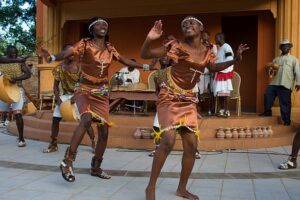
Uganda’s Wildlife Safaris, Gorilla Trekking, and Cultural Heritage: Traditional Dances From Uganda.
Beyond the central kingdoms, the northern regions, such as those inhabited by the Karamojong, offer a starkly different cultural experience, defined by pastoralist traditions, nomadic lifestyles, and a social structure deeply integrated with cattle-rearing and age-set systems.
Music, dance, and oral traditions serve as the primary vehicles for transmitting Ugandan heritage across generations. Traditional instruments, such as the adungu (a harp-like string instrument) and the entenga (a set of tuned drums), are central to ceremonial life, including weddings, coronations, and harvest festivals. The craftsmanship involved in these instruments, particularly the renowned drum-making traditions found in areas like Mpigi, reflects a meticulous attention to detail and a deep connection to the natural environment.
Furthermore, the culinary heritage of Uganda, featuring staples like matooke (steamed green bananas) and luwombo (stew steamed in banana leaves), provides a sensory connection to the agricultural practices that have sustained these communities for generations.
The preservation of this heritage is an ongoing process, balancing the pressures of modernization with the desire to maintain indigenous customs. The interaction between these diverse groups—from the Nilotic pastoralists of the north to the Bantu agriculturalists of the south—has created a unique national identity that is both resilient and adaptive. As visitors and scholars explore the country, they encounter a society that prides itself on hospitality and a profound respect for ancestral lineage, making Uganda a significant destination for those seeking to understand the complexities of East African cultural evolution.
What are the most popular national parks in Uganda for wildlife safaris?
Uganda, possesses a unique geographical convergence where the ecosystems of East and West Africa meet, resulting in an extraordinary density of biodiversity. The country’s national park system is managed by the Uganda Wildlife Authority, which oversees protected areas that serve as critical habitats for primates, large mammals, and diverse avian species.
Murchison Falls National Park
As Uganda’s largest national park, Murchison Falls is widely considered the premier destination for classic savanna safaris. The park is bisected by the Victoria Nile, which forces its way through a narrow seven-meter gorge, creating the spectacular Murchison Falls. Visitors frequently encounter large herds of elephants, giraffes, and buffalo, alongside lions and leopards. The river banks are also densely populated with hippopotamuses and Nile crocodiles, making boat cruises a staple of the safari experience.
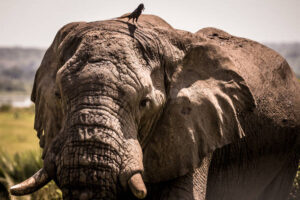
Uganda’s Wildlife Safaris, Gorilla Trekking, and Cultural Heritage: An elephant with a bird sitting on its head is seen at Murchison Falls National Park
Queen Elizabeth National Park
Located in the western rift valley, Queen Elizabeth National Park is renowned for its diverse ecosystems, ranging from open savanna and acacia woodlands to dense rainforests and volcanic craters. It is particularly famous for the tree-climbing lions found in the Ishasha sector. The Kazinga Channel, which connects Lake George and Lake Edward, provides one of the most concentrated wildlife viewing opportunities in Africa, hosting massive populations of hippos and waterbirds.
Bwindi Impenetrable National Park
Bwindi is a UNESCO World Heritage site and the primary destination for mountain gorilla trekking. This ancient, high-altitude rainforest protects approximately half of the world’s remaining mountain gorilla population. Unlike the savanna parks, the experience here is centered on guided forest treks to observe these primates in their natural habitat, offering a profound encounter with one of humanity’s closest relatives.
Kidepo Valley National Park
Situated in the remote northeastern corner of the country, Kidepo Valley is often cited by naturalists as one of the most pristine wilderness areas in Africa. Due to its isolation, it offers a more exclusive safari experience. The park features a rugged landscape and is home to species not commonly found elsewhere in Uganda, such as cheetahs, ostriches, and the greater kudu, alongside large prides of lions and herds of elephants.
Kibale National Park
Kibale is globally recognized as the premier destination for chimpanzee tracking. The park contains one of the highest concentrations of primates in the world, including thirteen different species. The dense tropical forest provides a canopy for chimpanzees, red colobus monkeys, and L’Hoest’s monkeys, making it an essential stop for primatologists and wildlife enthusiasts alike.
What is the best safari itinerary covering Uganda’s Wildlife Safaris, Gorilla Trekking, and Cultural Heritage
A comprehensive itinerary that balances these elements typically requires 12 to 14 days to account for the country’s diverse geography and the logistical demands of traversing its national parks.
The optimal itinerary begins in Entebbe or Kampala, allowing for an immediate immersion into the nation’s cultural heritage. A visit to the Uganda Museum provides a foundational understanding of the country’s ethnic diversity, while the Kasubi Tombs offer insight into the history of the Buganda Kingdom. From the capital, the journey should proceed west to Kibale Forest National Park, which is globally recognized as one of the premier locations for chimpanzee tracking. The dense tropical rainforest here provides a stark contrast to the savannah ecosystems found further south.
Following the primate experience, the itinerary should transition to Queen Elizabeth National Park. This region is essential for a classic wildlife safari, where visitors can observe tree-climbing lions in the Ishasha sector and take boat cruises along the Kazinga Channel to view hippopotamuses and diverse birdlife. The cultural component here is often enhanced by visiting local fishing communities or engaging with the Bunyaruguru people, whose traditions are deeply intertwined with the volcanic landscape of the region.
The climax of the Ugandan experience is undoubtedly the Bwindi Impenetrable Forest or Mgahinga Gorilla National Park for mountain gorilla trekking. As noted in authoritative travel guides, the choice of sector is critical; some areas offer shorter, more accessible treks, while others provide a more rigorous, deep-forest experience. To conclude the trip, a visit to Lake Bunyonyi is recommended for relaxation and cultural interaction with the Bakiga people, providing a serene environment to reflect on the wildlife encounters before returning to the capital.
Conclusion: The Enduring Allure of the Pearl of Africa (Uganda’s Wildlife Safaris, Gorilla Trekking, and Cultural Heritage)
Uganda, famously dubbed the “Pearl of Africa” by Winston Churchill, offers a synthesis of biodiversity and cultural depth that remains unparalleled on the continent. As this article has explored, the nation’s wildlife safaris—ranging from the vast savannahs of Murchison Falls to the dense, mist-shrouded forests of Bwindi—provide a window into the raw, untamed beauty of East Africa. The experience of gorilla trekking, in particular, represents a pinnacle of conservation-based tourism, where the intimate encounter with mountain gorillas serves as a profound reminder of our shared biological heritage and the critical importance of protecting endangered species.
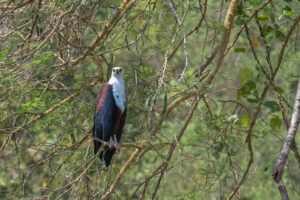
:Uganda’s Wildlife Safaris, Gorilla Trekking, and Cultural Heritage: African fish eagle standing and watching for preys, along the Nile river at Murchison Falls National park, Uganda.
Beyond the natural spectacle, Uganda’s cultural heritage acts as the heartbeat of the visitor experience. The intricate traditions of the Baganda, the pastoralist legacies of the Ankole, and the vibrant musical and culinary expressions found across the country provide a necessary human context to the landscape. When travelers engage with these communities, they move beyond the role of a spectator, becoming participants in a living history that has been shaped by the Great Lakes region’s unique geography and social evolution.
Ultimately, a journey through Uganda is more than a vacation; it is an immersion into a complex ecosystem where conservation, community, and commerce intersect. As global interest in sustainable and ethical tourism grows, Uganda stands as a model for how a nation can leverage its natural assets to foster economic development while preserving its ecological and cultural integrity for future generations. Whether you are tracking primates in the Bwindi Impenetrable Forest or exploring the historical sites of the Buganda Kingdom, the “Pearl of Africa” leaves an indelible mark on the soul, inviting a deeper appreciation for the delicate balance of life on Earth.
Leave a comment:
You must be logged in to post a comment.

Comment 01
Astute Africa Safaris,
05 May, 2026REF: Crafting Your Bespoke African Safari Experience with Astute Africa Safaris
Jambo,
Thank you for your interest in exploring the wonders of Africa with Astute Africa Safaris. We pride ourselves on creating immersive, tailor-made journeys that align perfectly with your personal interests, pace, and travel aspirations.
Because every safari is a unique narrative, we do not believe in “one-size-fits-all” pricing. To ensure we provide you with an accurate and competitive quotation that reflects the specific lodges, wildlife experiences, and logistical arrangements you desire, we invite you to connect with our team for a personalized consultation.
Please contact us at info@astuteafricasafaris.com, Whatsapp +254762663272 or fill the inquiry form with a few details regarding your preferred travel dates, group size, and specific interests (e.g., photography, luxury relaxation, or adventure trekking). Once we have these details, we will curate a comprehensive proposal designed specifically for you.
We look forward to the possibility of helping you plan an unforgettable journey.
Warm regards,
Team Astute Africa Safaris