

- 770 Views
- 8 Min Read
- (1) Comment
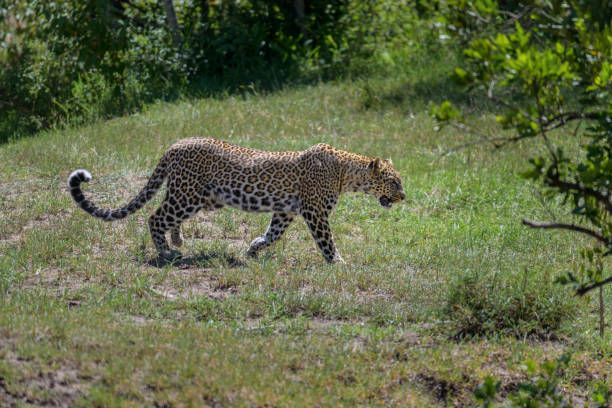
While both the cheetah and the leopard (Panthera pardus) are iconic spotted cats of the African and Asian savannas, they are distinct species with significant evolutionary, physical, and behavioral differences. Distinguishing the cheetah and the leopard is easy. The most immediate visual distinction lies in their markings: cheetahs possess solid, round black spots, whereas leopards feature complex, rose-shaped patterns known as rosettes. Furthermore, cheetahs are distinguished by the prominent black “tear stripes” that run from the inner corner of their eyes down to their mouths, a feature entirely absent in leopards.
Distinguishing the Cheetah and the Leopard
Distinguishing between a cheetah (Acinonyx jubatus) and a leopard (Panthera pardus) requires an understanding of their distinct evolutionary adaptations, which have shaped their physical appearances, behaviors, and ecological niches.
Physical Adaptations and Speed
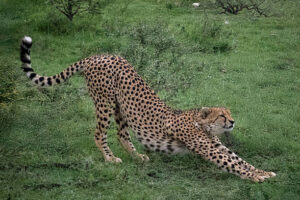
The cheetah is the world’s fastest land animal, evolved specifically for high-speed pursuit. Its body is aerodynamic, featuring a flexible spine, non-retractable claws that act like running spikes for traction, and a long tail that functions as a rudder for sharp turns. A cheetah can accelerate from 0 to 72 km/h in approximately 2.5 seconds. In contrast, the leopard is a powerful, muscular ambush predator. While fast, it lacks the specialized skeletal structure for sustained high-speed sprinting, relying instead on stealth, immense strength, and the ability to climb trees to secure its prey.
Distinguishing the Cheetah and the Leopard: Cheetah male scent marking a tree – wide angle perspective (Acinonyx jubatus). Maasai Mara National Reserve, Kenya.
Hunting and Diet
Cheetahs are diurnal hunters, typically active during the early morning and late afternoon to avoid competition with larger predators. They rely on visual acuity to spot prey, stalking within a short distance before initiating a sprint that usually lasts less than 30 seconds. Leopards are primarily nocturnal and are opportunistic, solitary hunters. Unlike the cheetah, which often loses its kill to larger carnivores like lions or hyenas, the leopard frequently hauls its prey high into trees to protect it from scavengers.
Social Structure and Reproduction
The social lives of these cats differ sharply. Female cheetahs are solitary, raising their cubs alone, while males often form permanent “coalitions” with their brothers to defend territories. Leopards are almost entirely solitary, with males and females only coming together briefly for mating. Regarding reproduction, the cheetah has a gestation period of approximately 93 days. Leopard gestation is slightly longer, typically ranging from 90 to 105 days.
Lifespan and Conservation
In the wild, cheetahs generally live between 8 and 12 years, with males often having shorter lifespans due to territorial conflicts. Leopards in the wild can live slightly longer, often reaching 12 to 15 years. Both species face significant threats from habitat loss and human-wildlife conflict, though the cheetah is currently listed as Vulnerable on the IUCN Red List, with its genetic diversity severely impacted by a historical population bottleneck.
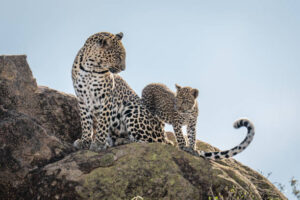
Distinguishing the Cheetah and the Leopard: Leopard cub walks round mother on rock
How do the hunting strategies of leopards and cheetahs compare?
The hunting strategies of leopards (Panthera pardus) and cheetahs (Acinonyx jubatus) are fundamentally dictated by their distinct physiological adaptations and ecological niches. Leopards are the quintessential masters of stealth and ambush, relying on their powerful, stocky builds and camouflage to approach prey within a very short distance—often less than 5 meters—before launching a lethal, explosive lunge. Their hunting success is predicated on the element of surprise, utilizing their ability to stalk through dense cover, rocky outcrops, or trees to remain undetected until the final, decisive strike, which typically results in a kill via strangulation.
Conversely, the cheetah is an evolutionary masterpiece of speed, designed for the “daylight dash” across open savanna plains. Unlike the leopard, which is a nocturnal or crepuscular hunter, the cheetah is primarily diurnal, a strategy that allows it to avoid direct competition with larger, more dominant predators like lions and leopards.
The cheetah’s hunting strategy relies on identifying vulnerable prey from a distance, followed by a high-speed, high-acceleration chase where they can reach speeds exceeding 100 km/h in just three seconds. Because they lack the brute strength and bone-crushing jaw power of the leopard, cheetahs must subdue their prey quickly, often using their non-retractable claws for traction during the sprint to pin the animal down. While leopards are solitary and often hoist their kills into trees to protect them from scavengers, cheetahs are more delicate feeders and, if hunting in a coalition, will often maintain a lookout while the others consume the meal to prevent theft by more aggressive carnivores.
The Apex Predators of the African Savanna: Cheetah and Leopard
The African continent is home to some of the world’s most formidable carnivores, among which the cheetah (Acinonyx jubatus) and the leopard (Panthera pardus) stand as distinct, highly specialized apex predators. While both are members of the Felidae family, they occupy different ecological niches, utilizing unique physiological adaptations to dominate their respective environments.
The cheetah is evolutionarily optimized for high-speed pursuit, functioning as a diurnal predator that relies on explosive acceleration to capture prey in open landscapes. Its body is a masterpiece of biological engineering, featuring a flexible, muscular spine and powerful hindlimbs that allow it to reach speeds of 93–104km/h. In contrast, the leopard is a master of stealth and strength, built for the nocturnal hunt and the ability to navigate complex, vertical environments like trees and rocky outcrops. While the cheetah’s hunting strategy is defined by the high-energy chase, the leopard utilizes its immense jaw strength and stocky, powerful build to ambush prey and hoist heavy carcasses into trees to protect them from scavengers.
These predators maintain their apex status through behavioral and physiological partitioning. By hunting at different times—cheetahs during the day and leopards under the cover of darkness—they minimize direct competition for resources. Furthermore, their physical differences are stark: the cheetah possesses solid black spots and distinctive “tear marks” that may reduce glare, while the leopard is characterized by complex rosettes that provide camouflage in dappled light.
Their survival as apex predators is also tied to their specific social structures; cheetahs often form male coalitions to defend territories, whereas leopards are largely solitary, territorial animals that rely on their ability to remain undetected in dense vegetation.
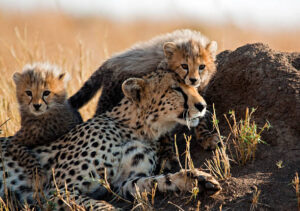
Differences Distinguishing the Cheetah and the Leopard: Mother cheetah with two playful young cubs Masai Mara, Kenya
Other Apex Predators : Social Structures, Reproduction, and Longevity
Apex predators, (0ther than distinguishing the Cheetah and the Leopard) or top-level carnivores, occupy the highest trophic level in their respective ecosystems, meaning they have no natural predators of their own. While the cheetah and leopard are iconic, other species such as the lion, tiger, and gray wolf exhibit vastly different biological and social strategies.
The Lion (Panthera leo)
The lion is unique among felids for its highly social nature. Unlike most cats, lions live in groups called prides, which typically consist of related females, their offspring, and a small coalition of resident males.
- Social Life: Prides are territorial, with males defending the group against intruders. Females are the primary hunters, often working cooperatively to take down large ungulates.
- Gestation: The gestation period for a lioness is approximately 110 days.
- Lifespan: In the wild, lions typically live between 10 and 14 years, though they can live longer in captivity.
The Tiger (Panthera tigris)
Tigers are the largest extant cat species and are predominantly solitary, maintaining large home ranges that they mark with scent.
- Social Life: They are generally antisocial, coming together only for mating or when a mother is raising cubs. Males do not participate in rearing offspring.
- Gestation: The gestation period is roughly 93 to 110 days.
- Lifespan: Tigers generally live for 10 to 15 years in the wild, with some individuals reaching up to 20 years in protected environments.
The Gray Wolf (Canis lupus)
As a highly social canid, the gray wolf operates within a complex pack structure, usually centered around a breeding pair and their offspring.
- Social Life: Wolves utilize sophisticated vocalizations and body language to maintain pack hierarchy. They are endurance hunters, capable of traveling long distances to exhaust prey.
- Gestation: The gestation period is approximately 60 to 63 days.
- Lifespan: In the wild, wolves typically live 6 to 8 years, though they can reach 13 years in rare cases.
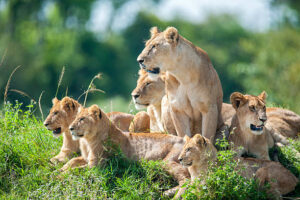
Differences Distinguishing the Cheetah and the Leopard: A moaning lioness (panthera leo) with her cubs is resting on a small hill. Shot in wildlife in the Masai Mara, Kenya.
Conclusion: Distinguishing the Cheetah and the Leopard
In summary, while the cheetah and the leopard may appear superficially similar to the casual observer, a rigorous comparative analysis reveals that they are distinct evolutionary masterpieces, each perfectly adapted to its own ecological niche. The leopard (Panthera pardus) is a robust, muscular ambush predator designed for stealth, climbing, and power, utilizing its rosette-patterned coat to blend into dense, wooded, or rocky environments. Conversely, the cheetah (Acinonyx jubatus) is a highly specialized, aerodynamic sprinter built for explosive acceleration and high-speed chases across open savanna plains, characterized by its solid black spots and distinctive facial “tear marks.”
Understanding these differences distinguishing the cheetah and the leopard—from their divergent hunting strategies and social structures to their unique physical builds—is essential for appreciating the complexity of these big cats. While the leopard relies on its strength to secure prey in trees and thrives in a variety of habitats, the cheetah’s survival is inextricably linked to its unmatched speed and the availability of open, unobstructed terrain. Ultimately, recognizing these authentic distinctions not only enhances our understanding of wildlife biology but also underscores the critical importance of conservation efforts tailored to the specific needs of each species as they face increasing threats in the wild.
Leave a comment:
You must be logged in to post a comment.



Comment 01
Astute Africa Safaris,
06 June, 2026REF: Crafting Your Bespoke African Safari Experience with Astute Africa Safaris
Jambo,
Thank you for your interest in exploring the wonders of Africa with Astute Africa Safaris. We pride ourselves on creating immersive, tailor-made journeys that align perfectly with your personal interests, pace, and travel aspirations.
Because every safari is a unique narrative, we do not believe in “one-size-fits-all” pricing. To ensure we provide you with an accurate and competitive quotation that reflects the specific lodges, wildlife experiences, and logistical arrangements you desire, we invite you to connect with our team for a personalized consultation.
Please contact us at info@astuteafricasafaris.com, Whatsapp +254762663272 or fill the inquiry form with a few details regarding your preferred travel dates, group size, and specific interests (e.g., photography, luxury relaxation, or adventure trekking). Once we have these details, we will curate a comprehensive proposal designed specifically for you.
We look forward to the possibility of helping you plan an unforgettable journey.
Warm regards,
Team Astute Africa Safaris