
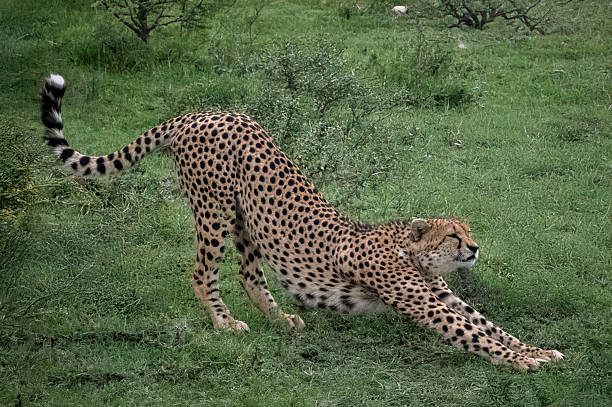

- 1.1k Views
- 10 Min Read
- (2) Comments
The African savanna is dominated by iconic felids that have evolved over millions of years to become the ultimate hunters. Among these, the lions, leopards, and cheetahs represent distinct evolutionary paths within the Felidae family. Lions are unique for their complex social structures, leopards for their unparalleled stealth and strength, and cheetahs for their unmatched physiological adaptations for speed. These cats have shaped the ecology of their habitats, serving as keystone species that regulate prey populations and maintain the health of the ecosystem.
The King of the Savannah: Guide to the African Lion
The African lion (Panthera leo) stands as an apex predator and a cultural icon of the African continent. Historically, lions roamed across much of Africa, Europe, and Asia, but today their populations are largely restricted to sub-Saharan Africa and a small, isolated population in India’s Gir Forest. As a social felid, the lion is unique among cats for its complex social structure, known as a pride, which typically consists of related females, their offspring, and a small coalition of resident males. Their survival is intrinsically linked to the health of the savannah ecosystem, where they act as keystone predators, regulating herbivore populations and maintaining the balance of the grasslands.
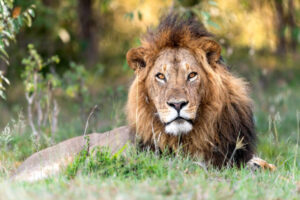
Lions, Leopards, and Cheetahs attracts more tourists in Africa: A lion in high grass with rolling landscape beyond – Masai Mara, Kenya
The Pride and Way of Life
A pride is a highly organized social unit that can range from 3 to 30 individuals. The females are the core of the pride, often remaining in their natal territory for life, while males compete to defend the pride from intruders. The social bond is reinforced through grooming, head rubbing, and collective vocalizations, such as the iconic roar, which can be heard up to 8 kilometers away to establish territory.
Hunting Skills and Strategy
Lions are opportunistic hunters that rely on stealth and teamwork. While they are capable of reaching speeds of up to 80km/h in short bursts, they lack the stamina for long chases. Instead, they utilize the landscape to stalk prey, often hunting at night or during twilight hours to maximize their advantage. Cooperative hunting allows them to take down large ungulates like wildebeest, zebras, and buffalo. The success rate of a hunt is mathematically influenced by group size, where the probability of a successful kill P can be modeled as a function of pride size n, often expressed as P(n)=1−e−kn, where k is a constant related to environmental cover.
Gestation and Life Cycle
Female lions reach sexual maturity around 3 to 4 years of age. The gestation period for a lioness is approximately 110 days, after which she typically gives birth to a litter of one to four cubs in a secluded den. Cubs are highly vulnerable and rely on the protection of the pride; communal nursing is common, where lionesses will suckle cubs that are not their own to ensure the survival of the next generation.
Why They Are Among the Big Five
The term “Big Five” was coined by big-game hunters to describe the five most difficult and dangerous animals to hunt on foot in Africa. The lion earned its place due to its formidable strength, aggressive territorial defense, and status as the ultimate apex predator of the savannah.
Lifespan
In the wild, the average lifespan of a lion is 10 to 14 years, though males often have shorter lives due to the physical toll of defending their territory and fighting off rivals. In protected environments or captivity, they can live up to 20 years.
The Stealth of Leopards
Leopards (Panthera pardus) are the most widely distributed of all wild cats, known for their solitary nature and incredible climbing ability. Historically, they have survived by being highly adaptable to diverse environments, from rainforests to arid deserts. Their hunting skill relies on ambush; they stalk prey until they are within striking distance, often dragging their kills into trees to protect them from scavengers like hyenas. The gestation period for a leopard is about 90 to 105 days, and they typically live for 12 to 15 years in the wild.
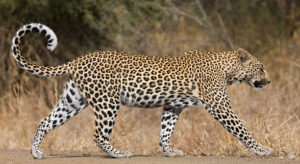
Why do you think these big cats Lions, Leopards, and Cheetahs attract more tourists?
The Anatomy of Camouflage
The leopard’s coat is a masterpiece of evolutionary engineering. The pattern of dark spots, known as rosettes, serves as a disruptive coloration mechanism that breaks up the cat’s outline against the dappled light of forest floors or the complex textures of rocky outcrops. This camouflage is essential for the leopard’s “stalk-and-ambush” hunting style. By minimizing the contrast between its body and the background, the leopard can approach prey to within a few meters without detection. Research indicates that the density and shape of these rosettes vary across subspecies, providing localized camouflage optimized for specific biomes, ranging from the dense, dark rainforests of Central Africa to the arid, pale landscapes of the Middle East.
Behavioral Stealth and Stalking Techniques
Stealth in leopards is not merely visual; it is behavioral. When stalking, a leopard moves with a fluid, low-slung gait, placing its paws with deliberate precision to avoid snapping twigs or rustling dry leaves. This silent approach is often accompanied by “freezing” behavior, where the leopard remains perfectly motionless for extended periods if the prey looks in its direction, effectively becoming part of the landscape. This patience is a hallmark of the species; a leopard may spend hours closing the final distance to its target, utilizing every available piece of cover—be it tall grass, boulders, or tree trunks.
The Vertical Dimension of Stealth
One of the most distinct aspects of leopard stealth is its mastery of the vertical plane. By dragging heavy kills into the canopy, leopards utilize trees not just as larders to protect food from hyenas and lions, but as a sanctuary of silence. The ability to haul prey weighing up to 1.5 to 2 times their own body mass up a vertical trunk requires immense muscular power, yet they perform this feat with a quiet efficiency that keeps them hidden from terrestrial competitors. This arboreal lifestyle allows the leopard to remain undetected by ground-dwelling predators, effectively removing itself from the competitive landscape of the savannah floor.
Sensory Advantages in the Dark
Leopards are primarily nocturnal or crepuscular, utilizing their highly developed sensory apparatus to maintain stealth in low-light conditions. Their eyes possess a tapetum lucidum, a reflective layer behind the retina that enhances night vision by reflecting light back through the photoreceptors. This allows them to navigate and hunt in near-total darkness, where their prey is at a significant sensory disadvantage. Furthermore, their acute hearing allows them to detect the subtle movements of prey from great distances, enabling them to adjust their path to intercept targets without ever being heard or seen.
The Speed of Cheetahs
The cheetah (Acinonyx jubatus) stands as the pinnacle of evolutionary engineering for terrestrial locomotion. As the fastest land animal, its physiological adaptations are specifically curated for high-velocity pursuit, allowing it to reach speeds between 93 and 104 km/h (58–65 mph) in short bursts. Unlike other felids, the cheetah’s body is a specialized machine designed to manage the immense kinetic energy generated during a sprint.
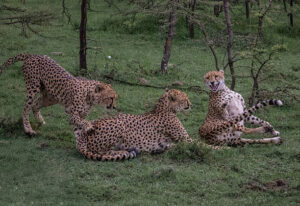
What do you know about Lions Leopards and Cheetahs; A candid editorial-style shot of three cheetahs in the grass, with one standing over another and a third rolling playfully with an open-mouthed expression.
Anatomical Adaptations for Velocity
The cheetah’s skeletal and muscular structure is fundamentally different from that of other large cats. To achieve rapid acceleration, the cheetah possesses a highly flexible spine that acts like a coiled spring, allowing for an extraordinary stride length of up to 7 meters (23 feet) per gallop. Its shoulder blades are not attached to the collarbone, which increases the range of motion in the forelimbs, while its powerful hindlimb muscles provide the explosive force required to initiate a chase.
Furthermore, the cheetah is unique among felids for its semi-retractable claws. These claws function similarly to the spikes on a track athlete’s shoes, providing essential traction on the ground during high-speed maneuvers. The tail, which is long and muscular, serves as a critical rudder, allowing the cat to maintain balance and make sharp, high-speed turns without losing momentum.
The Physics of Acceleration
The cheetah’s ability to accelerate is perhaps its most impressive trait. It can transition from 0 to 100 km/h in approximately 3 seconds, a rate of acceleration that rivals high-performance sports cars. This acceleration can be expressed using the fundamental kinematic formula: a=ΔvΔt Where a represents acceleration, Δv is the change in velocity, and Δt is the change in time. Because the cheetah is a pursuit predator, it must manage its internal body temperature carefully. The intense metabolic output required for such rapid acceleration generates significant heat, which is why cheetahs are primarily diurnal hunters, often operating in the cooler hours of the morning or late afternoon to avoid overheating.
Respiratory and Cardiovascular Efficiency
To sustain such high speeds, the cheetah requires an exceptional oxygen intake system. During a sprint, a cheetah’s respiratory rate can increase from 60 to 150 breaths per minute. Its oversized nostrils and nasal passages allow for rapid air intake, while its enlarged heart and lungs facilitate the efficient distribution of oxygenated blood to the muscles. Despite these adaptations, the cheetah is a sprinter, not a marathon runner; it can only maintain its top speed for approximately 20 to 30 seconds before it must cease the chase to prevent physiological collapse.
Evolutionary Context and Habitat
The cheetah’s evolution is a testament to the “arms race” between predator and prey in the African savannah and the arid regions of Iran. By specializing in speed, the cheetah occupies a unique ecological niche that minimizes direct competition with larger, more aggressive predators like lions or hyenas, which rely on strength and pack tactics rather than pure velocity.
The Big Five Significance (Lion, Elephant, buffalo, Rhino and Leopard)
The term “Big Five” was coined by big-game hunters to describe the five most difficult and dangerous animals to hunt on foot in Africa. The lion and leopard are included in this prestigious list because of their ferocity, intelligence, and the danger they pose when wounded or cornered. While the cheetah is not part of the traditional Big Five, it remains one of the most sought-after sightings for wildlife enthusiasts due to its rarity and unique biological traits. These animals are protected today, with conservation efforts focused on habitat preservation and mitigating human-wildlife conflict.
Where to see lions, leopards and cheetahs easily in Kenya
To identify the best locations for viewing big cats in Kenya, one must consider the specific habitat preferences of lions, leopards, and cheetahs. Kenya’s diverse ecosystems, ranging from the open savannahs of the Masai Mara to the rocky terrain of Samburu, provide unique opportunities for wildlife enthusiasts.
Where to See Lions
Lions are the most iconic predators in Kenya and are widely distributed across several key reserves. The Masai Mara National Reserve is arguably the premier location, hosting a massive population of approximately 900 lions, often seen during the Great Migration. Amboseli National Park is another significant site, home to roughly 200 lions, offering the unique backdrop of Mount Kilimanjaro. Additionally, Tsavo East and West National Parks are famous for their “red-dust” lions, while Meru National Park has seen a successful reintroduction program, now supporting over 80 lions.
Where to See Leopards
Leopards are notoriously elusive, preferring dense riverine forests and rocky outcrops where they can camouflage effectively. Samburu National Reserve is highly regarded for its leopard sightings due to the riverine vegetation along the Ewaso Ngiro River. The Laikipia Plateau, specifically the Ol Pejeta Conservancy, is also a top-tier destination, housing approximately 20 leopards within its protected borders. In the Masai Mara, leopards are frequently found deep within the riverine woodlands, though they require more patience to spot than lions.
Where to See Cheetahs
Cheetahs thrive in open grasslands where they can utilize their speed to hunt. The Masai Mara National Reserve remains the best location for cheetah viewing, particularly in the southern plains where the open terrain allows for excellent visibility of their hunting behavior. Ol Pejeta Conservancy is another excellent spot, hosting about 30 cheetahs, while Lake Nakuru National Park provides a mix of grassland and bush that serves as a productive hunting ground for these cats.
Lions, Leopards, and Cheetahs
Leave a comment:
You must be logged in to post a comment.


Comments (2)
Astute Africa Safaris,
05 May, 2026REF: Crafting Your Bespoke African Safari Experience with Astute Africa Safaris
Jambo,
Thank you for your interest in exploring the wonders of Africa with Astute Africa Safaris. We pride ourselves on creating immersive, tailor-made journeys that align perfectly with your personal interests, pace, and travel aspirations.
Because every safari is a unique narrative, we do not believe in “one-size-fits-all” pricing. To ensure we provide you with an accurate and competitive quotation that reflects the specific lodges, wildlife experiences, and logistical arrangements you desire, we invite you to connect with our team for a personalized consultation.
Please contact us at info@astuteafricasafaris.com, Whatsapp +254762663272 or fill the inquiry form with a few details regarding your preferred travel dates, group size, and specific interests (e.g., photography, luxury relaxation, or adventure trekking). Once we have these details, we will curate a comprehensive proposal designed specifically for you.
We look forward to the possibility of helping you plan an unforgettable journey.
Warm regards,
Team Astute Africa Safaris
The Authentic Differences Distinguishing the Cheetah and the Leopard: A Comparative Analysis - Astute Africa Safaris,
06 June, 2026[…] cheetah (Acinonyx jubatus) and the leopard (Panthera pardus) stand as distinct, highly specialized apex predators. While both are members of the Felidae family, they occupy different ecological niches, utilizing […]