
- 1.3k Views
- 33 Min Read
- (3) Comments
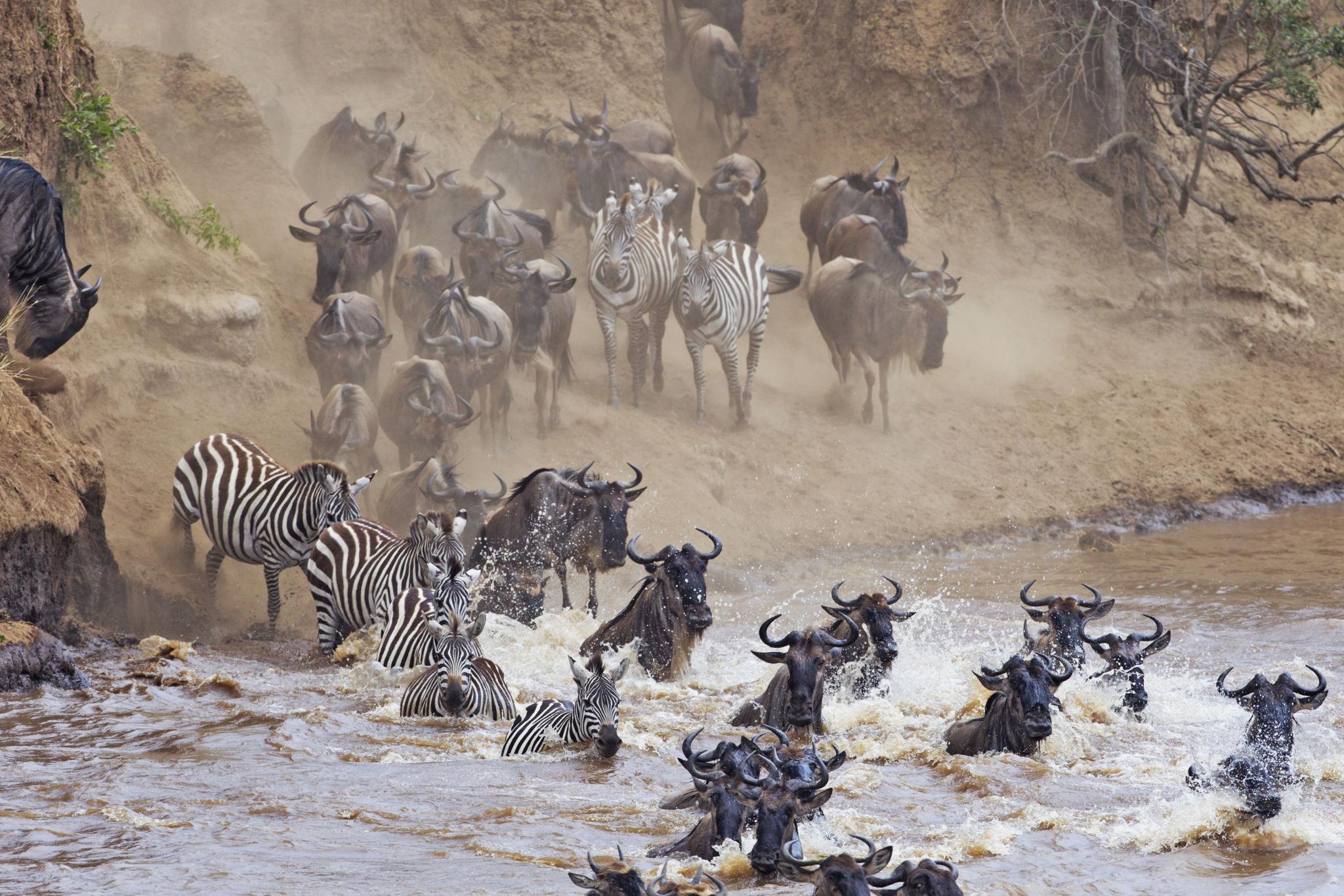
Imagine the feeling standing on the vast African savannah as thousands of wildebeest move across the horizon. Dust rises beneath their hooves. Zebras graze alongside them. Lions watch from the grass, crocodiles wait in the rivers, and newborn calves take their first steps into a world where survival depends on speed, instinct and the rhythm of the seasons.
This is the Great Wildebeest Migration, one of the most extraordinary wildlife spectacles on Earth.
Every year, approximately 1.3 million wildebeest, accompanied by more than 200,000 migratory plains zebras and other grazing animals, move through the connected ecosystems of Tanzania’s Serengeti and Kenya’s Maasai Mara. Their movements follow seasonal rainfall, fresh grazing and water availability rather than a fixed calendar.
For travellers, the migration offers much more than the famous river crossings. It includes the birth of hundreds of thousands of calves, dramatic predator encounters, enormous grazing herds, territorial battles, changing landscapes and the constant struggle for survival.
This guide by Astute Africa Safaris explores the migration from beginning to end: why it happens, where the animals go, how wildebeest live and reproduce, which other animals migrate with them, when to visit, where to stay and how to plan a memorable safari in Kenya and Tanzania.
Whether you are a first-time safari traveller, a wildlife photographer, a family planning an African holiday or a couple seeking a luxury safari, understanding the migration will help you choose the right destination and travel dates.
The Great Migration at a glance
~1.3 million
Migratory wildebeest in the Serengeti–Mara population
200,000+
Migrating plains zebras
Year-round
A continuous migration cycle
2 countries
Tanzania and Kenya
Population estimates vary by survey and year. These figures describe the migratory Serengeti–Mara population, not every wildebeest population in East Africa.
1. What is the Great Wildebeest Migration?

The Great Wildebeest Migration is the annual, continuous movement of large herds of wildebeest and accompanying herbivores through the Greater Serengeti–Mara ecosystem of northern Tanzania and southwestern Kenya.
Rather than travelling along one narrow route, the animals spread across grasslands, woodlands, river corridors and seasonal grazing areas. Their location changes as rainfall creates new grass and older grazing areas become dry or depleted.
The migration is not a single journey with a universally agreed starting date. Some herds are moving north while others are grazing, calving or beginning their return south. Its most celebrated events include:
-
The calving season on the southern Serengeti and Ndutu plains.
-
The movement of herds through the central and western Serengeti.
-
Crossings of the Grumeti River in Tanzania.
-
The movement into northern Serengeti and the Maasai Mara.
-
The dramatic, sometimes repeated crossings of the Mara River.
-
The return towards the southern plains as seasonal rains regenerate grazing.
UNESCO identifies the migration of wildebeest, zebras and gazelles, together with the predators that follow them, as one of the Serengeti’s outstanding natural spectacles.
Why is the migration so extraordinary?
Its scale is only part of the story. The migration is an interconnected ecological system.
Wildebeest consume large quantities of grass. Zebras graze on different parts of the vegetation, and gazelles select more tender growth. Predators respond to the abundance of prey, while scavengers feed on carcasses. Dung and decomposing remains return nutrients to the soil.
The migration therefore links rainfall, plants, herbivores, predators and nutrient cycling across an enormous landscape.
It also connects two countries. The wildebeest do not recognise the international boundary between Kenya and Tanzania, which makes cooperation between conservation authorities, protected areas and neighbouring communities essential.
2. Where does the Great Migration take place?

The migration takes place across the Greater Serengeti–Mara ecosystem, a landscape of open plains, seasonal rivers, wooded areas and permanent water sources.
The two best-known destinations are Tanzania’s Serengeti National Park and Kenya’s Maasai Mara National Reserve, but the full ecological picture includes several distinct areas.

Southern Serengeti and Ndutu, Tanzania
These short-grass plains are particularly important during the calving season, generally around January to March. The surrounding Ndutu area lies across the southern Serengeti and adjacent Ngorongoro Conservation Area landscape. Rich seasonal grazing supports lactating females and their newborn calves.

Central Serengeti, Tanzania
The Seronera region offers a mixture of plains, rocky outcrops, riverine vegetation and acacia woodland. Herds may pass through or spread across the area as grazing conditions change. It also supports excellent resident wildlife viewing beyond the migration.

Western Corridor and Grumeti River, Tanzania
The Western Corridor provides seasonal grazing and access to river systems. Some herds encounter the Grumeti River during their northwestern movement, although the timing and intensity of crossings vary between years.

Northern Serengeti, Tanzania
Areas around Kogatende and the Mara River can be excellent places to watch large herds during the northern phase of the migration. Staying here can offer a Tanzania-based alternative to travelling into Kenya.

Maasai Mara, Kenya
The Maasai Mara is a major dry-season refuge when herds enter Kenya, with particularly strong wildlife-viewing opportunities in years when substantial numbers reach the reserve. The Mara Triangle and surrounding conservancies can offer different viewing environments and accommodation experiences.
These areas are connected parts of one ecological system, not isolated migration destinations. The Convention on the Conservation of Migratory Species of Wild Animals describes seasonal movement between southern plains, the Western Corridor, the northern ecosystem and the Mara River refuge.
3. Why do wildebeest migrate?

The main driver of the Great Migration is the search for fresh grass and water. Seasonal rainfall changes where nutritious vegetation grows, and wildebeest move to exploit these changing conditions.
However, several factors work together.
3.1 Following seasonal rainfall
Rainfall is uneven across the Serengeti–Mara ecosystem. One area may receive rain while another remains dry.
When rain falls, dormant grasses grow, creating new feeding grounds. As the grass is eaten or dries out, the herds gradually shift towards other areas where grazing is available.
Wildebeest are not simply following visible rain clouds. They respond to the landscape’s changing food and water conditions, and their movements are influenced by the timing, distribution and amount of rainfall.
3.2 Finding nutritious grass
Grass quality matters as much as its quantity.
The short-grass plains of southern Serengeti and Ndutu are especially valuable during calving because seasonal growth can provide nutritious forage for pregnant and lactating females.
As the season progresses, the herds move to other feeding areas, including longer-grass plains and river corridors.
3.3 Access to water
Wildebeest need regular access to water, particularly during hot, dry periods and lactation. Seasonal water sources can disappear, making permanent rivers and other reliable sources increasingly important.
The Mara River is a critical dry-season refuge within the ecosystem because it continues to provide water when other sources diminish.
3.4 Reproduction and calf survival
Calving is closely connected to seasonal grazing conditions. Females benefit from nutritious grass while producing milk, and the synchronised arrival of large numbers of calves can overwhelm predators’ ability to capture every newborn.
This does not eliminate predation, disease or starvation, but it is an important part of the species’ reproductive strategy.
3.5 Herd behaviour and inherited movement patterns
Wildebeest are social animals. Their movement is influenced by group behaviour, environmental cues and recurring seasonal conditions. Familiar routes, grazing areas and access points to rivers can shape where herds travel.
It would be misleading to suggest that one leader directs every animal around a perfectly fixed circular route. The migration is a dynamic response to ecology and weather, with local variation in the movements of individual groups.
4. The complete annual wildebeest migration cycle: month by month

One of the most common safari-planning questions is: Where will the wildebeest be when I travel?
The table below gives a useful seasonal guide. It is not a guaranteed calendar: the timing can shift with rainfall, and different parts of the herd can occupy different regions simultaneously.
| Months | Likely migration phase | Areas to consider |
|---|---|---|
| January | Southern plains and calving activity | Ndutu and southern Serengeti |
| February | Peak calving often occurs | Ndutu and southern Serengeti |
| March | Calving continues; herds may begin spreading out | Southern and central Serengeti |
| April | Herds begin shifting as conditions change | Central and western Serengeti |
| May | Northwesterly movement often becomes more apparent | Central Serengeti and Western Corridor |
| June | Some herds move through western and northern areas; crossings may occur | Western Corridor and northern Serengeti |
| July | Many herds may be in the north; river-crossing opportunities can develop | Northern Serengeti and Maasai Mara |
| August | Often a strong month for northern herds and possible crossings | Northern Serengeti and Maasai Mara |
| September | Herds may remain in the northern ecosystem | Maasai Mara and northern Serengeti |
| October | Movement may begin shifting southward | Maasai Mara and northern Serengeti |
| November | Short rains often encourage movement south | Serengeti |
| December | Herds may spread across southern plains as grazing improves | Southern Serengeti and Ndutu |
January to March: The calving season

The southern Serengeti and Ndutu plains become particularly important during the calving season. Large numbers of pregnant females gather where nutritious short grass is available.
Calving is often concentrated in a relatively short period, especially in February, although births occur outside this peak.
This is an exceptional time for:
-
Seeing newborn calves and mother–calf behaviour.
-
Watching wildebeest herds spread across the plains.
-
Observing lions, cheetahs, hyenas and other predators responding to abundant prey.
-
Photographing family groups, feeding behaviour and early-life survival.
-
Experiencing the southern Serengeti’s green-season landscapes.
The calving season is ideal for travellers who want to understand wildlife reproduction and predator–prey relationships, rather than concentrating only on river crossings.
April to May: The movement through the Serengeti

As rainfall and grazing conditions change, herds spread out and move through parts of central and western Serengeti.
These months may bring lush scenery, fewer visitors in some areas and excellent photographic conditions. They can also bring wet roads and more complicated travel logistics.
Because the herds are dispersed, careful choice of accommodation and a flexible route become especially valuable.
June to July: The western corridor and northward movement

The movement northward and westward often becomes more noticeable as dry-season conditions develop. Some herds pass through the Western Corridor and encounter the Grumeti River.
River crossings can happen during this phase, but they are not scheduled events. Herds may approach a river, wait, retreat, cross at a different point or move elsewhere.
A safari during these months can suit travellers who want to explore Tanzania’s migration areas and potentially combine them with other northern-circuit highlights.
July to October: The northern Serengeti and Maasai Mara

This is the best-known period for the possibility of dramatic Mara River crossings. Large herds may gather near the river in northern Serengeti and the Maasai Mara, although not every herd crosses at the same time.
The spectacle can involve animals entering steep banks, negotiating fast-moving water and gathering on the opposite side. Crocodiles may be present, while lions and hyenas can take advantage of the concentrations of prey.
For travellers whose primary goal is to see the river crossings, July to September is a popular planning window. However, the correct camp location matters more than simply choosing a month, and no operator can guarantee a crossing on a specific day.
October to December: The return south

As seasonal rains return to parts of the ecosystem, herds often begin moving back towards southern grazing grounds.
Some animals may remain in the north longer, and the return is rarely a single, coordinated march. November and December can offer attractive green-season landscapes and good opportunities to explore the broader Serengeti ecosystem.
The cycle gradually brings many females back towards the southern plains, where the next major calving season will begin.
5. How far do wildebeest travel during the migration?

The Great Migration is often described as a journey of hundreds of miles. Depending on the route, season and individual herd, the annual circuit can span roughly 800–1,000 kilometres or more.
However, there is no single distance travelled by every animal. Some herds make longer movements between seasonal grazing grounds, while others remain in a particular area for a time before moving again.
The migration is a continuous cycle of feeding, resting, moving, reproducing and seeking water, not a nonstop march from Tanzania to Kenya and back.
Wildebeest may cover substantial distances during daily movements, particularly when conditions force them to seek new grazing. Their annual journey across the ecosystem is one reason the preservation of open wildlife corridors is so important.
6. Wildebeest social life: how do they live in such enormous herds?

Wildebeest have a complex social life that changes with age, sex, reproduction and environmental conditions.
6.1 Do wildebeest live in herds?
Yes. Wildebeest are highly social antelopes. Herds provide benefits such as shared vigilance, opportunities to find food and water, and reduced individual vulnerability to predators.
During migration, smaller groups can merge into enormous aggregations across the plains. The animals may look like one continuous herd from a distance, but the group is made up of many individuals and smaller social units.
6.2 How do males and females behave differently?
Adult males may establish territories during the breeding season, defending areas that attract females. Territorial males use displays, vocalisations, scent and physical confrontations to compete with rivals.
Females generally move in groups with their calves and other females. Outside the breeding period, males may form separate bachelor groups or travel alongside mixed herds.
These patterns are not rigid. Social organisation changes with the season, habitat and local conditions.
6.3 How do wildebeest communicate?
Wildebeest communicate through vocalisations, body posture, scent and movement. Calls can help maintain contact between animals, while mothers and calves use recognition and proximity to stay together.
Their senses also help them detect danger. A sudden change in the behaviour of nearby animals can alert others to a potential predator or disturbance.
6.4 Why do wildebeest gather in such large numbers?
Large herds offer several advantages, including greater collective awareness of danger and the ability to locate and exploit extensive grazing areas.
However, crowding also creates risks. Disease can spread, competition for grazing can increase, and large groups gathering at a river can encounter dangerous conditions.
The migration is therefore not simply a story of strength in numbers. It is a balance between the benefits of group living and the challenges of survival.
7. Wildebeest reproduction: mating, gestation and newborn calves

Reproduction is one of the most important reasons the Great Migration is so spectacular.
When do wildebeest mate?
Wildebeest breeding is seasonal, with mating commonly taking place around the period when conditions support the coming generation. In the Serengeti–Mara population, the main calving period is generally early in the year, so the main breeding period typically falls several months earlier.
Adult males compete for mating opportunities, and territorial behaviour can become particularly noticeable during the rut.
How long is a wildebeest’s gestation period?
A wildebeest’s gestation period is approximately eight and a half months, commonly given as around 250 days.
Females generally give birth to one calf at a time. Twins are uncommon.
How many calves are born during the migration?
Hundreds of thousands of wildebeest calves may be born during the main calving season. The precise total varies by year and by the area included in a particular estimate.
The concentration of births over a relatively short period is a remarkable adaptation. When many calves arrive close together, predators cannot catch every newborn, even though they may kill substantial numbers.
How quickly can a newborn wildebeest stand?
A newborn calf can usually stand and begin walking within minutes of birth, although its coordination and strength continue to develop.
This rapid mobility is essential because the herd does not remain stationary for long. A calf that cannot keep up with its mother faces increased risks from predators, exhaustion and separation.
How do mother wildebeest protect their calves?
Mothers remain attentive to their young, allowing them to nurse and helping them stay close to the group. In large herds, many newborns and adults are present together, but calves still face serious risks.
Predators such as lions, spotted hyenas, cheetahs and jackals may target calves. The outcome depends on the calf’s condition, the mother’s behaviour, the surrounding terrain and the number and proximity of predators.
How long do wildebeest live?
Wildebeest can live for well over a decade in favourable circumstances, although lifespan varies with predation, disease, environmental conditions and other hazards. Many calves do not survive their first year, while animals that reach adulthood may live considerably longer.
8. Why do wildebeest cross dangerous rivers?

River crossings are among the most famous scenes of the Great Migration. They are also among the most misunderstood.
Wildebeest do not cross rivers because they are trying to create a spectacle for safari visitors. They cross because their movements take them between grazing areas and seasonal ranges, and rivers lie across some of their routes.
What makes river crossings dangerous?
-
Crocodiles: Large Nile crocodiles may prey on wildebeest attempting to cross.
-
Strong currents: Fast-moving water can knock animals off balance.
-
Deep channels: Some parts of a river may be too deep for safe passage.
-
Steep banks: Animals can struggle to descend or climb muddy slopes.
-
Crowding: Large numbers of animals can push one another or become trapped at narrow entry points.
-
Exhaustion: Animals may be weakened by heat, long movement or poor physical condition.
Not every crossing results in heavy losses, and crocodiles do not capture every animal that enters the water. The risks vary according to river conditions, crossing points and the behaviour of the herd.
Why do wildebeest sometimes hesitate at the river?
Wildebeest may gather on a bank for a long time before crossing. They can approach the water and retreat repeatedly.
This is part of the uncertainty that makes the experience so difficult to predict. Herd movement, water conditions, the behaviour of animals at the front and the availability of alternative routes can all influence whether a crossing takes place.
Which river is most famous for the migration?
The Mara River is the most famous crossing location, running through the northern Serengeti and Maasai Mara ecosystem. Crossings can occur on either side of the Kenya–Tanzania border.
The Grumeti River in western Serengeti is also important during the migration’s northwestern phase.
Safari tip: Allow several days in a well-chosen migration area if river crossings are your priority. Even then, a crossing cannot be guaranteed. A safari that includes ordinary herd movement, predators and the wider landscape can still be exceptional if no crossing occurs.
9. Which animals migrate with the wildebeest?

The Great Migration is not exclusively a wildebeest migration. Several other herbivores participate in the seasonal movement, although they do not all follow exactly the same route or schedule.
Animals that accompany or overlap with the migration

1. Plains zebra
More than 200,000 plains zebras migrate through the Serengeti–Mara ecosystem. Zebras often graze on taller grass and can exploit different parts of the vegetation from wildebeest. Their family groups may merge into larger herds as they move between seasonal grazing grounds.

2. Thomson’s gazelle
Thomson’s gazelles are closely associated with the Serengeti plains. Many use the same broad landscape as the wildebeest, taking advantage of short grass and tender vegetation. Their movements are more localised and variable than the main wildebeest migration, so not every gazelle follows the full annual circuit.

3. Grant’s gazelle
Grant’s gazelles occur in the wider ecosystem and may share grazing areas with migrating herds. Many are relatively resident or make local seasonal movements rather than undertaking the same large-scale journey as migratory wildebeest.

4. Topi
Topi are often seen in the Maasai Mara and surrounding grasslands. They use the wider seasonal landscape, but many are resident or locally mobile rather than members of the main Serengeti–Mara migration.

5. Eland
Eland may move between feeding areas in response to seasonal conditions. They are not a defining component of the principal wildebeest migration, but they can be encountered in the wider ecosystem and other East African landscapes.
The most accurate way to describe the phenomenon is that wildebeest and plains zebras undertake major coordinated seasonal migrations, while gazelles and other herbivores may share parts of the route, follow related ecological patterns or make their own seasonal movements.
What about predators? Do lions and other predators migrate too?

Predators are not herbivore migrants in the same sense, but their movements and hunting opportunities are often closely connected to the migration.
-
Lions: May travel between territories and follow prey availability, although many remain within established home ranges.
-
Spotted hyenas: May range widely and take advantage of the seasonal abundance of prey.
-
Cheetahs: Hunt in open habitats where prey and visibility are suitable; they may adjust their movements to local conditions.
-
Leopards: Are more elusive and territorial, and do not follow the herds in the same way.
-
Nile crocodiles: Concentrate around rivers and exploit opportunities when migrating animals cross.
-
Black-backed jackals and other scavengers: Feed on carcasses and may benefit from the increased food supply.
The migration therefore produces a moving concentration of food resources, but predators have different hunting strategies, territories and movement patterns.
10. Other remarkable animal migrations in Africa and around the world
The Serengeti–Mara migration is one of the most celebrated land-mammal migrations, but it is not the only extraordinary movement of wildlife.
The following examples are useful additions for travellers interested in wildlife beyond wildebeest.

1. Straw-coloured fruit bats — Zambia
One of Africa’s spectacular seasonal wildlife movements occurs when enormous numbers of straw-coloured fruit bats gather in Kasanka National Park. Their arrival is linked to seasonal food availability. This is a migration of flying mammals rather than hoofed wildlife.

2. Flamingos — East African Rift Valley lakes
Flamingos move between lakes and wetlands as water levels, food and breeding conditions change. Lake Natron is an important breeding site for lesser flamingos, while other Rift Valley lakes can provide feeding and resting habitats.

3. African elephants — Botswana and southern Africa
Elephant populations in some regions undertake substantial seasonal movements between water, food and dry-season refuges. Botswana’s Chobe–Linyanti landscape is especially well known for large elephant concentrations and changing seasonal distributions.

4. Zebra — Botswana
Botswana’s zebra movements include one of Africa’s notable long-distance mammal migrations, with herds moving between seasonal grazing and water sources. This is a different migration system from the Serengeti–Mara zebra migration.

5. Monarch butterflies — North America
Monarch butterflies undertake remarkable seasonal migrations between breeding regions and overwintering sites. Their migration involves several generations and is biologically very different from the annual movements of African ungulates.

6. Humpback whales — oceans worldwide
Many humpback whale populations move between feeding grounds in colder waters and breeding grounds in warmer waters. Their long-distance ocean journeys provide another example of how animals respond to seasonal food and reproduction.

7. Arctic terns — polar regions
Arctic terns undertake exceptionally long annual migrations between Arctic breeding grounds and southern ocean regions. Their journeys demonstrate how migration connects distant ecosystems.
These examples show that migration is a broad biological strategy. Animals move for different reasons: food, water, breeding, temperature, habitat availability and survival. Not every seasonal movement is a mass migration, and not every migrating species follows the same pattern.
11. What other wildlife can you see during the Great Migration?

A migration safari should not be planned around wildebeest alone. Both the Serengeti and Maasai Mara support diverse wildlife throughout the year.
Depending on the region, habitat and season, you may see:
| Wildlife group | Examples | Why they matter |
|---|---|---|
| Big cats | Lions, leopards, cheetahs | Predators may hunt or scavenge around migrating herds |
| Other carnivores | Spotted hyenas, jackals | Scavenging and hunting opportunities can increase |
| Large herbivores | Elephants, buffalo, giraffes | Resident and locally mobile wildlife add variety |
| River wildlife | Hippos, Nile crocodiles | Important for understanding river ecosystems and crossing risks |
| Plains animals | Topi, hartebeest, gazelles | Share parts of the grassland habitat |
| Birds of prey | Eagles, vultures, secretary birds | Feed on small animals, carcasses or other prey |
Wildlife sightings are never guaranteed, and individual species may be more common in some areas than others. The advantage of a well-planned safari is that you can enjoy the ecosystem even when the main herds have moved elsewhere.
12. When is the best time to see the Great Wildebeest Migration?

The best time depends on what you want to experience. There is no single month that is best for every traveller.

Best for calving and predators
January–March
Choose southern Serengeti and Ndutu for newborn calves, nursery herds and potential predator encounters.

Best for western migration landscapes
May–July
Consider the Western Corridor and northern Serengeti, depending on current herd movements and rainfall.

Best for potential Mara River crossings
July–September
Consider the Maasai Mara or northern Serengeti. Allow several days and choose accommodation close to likely herd movements.

Best for the returning herds and green scenery
October–December
Explore northern and central Serengeti before considering the southern plains as rainfall and grazing conditions change.
These are broad planning windows, not guarantees. The actual migration position should be checked close to departure, particularly for a safari whose main objective is a river crossing.
13. Maasai Mara versus Serengeti: which should you choose?

Both destinations offer excellent wildlife experiences, but they suit different travel preferences.
| Factor | Maasai Mara, Kenya | Serengeti, Tanzania |
|---|---|---|
| Main migration experience | Northern herds and possible Mara River crossings | Calving, central and western movement, and northern crossings |
| Best-known seasonal focus | Often July–October | Year-round cycle, with calving in the south and crossings in the north |
| Landscape | Open plains, river corridors and rolling grasslands | Vast plains, woodlands, rocky outcrops and river corridors |
| Safari style | Main reserve and surrounding private conservancies | Extensive national park with distinct seasonal migration regions |
| Best for | A focused Kenya safari or combination with other Kenyan parks | A longer Tanzania safari or exploration of several migration stages |
| Planning consideration | Reserve location, conservancy access and seasonal demand | The enormous size of the park makes regional camp selection essential |
Why choose the Maasai Mara?
The Mara can be an excellent choice if you want a concentrated safari focused on wildlife viewing, the possibility of river crossings and a combination with other Kenyan destinations.
You can combine it with Lake Nakuru, Amboseli or a beach holiday on Kenya’s coast, depending on your available time.
Explore Astute Africa Safaris’ Maasai Mara safari guide.
Why choose the Serengeti?
The Serengeti is ideal if you want to understand the migration across different seasons. You can focus on the southern calving grounds, the central plains, the western corridor or the northern river areas.
A longer itinerary allows you to experience several habitats instead of concentrating on one event.
For travellers who want both countries, a combined safari can provide a broader view of the migration ecosystem.
Read The Ultimate East African Safari: Choosing Between Kenya and Tanzania.
14. Sample wildebeest migration safari itineraries
The right itinerary depends on your dates, budget, preferred accommodation and whether you want calving, river crossings or a wider wildlife circuit.
The examples below are planning templates. Exact routes and transfer times should be confirmed before booking, particularly for cross-border travel.

Option 1: 4-day Maasai Mara migration safari
Day 1: Travel from Nairobi to the Maasai Mara and enjoy an afternoon game drive.
Days 2–3: Full-day game drives, tracking herds and searching for predators. If the migration is in the area, your guide can monitor likely crossing locations.
Day 4: Morning game drive, followed by the return journey or onward transfer.
Best for: Travellers with limited time who want to concentrate on the Maasai Mara.

Option 2: 6-day Serengeti calving safari
Day 1: Arrive in northern Tanzania and transfer to your overnight accommodation.
Days 2–4: Explore the southern Serengeti and Ndutu area, focusing on herds, newborn calves and predator activity.
Day 5: Continue wildlife viewing or explore a suitable nearby area, depending on the season.
Day 6: Transfer towards your departure point.
Best for: Wildlife photographers, nature enthusiasts and travellers interested in animal behaviour.

Option 3: 8-day luxury migration safari
Comfort and flexible wildlife viewing
Days 1–2: Arrive and explore the migration region best suited to your dates.
Days 3–5: Enjoy extended game drives, flexible photographic stops and a luxury tented camp or lodge experience.
Days 6–7: Continue tracking herds and explore surrounding wildlife areas.
Day 8: Transfer to the agreed departure airport.
Best for: Couples, honeymooners and travellers who want comfort, privacy and more time for wildlife viewing.
Final camp locations should follow seasonal migration information rather than a fixed assumption about where the herds will be.

Option 4: 10-day Kenya and Tanzania safari
A wider East African experience
Days 1–3: Explore the Maasai Mara, allowing time for wildlife viewing and migration tracking.
Days 4–6: Continue into Tanzania and explore the Serengeti region most appropriate for your travel dates.
Days 7–8: Add the Ngorongoro Crater or another suitable northern Tanzania destination.
Days 9–10: Complete the remaining wildlife activities and transfer to your departure airport.
Best for: Travellers who want to explore both countries on one holiday.
For an existing bookable option, see Astute Africa Safaris’ 10-day Kenya and Tanzania safari. Its route and accommodation should be checked against the latest migration position before confirming a booking.
You can also explore the Kenya wildlife safari for an itinerary focused on Kenya.
15. How much does a wildebeest migration safari cost?

The cost of a migration safari depends on the season, number of days, accommodation, transport, park fees, group size and whether you travel privately or join a group.
The peak migration season often attracts higher accommodation rates, particularly around popular river-crossing areas.
For an initial planning budget, the following are broad illustrative estimates per person, not live quotations. They assume a typical multi-day safari and vary considerably by itinerary and departure arrangements.
| Safari style | Illustrative daily budget per person | Typical experience |
|---|---|---|
| Budget or camping | US$200–350 | Simple accommodation, shared arrangements where available |
| Mid-range | US$350–700 | Comfortable lodges or tented camps |
| Luxury | US$700–1,500+ | Premium camps, stronger locations and higher service levels |
| Ultra-luxury | US$1,500–3,000+ | High-end camps, exclusive experiences and potentially private flights |
These ranges are only preliminary planning estimates. They are not verified prices for any specific Astute Africa Safaris tour. International flights, visa costs, insurance, gratuities, optional activities and some transfers may be additional. Actual quotations should be based on the selected dates, itinerary and accommodation.
How can you make your migration safari more affordable?
-
Travel outside the highest-demand dates if your preferred wildlife experience allows it.
-
Consider a shared safari where the itinerary and group arrangements suit you.
-
Compare accommodation location as well as nightly price.
-
Avoid changing camps too frequently, which can increase transfer costs.
-
Spend enough time in the target region rather than paying to move between destinations every day.
-
Request a tailored itinerary that fits your budget and preferred travel style.
For a detailed comparison, read The Best Kenya and Tanzania Safari Packages.
16. Where should you stay to see the migration?

Accommodation location can be just as important as the season. A beautiful lodge may be poorly positioned for your specific wildlife objective if the herds are several hours away.
Southern Serengeti and Ndutu
Choose a camp in the southern migration area for calving season. Prioritise access to the plains where the herds are likely to be feeding.
Western and northern Serengeti
For the northward movement and potential river crossings, choose accommodation according to the anticipated herd location and the river areas accessible from the camp.
Maasai Mara and surrounding conservancies
The reserve and surrounding conservancies offer a variety of accommodation styles, from simple tented camps to high-end luxury properties. Ask about seasonal positioning, access rules, driving distances and whether the property offers the activities you want.
Read Astute’s Maasai Mara safari lodges and camps guide to compare accommodation options.
A practical rule: do not book a camp based on a photograph of a river crossing alone. Confirm its location and suitability for your exact travel dates.
17. Is the Great Wildebeest Migration suitable for families and children?

Yes. A migration safari can be an exceptional family holiday, offering children a chance to learn about wildlife, ecology, animal behaviour and conservation.
The best itinerary depends on children’s ages, patience, travel experience and the family’s accommodation preferences.
For families with younger children, consider shorter drives, camps with suitable family accommodation, flexible schedules and time to rest between game drives.
Older children and teenagers may particularly enjoy learning about predator behaviour, animal tracking, photography and the relationship between rainfall and migration.
River crossings are not guaranteed, so a family itinerary should include broader wildlife experiences rather than relying entirely on one event.
Explore the ultimate guide to an African safari in Kenya with children.
18. Photography tips for capturing the Great Migration

The migration offers opportunities for landscape, action, portrait and wildlife-behaviour photography.
-
Carry a telephoto lens: Useful for animals at a distance and close-up portraits.
-
Use a faster shutter speed: Helps freeze movement during river crossings and herd action.
-
Photograph early and late: Softer light often creates more attractive images.
-
Look for behaviour: Mother–calf interactions, territorial displays and herd movement can be more compelling than a simple animal portrait.
-
Include the landscape: Wide views communicate the extraordinary scale of the migration.
-
Follow your guide’s instructions: Respect wildlife distances and avoid unsafe or disruptive positioning.
If your priority is photography, allow several days in one region. Time creates more opportunities to observe behaviour, wait for suitable light and respond to changing conditions.
19. Conservation challenges facing the Great Migration

The migration depends on connected habitats. Even when protected areas remain intact, barriers outside park boundaries can disrupt the movement of wildlife between feeding grounds and water sources.
Major conservation challenges include:
Habitat fragmentation. Expanding settlements, fences, roads and other developments can block traditional wildlife routes.
Changes in rainfall. Altered rainfall patterns and extreme weather can affect grass growth, water availability and the timing of migration.
Human–wildlife conflict. Wildlife moving outside protected areas can compete with livestock for grazing and water, or damage crops and infrastructure.
Tourism pressure. Too many vehicles at sensitive sightings can disturb animals and diminish the quality of wildlife viewing.
Cross-border coordination. Because the herds move between Kenya and Tanzania, conservation management requires cooperation across national boundaries.
The decline of the separate Mara–Loita wildebeest population in Kenya illustrates the danger of restricting wildlife movement. It is important not to confuse that population with the much larger Serengeti–Mara migratory population.
How responsible safari tourism can help
Travellers can support responsible tourism by choosing operators who respect wildlife-viewing rules, use authorised routes, avoid pressuring animals at crossings and work with appropriately managed accommodation and conservation areas.
Where possible, ask how your trip supports local employment and community partnerships. Responsible tourism should benefit both wildlife and the people who live alongside it.
At Astute Africa Safaris, the migration can be presented not simply as a spectacle to photograph, but as a living ecosystem that depends on protecting habitat, water and wildlife corridors.
20. Practical tips for planning your migration safari
Before booking, consider the following checklist.
For combined Kenya–Tanzania trips, confirm the intended border crossing, transport arrangements and any applicable immigration requirements before finalising your route.
21. Frequently asked questions about the Great Wildebeest Migration
What is the Great Wildebeest Migration?
It is the annual, continuous movement of wildebeest and other grazing animals across the Serengeti–Mara ecosystem of Tanzania and Kenya in search of fresh grass and water.
When does the Great Migration start?
It does not have one fixed starting date. The cycle continues throughout the year, with many herds concentrated on the southern Serengeti plains during the early-year calving season.
What is the best month to see the migration?
February is often a good choice for calving, while July to September are popular months for potential Mara River crossings. The best month depends on the location of the herds and the experience you want.
Can I guarantee seeing a river crossing?
No. Herds can wait, retreat or cross at different locations and times. Staying several days in a suitable region can improve your opportunities, but crossings cannot be guaranteed.
How many wildebeest take part?
The migratory Serengeti–Mara population is estimated at approximately 1.3 million wildebeest, although estimates vary with survey methods and years.
Which animals migrate with wildebeest?
Plains zebras are the best-known companions. Thomson’s gazelles and other herbivores share parts of the ecosystem and may make related seasonal movements, although not all follow the same route.
How long is a wildebeest’s pregnancy?
Gestation is approximately eight and a half months, and females generally give birth to one calf.
Why do wildebeest cross the Mara River?
The river lies across seasonal movement routes between grazing areas. Crossing is part of the wider migration cycle, not an event that animals perform on a fixed schedule.
Is the migration better in Kenya or Tanzania?
Neither destination is always better. Tanzania offers access to calving areas and several stages of the migration, while Kenya’s Maasai Mara can offer excellent northern-herd viewing and river-crossing opportunities. Dates and camp location should guide your choice.
How many days do I need for a migration safari?
Four days can provide a focused experience in one region. Six to eight days allow more time for wildlife viewing, while a 10-day or longer itinerary can combine Kenya and Tanzania.
Can I see the Big Five during a migration safari?
You may see lions, leopards, elephants, buffalo and rhinoceroses, but sightings depend on the area, season and luck. A migration safari should not be treated as a guarantee of seeing every member of the Big Five.
Does the migration happen every year?
Yes, the seasonal movement continues each year, but its precise timing, location and intensity change according to rainfall, grazing and other environmental conditions.
22. Plan your Great Wildebeest Migration safari with Astute Africa Safaris

The Great Wildebeest Migration is not just about choosing a country or travelling during a popular month. It is about being in the right part of the ecosystem at the right time, allowing enough time to explore and choosing an itinerary that matches your expectations.
Astute Africa Safaris can help you plan a personalised Kenya or Tanzania safari around the migration season, your preferred accommodation, available travel dates and budget.
Whether you want to witness the calving season in southern Serengeti, look for the dramatic Mara River crossings, enjoy a luxury wildlife holiday or combine Kenya and Tanzania in one journey, a carefully planned itinerary can make the experience more rewarding.
Explore these safari options:

Explore Kenya’s wildlife-rich plains and plan around the seasonal movement of the herds.

10-day Kenya and Tanzania safari
Explore two iconic East African safari destinations in one wider itinerary.

Maasai Mara safari lodges and camps
Compare accommodation options for different comfort levels and budgets.
Ready to plan your migration safari?
Contact Astute Africa Safaris through astuteafricasafaris.com to discuss your travel dates, preferred safari style and budget. Request a personalised itinerary designed around the wildlife experience you want—not simply a fixed calendar.
The migration is a natural event, and wildlife sightings cannot be guaranteed. Itineraries should be adjusted to the latest available information on rainfall and herd movements.
Leave a comment:
You must be logged in to post a comment.
Comments (3)
Unique experiences that differentiate Kenya from other safari destinations - Astute Africa Safaris,
08 August, 2025[…] The Great Migration is arguably Kenya’s most famous natural spectacle, a phenomenon shared only with Tanzania. Each year, over two million wildebeest, zebras, and gazelles traverse from Tanzania’s Serengeti into Kenya’s Maasai Mara in search of fresh grazing grounds. Witnessing the dramatic Mara River crossings, where predators lie in wait, is a highlight that draws visitors from around the globe. This unique experiences that differentiate Kenya from other safari destinations, an event that is a powerful demonstration of nature’s raw power and is a primary reason many choose Kenya for their safari. […]
Why the Maasai Mara is the Premier Safari Destination in Africa - Astute Africa Safaris,
04 April, 2026[…] is the defining event of the Maasai Mara. Millions of wildebeest, zebras, and gazelles traverse the Serengeti-Mara ecosystem in a perilous journey driven by the search for fresh grazing lands. The most dramatic moments occur […]
Astute Africa Safaris,
05 May, 2026REF: Crafting Your Bespoke African Safari Experience with Astute Africa Safaris
Jambo,
Thank you for your interest in exploring the wonders of Africa with Astute Africa Safaris. We pride ourselves on creating immersive, tailor-made journeys that align perfectly with your personal interests, pace, and travel aspirations.
Because every safari is a unique narrative, we do not believe in “one-size-fits-all” pricing. To ensure we provide you with an accurate and competitive quotation that reflects the specific lodges, wildlife experiences, and logistical arrangements you desire, we invite you to connect with our team for a personalized consultation.
Please contact us at info@astuteafricasafaris.com, Whatsapp +254762663272 or fill the inquiry form with a few details regarding your preferred travel dates, group size, and specific interests (e.g., photography, luxury relaxation, or adventure trekking). Once we have these details, we will curate a comprehensive proposal designed specifically for you.
We look forward to the possibility of helping you plan an unforgettable journey.
Warm regards,
Team Astute Africa Safaris