

- 1.9k Views
- 29 Min Read
- (1) Comment
Safari Vehicles in Africa: Choosing the Best Vehicle for Your Holiday
The vehicle you choose for an African safari can make a remarkable difference to your comfort, wildlife viewing, photography opportunities and overall travel experience. From a luxury 4×4 Toyota Land Cruiser crossing rugged savannah tracks to an affordable safari minivan with a pop-up roof, each vehicle offers different advantages depending on your destination, budget, group size and itinerary.
Whether you are planning a family holiday in Kenya, a wildlife adventure across Kenya and Tanzania, a photographic safari in the Maasai Mara, a gorilla trekking holiday in Uganda or a luxury safari followed by a beach escape in Zanzibar, choosing the right transport is an important part of planning your journey.
But which safari vehicle is best? Is a Land Cruiser worth the extra cost? Can a safari minivan handle national park roads? What is the difference between a standard 4×4, a luxury safari jeep and an open-sided game-drive vehicle? And what should you check before paying for a safari package?
This guide by Astute Africa Safaris answers these questions and explains the practical differences between safari vehicles so you can choose transport that suits your holiday rather than paying for features you may not need.

Different safari vehicle designs suit different experiences, from economical road-based safaris to private luxury wildlife adventures.
1. Why your safari vehicle matters
An African safari is not simply about travelling from one destination to another. You may spend several hours a day on game drives, travel across uneven dirt roads, move between national parks, stop for wildlife photography and cover long distances between lodges or tented camps.
Your vehicle affects almost every part of that experience.
-
Wildlife visibility: A raised viewing roof, suitable seating arrangement and clear sightlines make it easier to watch animals.
-
Comfort: Seat design, legroom, suspension, ventilation and cabin space become important on long drives.
-
Terrain capability: Four-wheel drive and higher ground clearance are valuable on demanding tracks, especially when conditions are wet.
-
Photography: Stable camera support, accessible viewing positions and freedom to move safely within the cabin can improve photographic opportunities.
-
Privacy: A private vehicle allows your group to spend more time at sightings and follow a flexible schedule within park rules.
-
Luggage capacity: A vehicle must accommodate passengers, bags and camera equipment without compromising passenger comfort.
-
Budget: Safari minivans often offer a more economical option, while specialised 4×4 vehicles may cost more to operate.
The most expensive vehicle is not automatically the best. The right choice is the vehicle that matches the terrain, itinerary, passengers and style of safari you intend to enjoy.
2. Types of safari vehicles used in Africa
There is no single vehicle suitable for every safari destination. Operators use different vehicle configurations according to local conditions, the services included in the package, the accommodation and the type of wildlife experience being offered.
A. Luxury 4×4 Toyota Land Cruiser safari vehicle

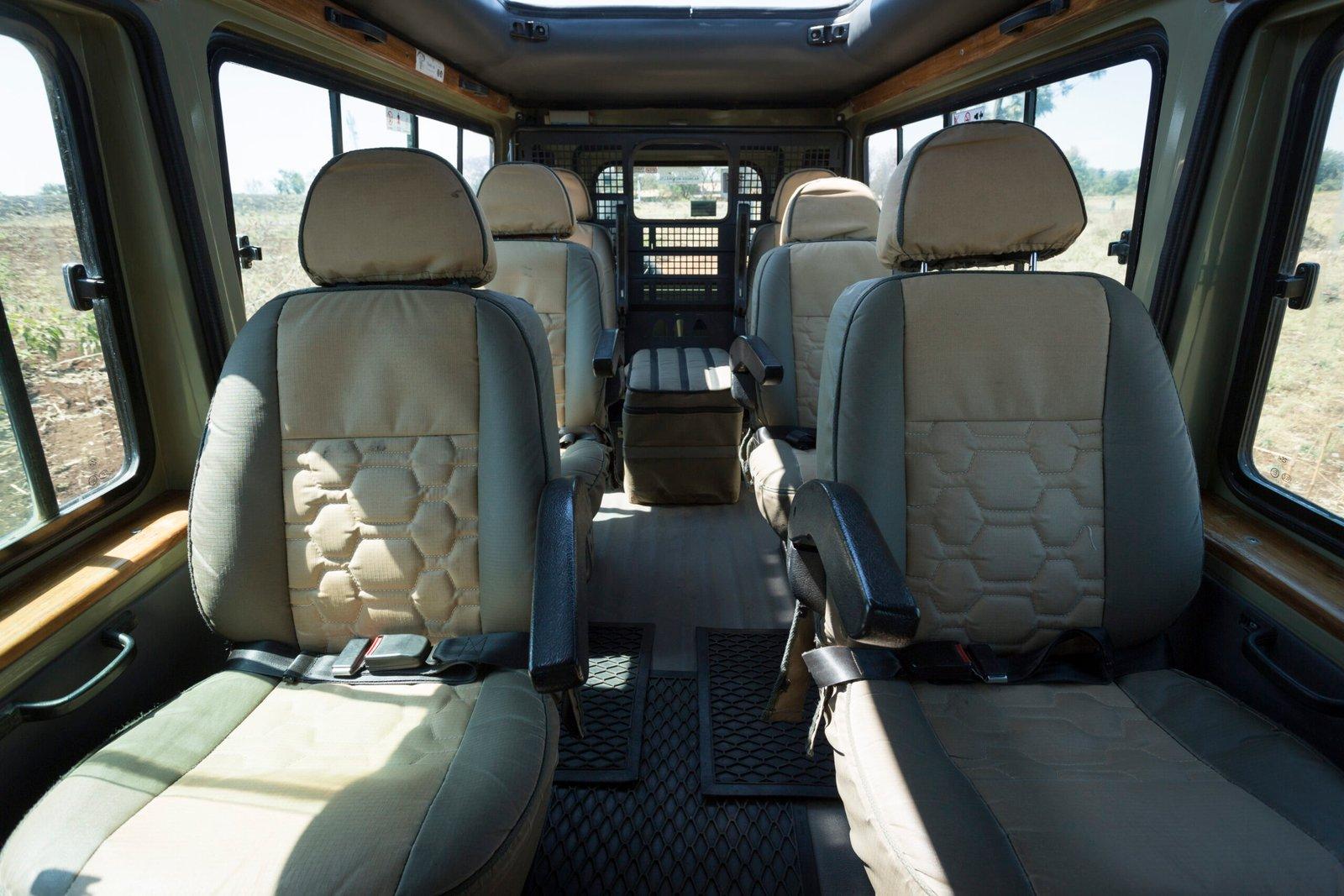
A specially converted 4×4 Land Cruiser is one of the most versatile options for an African road safari. It combines an enclosed cabin for transfers with a raised viewing roof for wildlife observation, while its four-wheel-drive capability and ground clearance make it well suited to many rough safari routes.
Land Cruisers are particularly useful for itineraries that combine several destinations, where the vehicle must handle long road transfers as well as game drives.
What makes a safari Land Cruiser different from an ordinary SUV?
A safari-modified Land Cruiser may feature:
-
Four-wheel drive and increased ground clearance.
-
A pop-up roof or another purpose-designed wildlife viewing arrangement.
-
Individual passenger seats with seat belts.
-
Large windows and raised or strategically arranged seating.
-
A luggage compartment suited to the intended passenger load.
-
Charging points for phones and cameras, where fitted.
-
A cooler or refrigerator, depending on the vehicle specification.
-
Radio communication or other operational equipment, where provided.
These features vary by operator and vehicle. Ask for the actual configuration rather than assuming every Land Cruiser has all of them.
Advantages of a Land Cruiser
-
Better suitability for many rough, rutted and muddy safari tracks than a conventional two-wheel-drive minivan.
-
Greater flexibility on multi-park road itineraries.
-
A raised roof that can help passengers observe wildlife and take photographs.
-
A practical balance of protection during transfers and visibility during game drives.
-
The option of a private vehicle for families, couples, photographers and small groups.
Potential disadvantages
-
It usually costs more than a comparable safari minivan.
-
Not every Land Cruiser has luxury interiors, large seats or the same amount of luggage space.
-
A 4×4 vehicle cannot guarantee access to every track in every weather condition.
-
A vehicle with too many passengers can still feel cramped, regardless of its make.
Who should choose it?
A 4×4 Land Cruiser is a strong choice for travellers visiting the Maasai Mara, Amboseli, Samburu, Tsavo and other wildlife destinations where road conditions, long distances or a demanding itinerary make vehicle capability important.
It is also worth considering for photographers, families who value space and travellers seeking a comfortable private safari.
Explore Astute’s Kenya safaris and tour packages to plan a trip around the country’s wildlife destinations.
B. Safari minivan with a pop-up roof

A safari minivan is a popular and often economical option for wildlife holidays, especially in Kenya. Many are converted minibuses with a pop-up roof, larger windows and a seating layout adapted for game viewing.
They are particularly suitable for budget safaris, shared departures, shorter excursions and itineraries that mainly use established roads and tracks suitable for the vehicle.
Advantages of a safari minivan
-
Generally more affordable to operate than a specialised 4×4.
-
Can provide a good wildlife-viewing experience when properly converted.
-
Suitable for many day trips and road-based safari circuits.
-
Often a practical option for groups travelling together.
-
May offer good value when the itinerary and road conditions do not require a 4×4.
Limitations to consider
-
Many safari minivans have less ground clearance and off-road capability than a genuine 4×4 Land Cruiser.
-
Deep mud, uneven tracks and difficult conditions can restrict access.
-
Passenger space and luggage capacity depend on the actual conversion.
-
A full vehicle may provide less room to move or adjust positions during wildlife sightings.
-
Ride comfort varies according to the vehicle’s maintenance, suspension, tyres and passenger load.
A safari minivan should not be dismissed simply because it is less expensive. A well-maintained minivan with an appropriate passenger load can be an excellent choice for the right itinerary.
Who should choose it?
Consider a safari minivan for a cost-conscious Kenya safari, a Nairobi National Park excursion, a group holiday or a route where the operator confirms that the vehicle is appropriate for the roads and conditions.
For a longer safari involving demanding tracks, wet-season travel or extensive photography, ask whether upgrading to a 4×4 is worthwhile.
You can also explore Astute’s Nairobi day trips and excursions for ideas on shorter wildlife and sightseeing experiences.
C. Open-sided safari 4×4

Open-sided safari vehicles are designed to provide an immersive wildlife-viewing experience. Depending on their design, they may have no conventional side windows or doors, allowing passengers a more direct view of the surrounding landscape.
They are commonly associated with selected lodges, camps and private conservancies, where the operator’s vehicle arrangements and local rules permit their use.
Advantages
-
An unobstructed view for wildlife observation and photography.
-
A strong connection with the sights and sounds of the bush.
-
Raised seats or specialised viewing arrangements on some vehicles.
-
Excellent potential for guided game drives when operated in suitable areas.
Limitations
-
Less protection from wind, rain, dust and cold.
-
Usually less suitable for long inter-destination road transfers.
-
Availability depends on the lodge, camp, reserve and local operating rules.
-
Not every open-sided vehicle is available for exclusive use.
Open-sided vehicles are especially appealing to travellers staying at camps that offer dedicated game drives. However, they are not automatically better than enclosed Land Cruisers for an itinerary involving several parks and long road transfers.
D. Standard SUV or private transfer vehicle

An ordinary SUV or private transfer vehicle can be useful for airport pickups, hotel transfers, intercity journeys and transport to lodges. However, a comfortable SUV is not necessarily a purpose-built safari vehicle.
Unless the vehicle has been appropriately modified and is permitted for the intended activity, it may not provide a pop-up roof, raised viewing positions or the configuration needed for wildlife observation.
When a safari quotation mentions a “4×4,” confirm whether this means a dedicated game-drive vehicle, a transfer SUV or a vehicle that serves both purposes.
E. Specialist photographic safari vehicle

Photographic safaris require more than a vehicle with a viewing roof. Travellers carrying long telephoto lenses, tripods, binoculars and other equipment may benefit from a spacious cabin, fewer passengers and carefully considered camera positions.
Depending on the operator, a specialist vehicle may include camera supports, beanbags, charging points and a layout designed to reduce crowding.
Before booking a photography safari, ask:
-
How many photographers will share the vehicle?
-
Can each passenger access a suitable shooting position?
-
Are camera beanbags or mounts supplied?
-
Is there sufficient room for camera bags?
-
Can the vehicle remain at a sighting when permitted?
-
Is the guide experienced in wildlife photography and animal behaviour?
Specialist equipment should be confirmed in writing. Do not assume that a vehicle advertised as “photography-friendly” includes camera mounts or a guaranteed seat beside a window.
3. Safari Land Cruiser vs safari minivan: which is better?
The decision usually comes down to terrain, comfort, group size, itinerary and budget.
|
Feature |
4×4 safari Land Cruiser |
Safari minivan |
|---|---|---|
|
Purchase or operating cost reflected in safari price |
Usually higher |
Usually lower |
|
Rough-track capability |
Generally stronger |
More limited on difficult tracks |
|
Ground clearance |
Generally higher |
Generally lower |
|
Wildlife viewing |
Excellent with a good viewing layout |
Good with a suitable pop-up roof and seating |
|
Long multi-park itineraries |
Often a strong choice |
Suitable when the route and conditions allow |
|
Budget-conscious safaris |
Available, but often costs more |
Often the economical choice |
|
Private family safaris |
Excellent option |
Also suitable for some families |
|
Photography |
Particularly useful on demanding routes |
Can work well with good seating and space |
|
Wet or muddy conditions |
Often better equipped, but not invulnerable |
Greater risk of access limitations |
|
Comfort |
Depends on vehicle condition and configuration |
Depends on vehicle condition and configuration |
The key distinction is that a Land Cruiser is generally more capable on difficult terrain, while a safari minivan can offer excellent value on appropriate routes.
Neither type guarantees a particular wildlife sighting. Wildlife encounters depend on animal movements, habitat, season, weather and the guide’s knowledge, not simply on the vehicle.
4. Which safari vehicle is best for each type of traveller?

Luxury travellers and honeymooners
A private 4×4 Land Cruiser is often a strong option when comfort, flexibility and personal space are priorities. Ask about seat design, passenger limits, air conditioning during transfers, refreshments and whether game drives are private or shared.
See Astute’s safari and beach holiday in Kenya.

Families travelling with children
Choose a vehicle with appropriate seat belts, accessible seating, space for day bags and a manageable ride for the children’s ages. A private vehicle can make it easier to adjust the pace and return to the lodge when necessary.
Read Astute’s family safari planning guide.

Budget-conscious travellers
A shared safari minivan can lower the transport cost per person. Confirm the number of passengers, whether you will share with other bookings, the number of game drives and any additional transport charges.

Wildlife photographers and birdwatchers
Prioritise a suitable camera position, unobstructed sightlines, space for equipment and a smaller group. A private Land Cruiser or specialist photographic vehicle may be worthwhile for a dedicated photography itinerary.
Discover Astute’s best birdwatching safari in Kenya.

Friends and group travellers
Compare the total cost of one larger vehicle with two smaller vehicles. Splitting a group can improve viewing space and comfort, especially when passengers have different interests.
5. The importance of a pop-up roof

A pop-up roof is one of the most useful features of an enclosed safari vehicle. It opens above the passenger compartment, allowing travellers to stand or look out from an elevated position during permitted game-viewing activities.
A well-designed roof can help passengers see over grass, observe animals at a distance and photograph wildlife without shooting through a window.
However, not all roofs open in the same way, and the available standing space depends on the vehicle’s layout.
Before booking, ask:
-
Does the vehicle have a pop-up roof for game drives?
-
Can all passengers access a suitable viewing position?
-
Are the roof opening and interior height comfortable for adults?
-
Can the roof be closed during transfers or bad weather?
-
Are passengers required to remain seated while travelling?
-
Does the design provide adequate shade and protection when needed?
Safety matters: Follow the guide’s instructions and park regulations. Remain seated and keep the roof closed or lowered when instructed, particularly while the vehicle is moving or conditions make standing unsafe.
A pop-up roof is not the same as an open-sided vehicle. The former usually retains an enclosed cabin with an opening roof, while the latter offers a more exposed viewing experience.
6. What makes a safari vehicle comfortable?
A vehicle can look impressive in photographs but feel uncomfortable after several hours on uneven roads. For that reason, travellers should look beyond the brand name and assess the features that affect the actual journey.
Seating and passenger space
Ask how many paying guests will travel in the vehicle, not just how many seats it can physically accommodate. A vehicle advertised for seven passengers may feel different from one carrying four, particularly when everyone has day bags or camera equipment.
Confirm whether each passenger has a seat belt and whether the seating arrangement provides an appropriate viewing position.
Suspension and ride quality
Safari tracks may be bumpy, corrugated or uneven. A well-maintained vehicle with suitable suspension and tyres can improve comfort, but no safari vehicle eliminates every bump.
If anyone in your group has difficulty sitting for long periods, discuss the expected driving times and road conditions before choosing an itinerary.
Air conditioning and ventilation
Air conditioning can be particularly useful during transfers in hot weather. In some safari vehicles, the main game-viewing compartment is designed primarily for open-window or pop-up-roof use, so cooling may not operate in the same way as in a conventional passenger car.
Confirm which areas are air-conditioned and when the system can be used.
Charging points and refreshments
USB ports, power outlets, a cooler box and drinking-water arrangements can be helpful on long drives. These are vehicle-specific amenities, so ask which ones are included rather than relying on generic descriptions.
Luggage space
A multi-day safari may involve clothing, camera bags, binoculars and other essentials. If your itinerary includes several destinations, check how luggage will be carried and whether soft-sided bags are recommended.
For fly-in safaris, airline luggage restrictions may be more restrictive than those for road safaris. Confirm the applicable limits for your particular flights.
7. Choosing a safari vehicle by destination
The right vehicle depends on the routes you will travel and how each destination organises its game drives. A vehicle suitable for one section of a holiday may not be the vehicle used for another.

Maasai Mara, Kenya
A 4×4 Land Cruiser is a strong choice for many road-based Mara safaris, particularly where the itinerary involves rough tracks or travel in wet conditions. A suitable safari minivan can also work on appropriate routes. Ask about the specific vehicle, seasonal road conditions and whether game drives are included in the same vehicle.
Read the Maasai Mara National Reserve guide.
Amboseli National Park, Kenya
Vehicle choice should account for the route, season and wildlife-viewing plans. A raised roof is useful for observing elephants and photographing the landscape, while a 4×4 offers added flexibility on challenging tracks.
Consider combining Amboseli with the Masai Mara and Amboseli safari.

Tsavo East and Tsavo West, Kenya
These large wilderness areas can involve substantial driving distances. Prioritise reliability, passenger comfort, luggage capacity and a vehicle suitable for the planned tracks. A 4×4 may be particularly valuable when conditions or the route require it.

Serengeti and Ngorongoro, Tanzania
For a multi-day northern Tanzania circuit, discuss vehicle suitability for the whole route, including transfers between parks, game-drive conditions and the crater itinerary. Ask whether your safari uses the same vehicle throughout or whether transport arrangements change between locations.
Explore Astute’s Kenya and Tanzania safari destinations.

Uganda wildlife safaris
A suitable 4×4 is useful for many wildlife itineraries involving national parks and rural roads. Gorilla trekking involves a different combination of road transfers and guided walking; confirm what transport is included, how far the lodge is from the trekking briefing point and what luggage arrangements apply.
Explore the Uganda wildlife and gorilla trekking safari.

Rwanda and other African safari destinations
Vehicle arrangements differ by destination, operator, park and activity. Ask whether a dedicated vehicle, lodge-operated game drive or separate transfer is planned for each stage. For holidays that combine safari with a beach destination, road transfers and game-drive vehicles may be different.
A useful principle is to select the vehicle for the most demanding part of your road itinerary, while confirming whether your accommodation or local operator supplies a different vehicle for game drives.
8. Private safari vehicle vs shared safari vehicle
The way you book the vehicle can be just as important as the type you choose.

A private safari vehicle is reserved for your group, usually with a dedicated driver-guide. A shared safari vehicle carries travellers who have booked separately or as part of a group departure.
|
Consideration |
Private safari |
Shared safari |
|---|---|---|
|
Privacy |
Your own group |
Other travellers may join |
|
Schedule |
More flexible, subject to itinerary and park rules |
Follows the shared departure schedule |
|
Wildlife stops |
More control over how long to stay |
Decisions may need to accommodate the group |
|
Cost per person |
Often higher for small groups |
Often lower |
|
Family travel |
Easier to accommodate individual needs |
Depends on the group’s composition |
|
Photography |
More control over positions and time |
Space and viewing time are shared |
|
Best for |
Couples, families, friends and specialist trips |
Solo travellers and budget-conscious visitors |
Private does not necessarily mean luxury, and shared does not necessarily mean uncomfortable. Both can be good options if the vehicle is suitable and the operator manages passenger numbers responsibly.
Before booking a shared safari, confirm the maximum number of passengers, whether every passenger has a suitable viewing position, and whether the itinerary includes any additional transfers in a separate vehicle.
For a private safari, ask whether the quoted price covers the vehicle for the full itinerary, including airport transfers and travel between lodges, or only the scheduled game drives.
9. How many passengers should a safari vehicle carry?
There is no universal passenger limit that applies to every safari vehicle. Capacity depends on the vehicle’s conversion, seating layout, operator arrangements and applicable regulations.
However, the number of passengers can be more important than the vehicle’s name when assessing comfort.
Consider two examples:
-
A Land Cruiser carrying a full passenger load may offer less personal space than expected, even though it has excellent off-road capability.
-
A safari minivan carrying a smaller group may provide comfortable viewing and sufficient room on a suitable route.
When comparing quotations, ask for the actual passenger configuration rather than a general claim that the vehicle is spacious.
For larger families or groups, it may be worth comparing one vehicle with a larger capacity against two vehicles with more room per person. Two vehicles can also allow groups to pursue different interests, such as birdwatching and general wildlife viewing.
10. The best safari vehicle for wildlife photography

Wildlife photography places particular demands on safari transport. A vehicle must offer useful shooting angles, enough room for equipment and opportunities to remain at sightings when permitted.
The following features are worth prioritising:
1. Clear sightlines. Raised viewing positions and accessible windows help you frame subjects without other passengers obstructing your view.
2. Camera support. Beanbags, window ledges or approved camera mounts can help stabilise long lenses. Confirm whether these are supplied.
3. Space for equipment. Camera bags should be accessible without blocking seats, aisles or exits.
4. Fewer passengers. A private vehicle or a specialist photographic departure can provide more flexibility to choose a shooting position.
5. An experienced guide. Understanding animal behaviour, light, habitat and respectful viewing practices is essential. A capable guide can be as valuable as the vehicle itself.
6. Charging arrangements. Extra batteries are important on long game drives. Ask about charging points, but bring spare batteries and a suitable power bank rather than relying entirely on the vehicle.
A pop-up roof can be excellent for observing animals, but photography through an open roof is not always the best angle. Depending on the animal’s position, a seated window position may provide a lower perspective or more stable support.
Do not ask the driver to approach animals dangerously or leave permitted tracks for a photograph. Responsible wildlife viewing should take priority over getting the perfect image.
11. Safari vehicle safety and reliability: what to check
The vehicle should be suitable for the itinerary, maintained properly and operated by a competent driver-guide. A polished exterior or a luxury badge alone does not establish safety.
Before departure, check or ask about the following:
-
Seat belts for all passengers.
-
A suitable seating arrangement and adequate passenger capacity.
-
Vehicle maintenance and mechanical condition.
-
Tyres appropriate for the planned terrain.
-
Functional doors, windows and roof mechanisms.
-
A spare tyre and appropriate recovery equipment for the route.
-
First-aid arrangements and a way to contact assistance.
-
Driver-guide experience and appropriate licensing.
-
A plan for delays, breakdowns or difficult road conditions.
-
Safe luggage storage that does not obstruct passengers.
For remote itineraries, ask how the operator handles mechanical problems and emergencies. The answer should explain the practical arrangements without making unrealistic promises that breakdowns can never occur.
A responsible operator should also explain the limits of vehicle access. Four-wheel drive is useful, but it does not make every muddy track safe or passable.
12. How much does a safari vehicle cost?
There is no single price for a safari vehicle across Africa. Costs vary by destination, season, vehicle type, distance, duration, group size and whether the booking is private or shared.
In many cases, the vehicle cost is included in a complete safari package rather than charged separately. The quotation may also include a driver-guide, fuel and certain transfers, while park fees, accommodation, meals, flights and other services are priced separately or bundled into the total.
The table below explains the typical relative cost structure without presenting unverified prices as current market rates.
|
Vehicle or arrangement |
Relative cost |
Best suited to |
|---|---|---|
|
Shared safari minivan |
Lower |
Budget trips and shared departures |
|
Private safari minivan |
Moderate |
Families and groups on suitable routes |
|
Private 4×4 Land Cruiser |
Moderate to higher |
Multi-park trips and more demanding routes |
|
Luxury or specialist photographic 4×4 |
Higher |
Premium holidays and dedicated photography |
|
Lodge-operated open-sided game drive |
Varies; may be included in the stay |
Selected camps and conservancies |
|
Private transfer SUV |
Varies by distance and service |
Airport transfers and road transport |
What determines the price?
Vehicle type: A specialised 4×4 may cost more to operate than a standard minivan.
Duration: A vehicle required for several days, including transfers and game drives, involves more than a short excursion.
Distance and fuel: Long road transfers and remote destinations can increase operating costs.
Group size: Private vehicle costs are shared across the people travelling together, which can make the per-person price more attractive for larger groups.
Season and demand: Availability and rates can vary during busy travel periods.
Included services: Confirm whether the quote includes the driver-guide, fuel, transfers, game drives, parking or other relevant costs.
Is a luxury Land Cruiser worth the extra cost?
It can be, particularly when you value off-road capability, a private schedule, photographic flexibility or a demanding multi-park itinerary. However, if your trip involves shorter drives on suitable roads and your budget is limited, a well-maintained safari minivan may be the more practical option.
The best comparison is not simply the vehicle’s price. Compare the complete experience, including passenger numbers, route, guide, included services and comfort.
For a wider understanding of safari budgeting, read Astute’s guide to booking your dream African safari.
13. How to choose the right vehicle for your itinerary
The easiest way to choose is to start with your planned journey, then select the vehicle that fits it.
Find the best vehicle for your safari
Use this quick guide to narrow down your options.
1. What type of route are you planning?
2. What is your budget preference?
3. How do you want to travel?
4. What matters most?
Recommend my safari vehicle
Initial guidance: compare a safari-modified Land Cruiser and minivan by passenger space, terrain and included services.
This is a starting point rather than a substitute for route-specific advice. Your destination, travel dates, group size and accommodation arrangements will determine the final recommendation.
14. Questions to ask before booking a safari vehicle
Before confirming your safari, ask your tour operator the following questions.
-
Which exact type of vehicle will we use? Is it a 4×4 Land Cruiser, a safari minivan, an SUV or an open-sided vehicle?
-
How many guests will travel in it? Ask for the maximum passenger number and the number expected on your departure.
-
Will every passenger have a suitable viewing position? Confirm the seating layout and window access.
-
Does the vehicle have a pop-up roof? Ask whether it will be available during the game drives.
-
Is the vehicle suitable for our entire route? This is particularly important for muddy tracks and remote destinations.
-
What is included in the quoted price? Check fuel, transfers, driver-guide, game drives and any relevant additional charges.
-
Will the vehicle be private or shared? Confirm whether other bookings can join your group.
-
How much luggage can we bring? Ask about soft-sided bags and storage arrangements.
-
Does the vehicle have seat belts and charging points? Confirm the features that matter to your group.
-
What happens if the vehicle breaks down? Ask about recovery, replacement transport and emergency communication.
-
Will the same vehicle be used throughout? Fly-in arrangements, lodge game drives and cross-border itineraries can involve vehicle changes.
-
Can our special requirements be confirmed in writing? This may include child seating arrangements, photographic equipment, reduced passenger numbers or mobility needs.
These questions help you compare safari packages on the quality of the actual experience, not just the advertised price.
15. What to pack for a safari vehicle journey
Even the best vehicle cannot replace good preparation. For long drives and game-viewing days, consider carrying:
-
Binoculars for observing distant wildlife.
-
A camera, spare batteries and memory cards.
-
A refillable water bottle.
-
Sunscreen, a hat and sunglasses.
-
A light jacket or warm layer for early morning game drives.
-
Dust protection for camera equipment.
-
Personal medication and any essentials you need during the day.
-
A small day bag that fits safely without obstructing other passengers.
Avoid bringing more luggage into the passenger compartment than necessary. Large suitcases should be stored in the designated luggage area, and loose equipment should be secured before the vehicle moves.
For itineraries involving domestic flights, check luggage limits separately because they may differ from those for road travel.
16. Responsible safari driving and wildlife protection
The best safari experience respects wildlife and the habitats that make the journey possible.
A suitable vehicle is important, but responsible conduct is equally essential. Travellers should expect their driver-guide to follow park rules, maintain appropriate distances from animals and avoid behaviour that could disturb wildlife.
Choose an operator that takes conservation seriously and explains its approach to wildlife encounters. Do not encourage drivers to chase animals, crowd a sighting or leave authorised tracks where this is prohibited.
A good safari is not measured only by how close a vehicle gets to a lion or elephant. It is also measured by whether the encounter allows animals to behave naturally and whether the surrounding environment is respected.
For travellers interested in combining wildlife experiences with responsible tourism, Astute can help plan itineraries that consider conservation, local communities and the practical requirements of travelling between destinations.
17. Planning a safari across several African destinations
A multi-country safari requires additional thought because vehicle arrangements, road conditions and border-crossing requirements differ by country.
For a Kenya and Tanzania safari, for example, you should confirm whether your itinerary uses one vehicle throughout or whether you transfer to a different vehicle at a border or designated meeting point. Cross-border vehicle arrangements depend on the operator’s permissions and the specific itinerary.
For a safari and beach holiday, the vehicle used for game drives may be different from the transfer vehicle used to reach the coast or airport.
For a Uganda gorilla trekking itinerary, the safari vehicle handles road transport, while the trek itself takes place on foot with authorised guides. The road journey, lodge location and trekking arrangements should all be considered when planning the trip.
When comparing multi-country safari packages, request a clear breakdown of:
-
The vehicle used in each country.
-
Road transfers and domestic flights.
-
Whether game drives are private or shared.
-
The luggage limits for each transport segment.
-
Any vehicle changes and the arrangements for meeting your next driver.
-
The services included in the price.
Astute’s 10-day Kenya and Tanzania safari is a useful starting point for exploring a multi-destination wildlife holiday.
Before confirming your safari, review Astute Africa Safaris’ booking terms and conditions. Confirm the applicable deposit, balance-payment deadline, cancellation conditions and payment method in writing.
The vehicle and transport arrangements should be clearly identified in your itinerary or quotation, especially if you have requested a private Land Cruiser, a particular passenger limit or special photography equipment.
18. Frequently asked questions about safari vehicles in Africa
1. What is the best safari vehicle in Africa?
A well-maintained 4×4 safari Land Cruiser with a suitable wildlife-viewing roof is a versatile option for many African road safaris. However, the best vehicle depends on the terrain, destination, group size, budget and travel style. A safari minivan may be perfectly suitable for a shorter trip on appropriate roads.
2. Is a Land Cruiser better than a safari minivan?
A 4×4 Land Cruiser generally offers greater ground clearance and off-road capability. A safari minivan is usually more economical and can provide a very good viewing experience on suitable routes. Neither is automatically better for every itinerary.
3. Are safari minivans safe?
A properly maintained safari minivan operated within its intended conditions can be suitable for many safaris. Ask about seat belts, maintenance, passenger capacity, driver qualifications and whether the vehicle is appropriate for your planned route.
4. Do all safari vehicles have pop-up roofs?
No. Many enclosed safari Land Cruisers and minivans have pop-up roofs, but standard SUVs, transfer vehicles and some specialist vehicles do not. Confirm the exact configuration when booking.
5. How many people can fit in a safari Land Cruiser?
Capacity varies by model and conversion. Some vehicles are configured for smaller groups, while others accommodate more passengers. Ask how many guests will travel in your particular vehicle and whether each person has a suitable viewing position and seat belt.
6. Is a private safari vehicle worth the extra cost?
It can be worthwhile if you value privacy, flexible game drives, family convenience or photography opportunities. Shared vehicles can be more economical for solo travellers and couples who are happy to travel with other guests.
7. Which vehicle is best for a luxury African safari?
A private 4×4 Land Cruiser or a suitable specialist vehicle can be an excellent option. Look beyond the label “luxury” and check passenger space, seat comfort, vehicle condition, viewing arrangements and the quality of the guide service.
8. Which vehicle is best for the Maasai Mara?
A 4×4 Land Cruiser is a strong option for many Maasai Mara itineraries, especially where rough tracks or wet conditions are expected. A suitable safari minivan may also work on appropriate routes. The final choice should reflect the planned route, season and vehicle arrangements.
9. Can I use a safari minivan for a Kenya and Tanzania safari?
It depends on the specific itinerary, road conditions and cross-border transport arrangements. Some trips use different vehicles in each country or require a transfer between operators. Confirm the arrangements before booking.
10. Are open-sided safari vehicles better for photography?
They can provide excellent visibility and reduce reflections from windows. However, camera stability, passenger numbers, shooting angles and the guide’s experience also matter. A well-configured enclosed 4×4 can be an excellent photographic vehicle too.
11. Do safari vehicles have charging points and refrigerators?
Some do, but these amenities are not universal. Ask whether USB ports, power outlets, cool boxes or refrigerators are included in the vehicle you will use.
12. Can I request a specific safari vehicle?
You can request a particular vehicle type, but availability may depend on the operator, dates, destination and itinerary. Have any important requirements confirmed in writing, including whether a substitute vehicle may be used.
13. What should I check before paying for a safari?
Confirm the vehicle type, passenger numbers, private or shared arrangements, roof configuration, included transfers, luggage limits and additional charges. Review the complete itinerary and booking conditions before paying.
14. Can Astute Africa Safaris help me choose a safari vehicle?
Yes. You can enquire about a safari itinerary and specify your preferred vehicle, group size, destinations, travel dates and budget. The proposed arrangement should then be confirmed in your written quotation.
19. Plan your African safari with Astute Africa Safaris

Your safari vehicle should support the experience you want to enjoy, whether that means travelling comfortably between national parks, watching elephants from a raised viewing roof, photographing big cats in the Maasai Mara or sharing an affordable adventure with friends and family.
Astute Africa Safaris is a Nairobi-based safari company offering personalised travel planning across East Africa. We can help you explore vehicle options alongside your destinations, accommodation, activities and overall budget.
When requesting a quotation, tell us:
-
Your preferred travel dates and trip duration.
-
The number of adults and children travelling.
-
The destinations you want to visit.
-
Whether you prefer a budget, mid-range or luxury safari.
-
Whether you want a private vehicle or are open to sharing.
-
Any special requirements for photography, luggage, accessibility or family travel.
This information helps establish which vehicle and itinerary may be most suitable for your journey.
Ready to choose your safari vehicle?
Whether you prefer a luxury 4×4 Land Cruiser, a comfortable safari minivan or a specialised photographic vehicle, let Astute Africa Safaris help you plan a journey around your priorities.
Explore safari itineraries
Compare destinations, travel styles and holiday ideas.
Discover East Africa
Plan a safari across wildlife parks, forests and coastlines.
Plan your booking
Discuss your travel dates, preferred vehicle and budget.
The best African safari vehicle is not necessarily the biggest, newest or most expensive. It is the one that safely and comfortably supports the journey you want to experience.
Leave a comment:
You must be logged in to post a comment.

Comment 01
Astute Africa Safaris,
05 May, 2026REF: Crafting Your Bespoke African Safari Experience with Astute Africa Safaris
Jambo,
Thank you for your interest in exploring the wonders of Africa with Astute Africa Safaris. We pride ourselves on creating immersive, tailor-made journeys that align perfectly with your personal interests, pace, and travel aspirations.
Because every safari is a unique narrative, we do not believe in “one-size-fits-all” pricing. To ensure we provide you with an accurate and competitive quotation that reflects the specific lodges, wildlife experiences, and logistical arrangements you desire, we invite you to connect with our team for a personalized consultation.
Please contact us at info@astuteafricasafaris.com, Whatsapp +254762663272 or fill the inquiry form with a few details regarding your preferred travel dates, group size, and specific interests (e.g., photography, luxury relaxation, or adventure trekking). Once we have these details, we will curate a comprehensive proposal designed specifically for you.
We look forward to the possibility of helping you plan an unforgettable journey.
Warm regards,
Team Astute Africa Safaris