

- 438 Views
- 4 Min Read
- (1) Comment
Planning a multi-country safari through East African family safari is an ambitious and rewarding endeavor for families seeking a blend of adventure, education, and natural wonder. This journey spans the vast savannahs of Kenya and Tanzania, the lush rainforests of Uganda, and the mist-covered mountains of Rwanda. To begin, one must consider the logistical complexity of crossing borders, which requires careful coordination of visas, such as the East Africa Tourist Visa, and internal flight connections. The primary goal of such an expedition is to witness the “Big Five” while fostering a deep appreciation for conservation among younger travelers.
East African family safari itinerary
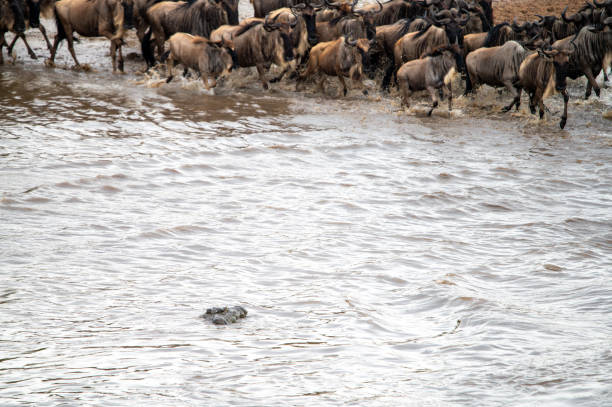
The itinerary typically commences in Kenya, specifically the Maasai Mara, where the Great Migration offers an unparalleled wildlife spectacle. Families should prioritize staying in conservancies, which provide a more private and educational experience compared to the main reserve. From Kenya, the journey moves south into Tanzania’s Serengeti and Ngorongoro Crater. The Crater is particularly family-friendly due to its high density of animals in a contained area, making it the most reliable location for spotting lions, elephants, and rhinos in a single day.
Transitioning from the savannahs to the primate habitats of Uganda and Rwanda requires a shift in pace. In Uganda’s Bwindi Impenetrable Forest, families with teenagers can engage in gorilla trekking, a transformative experience that highlights the importance of habitat preservation. Rwanda, often referred to as the “Land of a Thousand Hills,” offers a more accessible infrastructure for trekking in Volcanoes National Park. It is essential to note that the minimum age for gorilla trekking is generally 15 years old, a regulation strictly enforced to protect the primates from human-borne illnesses.
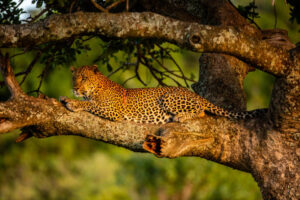
East African family safari: A leopard İs lying on the branches of the tree that it’s on. It’s an impressive side shot. Its beautiful face is clearly visible. It looks sharp. Its fur is elegant. Background is blurry.
When calculating the budget for a family of four, one must account for the exponential increase in costs associated with private bush planes versus overland travel. If C represents the total cost, n the number of travelers, and d the number of days, the cost can be estimated using the formula C=n×d×(a+t+l), where a is the average daily activity fee, t is transport, and l is lodging. Families should aim to balance high-end luxury lodges with community-run eco-camps to ensure a portion of their expenditure directly benefits local conservation efforts.
Safety and health are paramount. All travelers must consult with travel medicine specialists regarding malaria prophylaxis and yellow fever vaccinations, which are mandatory for entry into several of these nations. Furthermore, the optimal time for this multi-country circuit is during the dry seasons, specifically from June to October or January to February, when wildlife congregates around water sources, making them easier to track and observe.
Ultimately, the success of an East African family safari lies in the balance between structured game drives and downtime. Children benefit significantly from guided nature walks and cultural visits to local Maasai or Batwa communities, which provide context beyond the wildlife sightings. By integrating these diverse experiences, families return home not just with photographs, but with a profound understanding of the delicate ecological balance that defines the East African landscape.
Kenya and Tanzania: The Great Migration Experience
Kenya’s Maasai Mara and Tanzania’s Serengeti form a contiguous ecosystem that hosts the Great Migration. For families, the best time to visit is between July and October, when the herds are most active. In Kenya, the conservancies offer a more private experience, allowing for off-road driving and walking safaris, which are often more educational for children than the crowded national park roads. In Tanzania, the Ngorongoro Crater provides a “natural zoo” environment where the high density of wildlife ensures that children will see the “Big Five” within a single morning game drive.
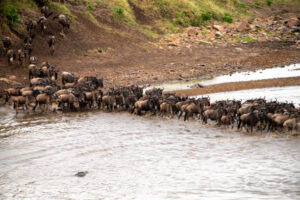
East African family safari: crocodiles huntig wildebeest and zebras which are crossing the Mara river in the Northern Serengeti (The Great Migration)
Uganda and Rwanda: Primate Encounters
Transitioning from the savannahs to the montane forests of Uganda and Rwanda requires a shift in pace. Uganda’s Bwindi Impenetrable Forest is the premier destination for mountain gorilla trekking. It is important to note that the minimum age for gorilla trekking in both Uganda and Rwanda is 15 years old. For families with younger children, Rwanda’s Nyungwe Forest offers chimpanzee tracking and canopy walks that are more accessible. The cultural immersion in Rwanda, particularly the visit to the Iby’iwacu Cultural Village, provides a profound educational experience for children, teaching them about the history of conservation and local traditions.
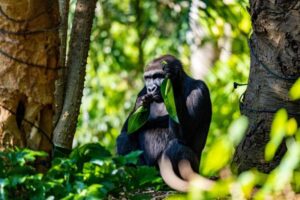
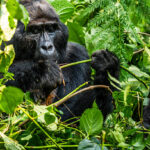
East African family safari: Gorilla at Bwindi Forest
Leave a comment:
You must be logged in to post a comment.

Comment 01
Astute Africa Safaris,
05 May, 2026REF: Crafting Your Bespoke African Safari Experience with Astute Africa Safaris
Jambo,
Thank you for your interest in exploring the wonders of Africa with Astute Africa Safaris. We pride ourselves on creating immersive, tailor-made journeys that align perfectly with your personal interests, pace, and travel aspirations.
Because every safari is a unique narrative, we do not believe in “one-size-fits-all” pricing. To ensure we provide you with an accurate and competitive quotation that reflects the specific lodges, wildlife experiences, and logistical arrangements you desire, we invite you to connect with our team for a personalized consultation.
Please contact us at info@astuteafricasafaris.com, Whatsapp +254762663272 or fill the inquiry form with a few details regarding your preferred travel dates, group size, and specific interests (e.g., photography, luxury relaxation, or adventure trekking). Once we have these details, we will curate a comprehensive proposal designed specifically for you.
We look forward to the possibility of helping you plan an unforgettable journey.
Warm regards,
Team Astute Africa Safaris