

- 1.1k Views
- 34 Min Read
- (1) Comment
A safari in Kenya can be a rewarding experience for wheelchair users and travellers with mobility limitations, provided the journey is planned around their individual needs. From watching elephants against the backdrop of Mount Kilimanjaro in Amboseli to searching for lions across the Maasai Mara, Kenya offers wildlife experiences that do not necessarily require strenuous walking.
However, an enjoyable wheelchair-accessible safari and holiday in Kenya depends on much more than choosing a national park or booking a hotel advertised as accessible. The vehicle, method of boarding, wheelchair storage, room layout, bathroom facilities, walking surfaces, transfers and availability of personal assistance all influence how comfortable the holiday will be.
At Astute Africa Safaris, we can help travellers explore tailor-made safari and beach holiday options across Kenya, with arrangements discussed and confirmed according to the requirements of each journey. The aim is to help you understand what is feasible, what needs special arrangements and what should be verified before making a booking.
Whether you travel independently in a wheelchair, need help transferring into a vehicle, use a walking frame, have reduced stamina or are organising a holiday for an older relative, this guide will help you make informed decisions.
The most important principle: accessibility is individual. Two travellers who both use wheelchairs may need very different vehicles, bathrooms, levels of assistance and daily schedules.
Is Kenya suitable for a wheelchair-accessible safari?
Yes, Kenya can be suitable for many wheelchair users and people with limited mobility. The key is to design the trip around the traveller rather than expecting the traveller to adapt to a standard safari itinerary.
Much of a traditional wildlife safari takes place inside a vehicle. Guests can watch wildlife from their seats, and many game drives do not require walking through the bush. Nevertheless, getting into the vehicle, accessing the accommodation and managing bathroom needs can be more challenging than the wildlife viewing itself.

What is possible?
Depending on the arrangements confirmed for your trip, you may be able to:
-
Enjoy private game drives in selected national parks and conservancies.
-
Stay in a hotel, lodge or tented camp with a room that meets your access requirements.
-
Travel between destinations by adapted road vehicle or, where suitable, domestic aircraft.
-
Combine a wildlife safari with a beach holiday.
-
Travel with family members, friends, a companion or a personal carer.
-
Include cultural visits, scenic stops and selected attractions that do not require strenuous walking.
-
Plan shorter outings, additional rest periods and flexible departure times.
These experiences are not automatically available at every property or destination. Each component must be assessed individually.
What can make an accessible safari challenging?
Kenya has varied terrain and infrastructure. Some roads are uneven, some safari tracks are rough, some lodges have steps or sloping pathways, and some bathrooms cannot accommodate a wheelchair or assisted transfer.
Other challenges may include:
-
Standard safari vehicles with high steps and narrow doorways.
-
Wheelchairs that cannot be secured safely in a conventional vehicle.
-
Long road journeys that cause discomfort, fatigue or pain.
-
Tented accommodation with loose gravel, sand or uneven paths.
-
Bathrooms with insufficient turning or transfer space.
-
Light aircraft with narrow entrances, stairs and strict luggage limits.
-
Beaches where ordinary wheelchair wheels sink into soft sand.
-
Excursions involving boats, steep ramps or unassisted boarding.
These challenges do not necessarily rule out a holiday. They mean the itinerary and equipment need to be chosen carefully.
Two important questions before planning
Can you transfer from your wheelchair into a vehicle seat?
If you can transfer independently or with assistance, a suitable vehicle with an appropriate seat, manageable step height and safe handholds may be an option. The precise arrangement depends on your mobility, transfer method and the vehicle.
Do you need to remain seated in your own wheelchair while travelling?
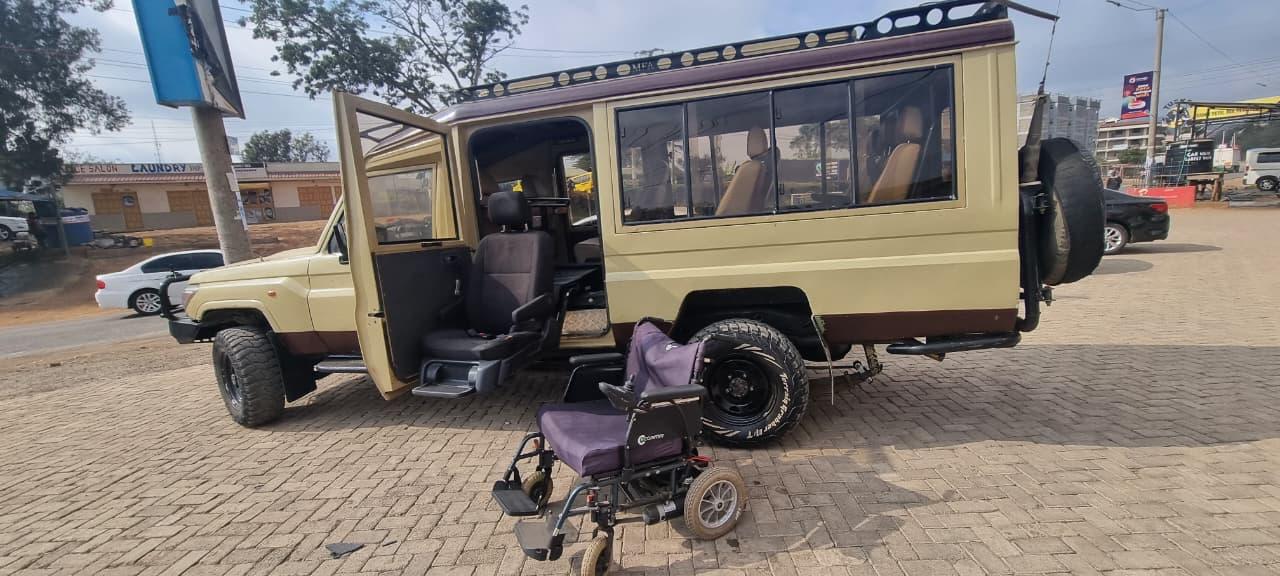
If so, a conventional safari Land Cruiser may not be appropriate. You would need to investigate a purpose-adapted vehicle with a suitable ramp or lift, secure wheelchair tie-downs and occupant restraints. The operator must confirm that the specific vehicle is available for your dates and suitable for the wheelchair and passenger.
Do not assume that a vehicle with a pop-up roof, an extra-wide door or a low step can accommodate someone travelling in their wheelchair.
How to plan an accessible safari around your individual needs
Before selecting parks, accommodation or flights, establish the practical requirements of the traveller.

1. Wheelchair and mobility equipment
Identify whether you use a manual wheelchair, powered wheelchair, mobility scooter, walking frame or other equipment. Record its dimensions, weight, turning needs and battery type where relevant.

2. Transfers and seating
Clarify whether you can transfer into a seat, need a transfer board or hoist, require assistance from a companion, or must remain in your wheelchair during transport.

3. Bedroom and bathroom
Establish whether you need a roll-in shower, grab rails, a shower chair, a raised toilet, side-transfer space, a particular bed height or assistance equipment.

4. Daily comfort and assistance
Discuss fatigue, pain, pressure-relief needs, medication storage, personal care, preferred game-drive length, rest periods and the level of assistance available from travelling companions.
These details should inform the accommodation shortlist, vehicle choice, transfer schedule and daily itinerary. If a required feature cannot be confirmed, it should be discussed openly before a deposit is paid.
Best national parks and destinations for an accessible safari in Kenya
There is no single Kenyan destination that is best for every wheelchair user. The right choice depends on the type of wildlife experience you want, your tolerance for rough roads, your accommodation requirements and how much time you want to spend travelling.
The following comparison is a planning guide, not a certification that any destination is fully accessible.
| Destination | Why consider it? | Accessibility considerations |
|---|---|---|
| Nairobi National Park | A short wildlife experience near the capital | Confirm vehicle access, toilet availability and suitable stops |
| Amboseli National Park | Elephants and views of Mount Kilimanjaro | Check lodge routes, bathroom facilities and game-drive road conditions |
| Maasai Mara National Reserve | Big cats, open plains and seasonal wildebeest migration | Rough tracks, camp pathways and vehicle transfers require careful planning |
| Lake Nakuru National Park | Rhino viewing, birdlife and scenic drives | Verify lodge access, road conditions and toilet stops |
| Lake Naivasha | Lakeside scenery and a relaxed stop between safari regions | Boat boarding and walking-based activities need individual assessment |
| Selected conservancies | Private game drives and potentially flexible arrangements | Verify vehicle access, terrain, accommodation and any additional fees |
| Diani Beach | Coastal relaxation after a safari | Soft sand, beach access, accessible transfers and bathroom layouts require checking |
| Watamu or Malindi | Coastal stays and selected marine experiences | Confirm step-free routes, boat boarding and excursion arrangements |
1. Nairobi National Park: A shorter safari close to the city

Nairobi National Park is worth considering for travellers who prefer to begin with a shorter safari rather than immediately undertaking a long journey into the countryside. It offers opportunities to see wildlife while staying close to Nairobi’s hotels and international airport.
The park’s proximity to the city can help reduce travel time and make it easier to organise a half-day or full-day outing, depending on the traveller’s comfort and schedule. Kenya Wildlife Service provides official visitor information and guidance for the park.
Accessibility planning points
-
Confirm whether the proposed safari vehicle can accommodate your wheelchair and transfer needs.
-
Ask how long the game drive is expected to last and whether the route can be shortened.
-
Establish where suitable toilets are available before entering the park.
-
Arrange a comfortable, accessible hotel for the preceding night if you arrive after a long flight.
-
Consider a private outing so the departure time and pace can be discussed in advance.
Best for: travellers with limited time, first-time safari visitors, families with older relatives and guests who prefer to remain near Nairobi.
2. Amboseli National Park: Elephants and Mount Kilimanjaro

Amboseli is famous for its elephant herds, expansive landscapes and views of Mount Kilimanjaro. It can be an excellent option for a traveller who wants a classic African safari without trying to visit too many parks in one trip.
Kenya Wildlife Service lists road access and a light-aircraft airstrip serving the area. Travel time depends on the route, traffic, road conditions and the chosen lodge.
Accessibility planning points
-
Allow sufficient time for the road transfer from Nairobi, or investigate suitable flights.
-
Confirm the exact room and bathroom configuration at the proposed lodge.
-
Ask whether the route from the vehicle to the bedroom, restaurant and common areas is step-free.
-
Discuss how bumpy the game-drive tracks may be and whether shorter drives are preferable.
-
Confirm that the selected vehicle can safely accommodate the traveller’s wheelchair or transfer method.
Best for: elephant lovers, landscape photography, couples and families who want a focused safari with time to rest.
3. Maasai Mara: Big cats and the Great Migration

The Maasai Mara is a leading choice for travellers interested in lions, leopards, elephants, cheetahs and the seasonal wildebeest migration. The migration is seasonal, and wildlife movements vary from year to year; a particular sighting can never be guaranteed.
For wheelchair users, the Mara can require more detailed logistical planning than a short Nairobi safari. Some tracks are uneven, some camps are spread across natural terrain, and transfers between aircraft, vehicles and accommodation may involve steps or unpaved surfaces.
Accessibility planning points
-
Consider a fly-in itinerary if long road journeys would be uncomfortable and suitable flight arrangements can be confirmed.
-
Verify how passengers are assisted when boarding and leaving the aircraft.
-
Confirm luggage and mobility-equipment limits with the airline before booking.
-
Ask for photos or detailed descriptions of the actual camp pathways and room entrance.
-
Request a private game-drive vehicle where available, with a schedule suited to the traveller.
-
Confirm bathroom access and the distance between the room, restaurant and vehicle pickup point.
Best for: travellers prioritising classic safari wildlife and willing to invest time in checking the details.
4. Lake Nakuru National Park: Rhino and birdlife

Lake Nakuru offers scenic game drives, opportunities to see rhinos and a rich birdlife experience. It may work as part of a multi-stop itinerary, especially for travellers who want to combine several wildlife areas.
The important consideration is the whole route, not just the park. A lodge with a suitable bathroom, a comfortable vehicle and realistic journey times can make a greater difference to the holiday than the number of destinations visited.
Accessibility planning points
-
Confirm the accessibility of the specific lodge rather than relying on its star rating.
-
Check the expected condition of game-drive roads for your travel dates.
-
Identify suitable rest and toilet stops on the journey.
-
Avoid connecting too many long driving days without time to recover.
Best for: travellers who enjoy rhino viewing, photography and a measured multi-destination safari.
5. Lake Naivasha: A relaxed lakeside stop

Lake Naivasha can provide a change of pace between Nairobi and other safari areas. Its lakeside setting makes it appealing for travellers who want time to enjoy the scenery rather than spend every day searching for wildlife.
However, a lakeside location does not automatically make an activity accessible. Boat boarding, docks, paths and nature walks need to be assessed separately.
Accessibility planning points
-
Confirm whether a boat can be boarded safely with the traveller’s mobility requirements.
-
Ask about ramps, steps, the distance to the dock and the assistance provided by the crew.
-
Treat walking-based excursions as optional unless the route has been checked.
-
Choose a property with a suitable bedroom, bathroom and dining route.
Best for: travellers seeking scenery, birdlife and a quieter break between safari destinations.
6. Private conservancies: An option worth investigating

Some private conservancies offer a more flexible safari experience, with private guiding arrangements or fewer vehicles in selected areas. These benefits can be useful when the traveller wants a slower schedule.
However, a private conservancy is not automatically more accessible than a national park. Its roads, vehicles, accommodation and support arrangements must be checked individually.
Ask whether the conservancy can accommodate your preferred game-drive schedule, whether the vehicle is appropriate for your mobility equipment and whether any additional conservation or conservancy fees apply.
Wheelchair-accessible safari lodges, camps and hotels in Kenya

Accommodation is one of the most important parts of an accessible holiday. A hotel may advertise accessible facilities but still have a bathroom, bed, entrance or route that does not suit a particular guest.
For this reason, Astute Africa Safaris should assess each proposed property against the traveller’s actual requirements before confirming the booking.
What should an accessible room provide?
Depending on the guest’s needs, the following features may be important.
Step-free access: A continuous route from the drop-off point to reception, the bedroom, bathroom and dining area, with ramps or lifts where required.
Suitable doorways: Door widths that accommodate the wheelchair, including any hand rims, footrests or other equipment.
Bathroom access: A roll-in shower if needed, sufficient turning space, an appropriate shower seat, grab rails and a toilet layout that supports the traveller’s transfer method.
Bed height: A bed that allows safe transfers, or an agreed solution if its height is unsuitable.
Room circulation: Enough space to manoeuvre alongside the bed and reach the wardrobe, controls and other essential facilities.
Night-time routes: Well-lit, manageable paths between the room and shared areas. This is particularly important in tented camps where paths may be unpaved.
Emergency arrangements: A clear explanation of how staff would assist a guest in an emergency, taking into account the room’s location and any stairs.
Questions to ask before confirming a lodge
-
Is the exact room available for my dates, rather than simply an accessible room category in general?
-
Can you provide recent photographs of the entrance, bathroom, toilet and shower?
-
Is the shower genuinely step-free, or is there a raised lip?
-
Are grab rails installed beside the toilet and in the shower?
-
Is there enough space for a side transfer from my wheelchair?
-
Is a shower chair available, and can its suitability be confirmed?
-
What is the bed height?
-
Is the route to the restaurant, reception and vehicle pickup point step-free?
-
Are there steep slopes, loose gravel, sand or other difficult surfaces?
-
Is assistance available at night, and what assistance can staff actually provide?
A room described as accessible may meet some requirements but not others. Photos, measurements and direct confirmation help reduce the risk of discovering a problem after arrival.
Should you choose a hotel, lodge or tented camp?
| Accommodation type | Potential advantages | Points to verify |
|---|---|---|
| City hotel | May offer lifts, paved entrances and accessible room options | Bathroom design, doorway widths and the route from the vehicle |
| Established safari lodge | May have permanent pathways and conventional guest rooms | Steps, slopes, room location and access to dining areas |
| Luxury tented camp | Can provide an intimate wildlife experience | Raised tent platforms, narrow paths, tent thresholds and nighttime access |
| Beach resort | May provide spacious rooms and leisure facilities | Sand, pool access, beach routes and accessible bathrooms |
No accommodation type is automatically suitable. The exact room and route are what matter.
What about luxury accessible accommodation?
Luxury travel can make an accessible holiday more comfortable when it provides the features the guest actually needs: a well-designed room, a suitable bathroom, a private vehicle, flexible meal times, shorter transfers and enough downtime.
The most expensive lodge is not necessarily the most accessible. A carefully selected mid-range property with a verified bathroom and step-free route may be more suitable than a luxury camp with difficult terrain.
Astute should recommend accommodation based on confirmed requirements, not price or luxury branding alone.
Accessible beach holidays in Mombasa, Diani, Watamu and Malindi

A beach holiday can be a wonderful addition to a wheelchair-accessible Kenya safari. After several days of game drives, travellers may appreciate time to relax by the Indian Ocean, enjoy meals overlooking the water and experience coastal culture at a comfortable pace.
The challenge is that beautiful beaches often have soft sand, which can make ordinary wheelchair movement difficult. Access to a hotel room does not necessarily mean access to the beach, swimming pool, boat excursions or waterfront restaurants.
Diani Beach
Diani is worth considering for travellers seeking a tropical beach stay, resort facilities and opportunities to rest after a safari.
Before booking, establish whether the resort offers:
-
A bedroom and bathroom that meet your specific needs.
-
Step-free access from the arrival point to the room and restaurant.
-
A suitable route to the pool and outdoor seating.
-
Assistance for reaching the beach, if required.
-
A beach wheelchair or other appropriate equipment, if available and confirmed.
-
Accessible airport transfers and a realistic journey from the airport.
Soft sand can remain a barrier even where a hotel has ramps and accessible rooms. Ask exactly how the hotel would help you reach the beach rather than assuming that assistance will be available.
Mombasa

Mombasa may suit travellers who want to combine a beach stay with selected city attractions, restaurants and coastal excursions.
The historic streets of Old Town can be narrow and uneven, and some heritage buildings have steps. A vehicle-based sightseeing tour with carefully selected stops may be more comfortable than an itinerary centred on extensive walking.
Fort Jesus, Old Town, waterfront areas and other attractions should each be assessed individually. Confirm the accessible entrance, toilet facilities, route surfaces and whether any sections require stairs.
Watamu and Malindi

Watamu and Malindi offer coastal scenery, resort stays and opportunities to investigate marine experiences.
Boat excursions require particular care. Ask about the boarding point, dock or beach surface, the height of the boat’s entrance, available assistance, seating and whether the wheelchair can be carried safely. A glass-bottom boat excursion is not automatically wheelchair-accessible simply because it is suitable for sightseeing.
For any coastal destination, Astute should confirm the hotel, transfers and proposed activities as separate components of the trip.
Which beach should you choose?
The right choice depends on more than scenery. Compare:
-
The quality and layout of the accessible room.
-
The transfer time from the safari destination.
-
Whether you can reach the beach or pool comfortably.
-
The availability of suitable dining facilities.
-
Whether you want quiet relaxation or organised excursions.
-
The support available if you require assistance with personal care.
For travellers with substantial mobility needs, it may be better to choose one well-verified coastal resort and stay for several nights rather than move between several hotels.
Accessible transport, flights and airport assistance in Kenya

Transport is one of the most important parts of planning an accessible safari. A suitable room will not solve the problem if the traveller cannot board the vehicle, and a suitable vehicle will not make the trip comfortable if the journey is too long.
The transport plan should cover every transfer, including the international airport, hotel, safari park, domestic airport and beach resort.
1. Adapted road vehicles
For travellers who use wheelchairs, a purpose-adapted vehicle may be the most suitable option for some or all road journeys.
Depending on the vehicle, adaptations can include:
-
A ramp or lift for boarding.
-
Space for a passenger to remain seated in their wheelchair.
-
Wheelchair tie-downs and occupant restraint systems.
-
A swivel seat or other transfer aid.
-
Additional space for mobility equipment.
-
A suitable 4×4 configuration for safari roads, where required.
Before booking, confirm the exact vehicle and its configuration. Ask whether the ramp or lift can safely accommodate your wheelchair’s combined weight, whether the wheelchair fits through the entrance, and whether securement and restraints are appropriate for road travel.
An adapted passenger van is not necessarily a safari vehicle. If you need an adapted 4×4, that requirement must be confirmed separately.
2. Conventional safari vehicles
Many standard safari vehicles have high steps and are designed for passengers who can transfer into conventional seats.
They may be suitable for a traveller who can manage the transfer with appropriate assistance, but should not be assumed suitable for someone who needs to remain in their wheelchair.
Discuss:
-
Step height and handholds.
-
Seat position and available transfer space.
-
Whether the wheelchair can be folded and stored.
-
The safety and availability of assistance.
-
The suitability of the vehicle for the park roads.
Never assume that a pop-up roof makes a vehicle wheelchair-accessible. The roof supports wildlife viewing; it does not necessarily provide an accessible entrance.
3. Domestic and light-aircraft flights

Flying between Nairobi and a safari destination can reduce long road journeys. It may be helpful for guests who experience fatigue, pain or discomfort when sitting in a vehicle for extended periods.
However, light aircraft introduce additional considerations:
-
Boarding may involve stairs or assistance from ground staff.
-
Aircraft doors and aisles can be narrow.
-
The traveller may need to transfer into an aircraft seat.
-
Wheelchairs and mobility devices may need to travel in the hold.
-
Powered-wheelchair batteries are subject to airline and safety requirements.
-
Luggage allowances can be restrictive.
-
Remote airstrips may have limited infrastructure.
Before booking, give the airline the wheelchair’s dimensions and weight, battery type and other relevant specifications. Explain the passenger’s transfer requirements and ask the airline to confirm what assistance it can provide.
A fly-in safari reduces some road travel but does not automatically make the complete journey accessible.
4. International airports and assistance
When booking international flights, request the appropriate assistance directly from the airline. Explain whether you can walk short distances, climb stairs, transfer to an aircraft seat or need assistance throughout the journey.
Confirm assistance at both departure and arrival airports, including connections. For Nairobi arrivals, arrange the handover from the airport to the pre-booked transfer vehicle in advance.
Airport assistance does not automatically include a private carer, help with personal care or an accessible transfer beyond the terminal. Those requirements should be discussed separately.
5. How to choose between road and air travel
| Consideration | Adapted road transfer | Domestic or light-aircraft flight |
|---|---|---|
| Travel experience | More time on the road, with planned stops where possible | Shorter travel time over many routes |
| Boarding | Depends on ramp, lift or transfer arrangements | May involve stairs and a transfer into an aircraft seat |
| Wheelchair | May be secured in the vehicle if suitably equipped | Usually requires airline-approved carriage arrangements |
| Luggage | Vehicle capacity depends on configuration | Weight and bag restrictions may be strict |
| Route flexibility | Can allow stops and schedule changes | Depends on flight schedules and airstrip logistics |
| Accessibility | Must verify vehicle and securement | Must verify boarding, seating, wheelchair handling and transfers |
The best option is the one that meets the traveller’s safety, comfort and assistance requirements—not necessarily the fastest or most luxurious one.
Sample wheelchair-accessible Kenya safari itineraries
The following itineraries illustrate how an accessible holiday could be organised. They are proposed planning examples, not confirmed accessible packages. Vehicle availability, accommodation features, transfers, excursions and prices must be verified before a booking is accepted.
Each itinerary can be adjusted to include a companion or carer, shorter game drives, additional rest days and a different standard of accommodation.
Itinerary 1: Three-day Nairobi safari and city stay

3 days / 2 nights
Best for: travellers who prefer a short introduction to Kenya, have limited time or want to minimise long road journeys.
Day 1 — Arrive in Nairobi
-
Meet your pre-arranged airport transfer.
-
Travel to the selected hotel and settle into the confirmed room.
-
Allow time to rest, check bathroom arrangements and organise mobility equipment.
-
Discuss the next day’s game-drive schedule with the safari team.
Day 2 — Nairobi National Park
-
Enjoy a private game drive if a suitable vehicle is confirmed.
-
Arrange a flexible departure time and a manageable duration.
-
Include rest periods and any suitable stops available along the route.
-
Return to the hotel for a relaxed afternoon.
Day 3 — A gentle city activity or departure
Choose an attraction only after checking its paths, entrances, toilets and the amount of walking required. Alternatively, enjoy a relaxed breakfast and transfer to the airport.
Accessibility priorities: a verified hotel room, suitable transfer vehicle, an appropriate safari vehicle and a manageable schedule.
Itinerary 2: Five-day Nairobi and Amboseli safari

5 days / 4 nights
Best for: travellers who want elephant viewing and iconic Kenyan landscapes without attempting too many destinations.
Day 1 — Arrival in Nairobi
Transfer to a suitable hotel and rest after the international flight.
Day 2 — Travel to Amboseli
Travel by a suitable road vehicle or an appropriate flight connection. The transfer method should be selected according to the traveller’s mobility and comfort requirements.
Day 3 — Amboseli game drives
Enjoy a morning or afternoon game drive, or split the wildlife viewing into shorter sessions. Allow time to rest at the lodge between activities.
Day 4 — A flexible safari day
Continue wildlife viewing, take photographs and enjoy the scenery. Keep the schedule flexible according to comfort and weather.
Day 5 — Return to Nairobi
Return to Nairobi and connect with your onward journey only after allowing sufficient transfer time.
Accessibility priorities: confirm the lodge bathroom, game-drive vehicle, route conditions and realistic transfer times. If the traveller is sensitive to road vibration, consider suitable flight options.
Itinerary 3: Six-day Maasai Mara safari

6 days / 5 nights
Best for: travellers who want more time for wildlife viewing and a relaxed pace in one of Kenya’s best-known safari regions.
Day 1 — Arrival in Nairobi
Check into a suitable hotel, review the transport arrangements and rest.
Day 2 — Travel to the Maasai Mara
Fly or travel by road, depending on the confirmed accessibility arrangements. Verify aircraft boarding assistance if flying.
Days 3 and 4 — Private wildlife viewing
Arrange game drives with a suitable vehicle and a flexible schedule. The guide can focus on wildlife viewing and photography while allowing breaks as needed.
Day 5 — A relaxed day at camp
Enjoy a shorter game drive or rest at the accommodation. Optional activities should only be included if their access requirements have been confirmed.
Day 6 — Return to Nairobi
Arrange the return transfer and any onward flight with sufficient time for delays.
Accessibility priorities: camp pathways, room and bathroom access, aircraft boarding where applicable, wheelchair storage and the suitability of game-drive tracks.
Itinerary 4: Eight- to ten-day safari and beach holiday

8–10 days
Best for: couples, families and travellers who want a combination of wildlife and coastal relaxation.
Days 1–2 — Nairobi
Arrive, rest, and enjoy a short safari or suitable city activity if desired.
Days 3–5 — Amboseli or another selected safari destination
Transfer to the chosen park, enjoy game drives at a manageable pace and stay in accommodation that meets the traveller’s confirmed requirements.
Days 6–8 — Coastal transfer and beach stay
Travel to Diani, Mombasa, Watamu or Malindi using a suitable confirmed transfer or flight. Enjoy the resort, dining and relaxation.
Day 9 — Optional coastal activity
Consider a suitable sightseeing outing or marine excursion only after confirming boarding, pathways, toilets and assistance.
Day 10 — Departure
Transfer to the departure airport. Depending on the flight schedule, a shorter itinerary may be preferable or an additional night may be needed.
Accessibility priorities: the safari vehicle, accommodation at both destinations, airport transfers, luggage arrangements and the route between the safari region and coast.
How much rest should you build into the itinerary?
A common planning mistake is to copy a standard safari itinerary without allowing for the additional time that transfers, boarding, bathroom arrangements and fatigue may require.
A more comfortable itinerary may include:
-
One main activity per day instead of several.
-
A late start after a long transfer.
-
A rest afternoon after arrival.
-
Shorter game drives where practical.
-
Two or more nights in one property to reduce repeated packing and transfers.
-
A buffer before international flights.
-
Alternative activities in case of rain or unexpected access problems.
The objective is not to see the greatest number of places. It is to create a holiday the traveller can enjoy comfortably and with dignity.
What does a wheelchair-accessible safari in Kenya cost?
The cost depends on the travel season, group size, accommodation standard, destination, vehicle type, transfer method and level of assistance required.
An accessible safari may cost more than a standard safari when specialist vehicles, private transfers, additional staff, particular rooms or extra nights are necessary. However, the price should be explained in terms of the actual services included rather than described as an unexplained accessibility surcharge.
What determines the price?
| Cost component | What to establish |
|---|---|
| Accommodation | Room category, meal plan, number of nights and any required accessible-room supplement |
| Safari transport | Vehicle type, private-use charges, adapted equipment and mileage |
| Park and conservancy fees | Applicable entry charges, conservation fees and payment conditions |
| Domestic flights | Route, passenger fares, wheelchair handling and baggage restrictions |
| Airport transfers | Vehicle suitability, meet-and-assist arrangements and waiting time |
| Personal assistance | Whether a carer or specialist support is required and how it will be arranged |
| Mobility equipment | Whether equipment is included, available to rent or must be brought by the traveller |
| Activities | Excursion fees, accessible transport and any additional staff or equipment |
| Contingencies | Additional nights, delays, alternative transfers or changes to the itinerary |
Budget, mid-range and luxury options
Budget-conscious travel: Consider fewer destinations, longer stays in one property, a shorter safari and fewer transfers. The chosen accommodation and vehicle must still meet essential access requirements.
Mid-range travel: A carefully selected lodge, private transfers where necessary and a measured itinerary may offer a useful balance of comfort and cost.
Luxury travel: Consider higher-comfort accommodation, a private vehicle, flexible game drives and flight connections where suitable. Luxury does not guarantee accessibility, so each room and vehicle still requires verification.
For an accurate quotation, provide the travel dates, number of travellers, preferred accommodation standard, wheelchair and transfer needs, and the destinations you wish to visit.
When is the best time for a wheelchair-accessible safari in Kenya?

Kenya offers safari opportunities throughout the year, but weather can affect road conditions, transfer times and the ease of moving around accommodation.
The best period depends on the destinations, wildlife priorities and the traveller’s individual comfort needs.
| Period | What to consider |
|---|---|
| January–February | Often a useful period for wildlife viewing in several regions; heat and local conditions still need consideration |
| March–May | Long rains can make some tracks and pathways muddy; confirm conditions close to travel |
| June–October | Often a popular safari period, with generally drier conditions in many areas; availability and prices can be higher |
| November–December | Short rains may affect some roads and outdoor activities, although conditions vary by region and year |
These are broad seasonal patterns, not guarantees. Kenya’s regions have different climates, and conditions can vary considerably.
For a traveller using a wheelchair, ask not only about wildlife but also about:
-
Road conditions on the actual route.
-
Whether wet weather affects pathways around the lodge.
-
Availability of covered drop-off points.
-
Shade and rest facilities during game drives.
-
Temperature management and access to drinking water.
-
The flexibility to change the day’s activities if conditions deteriorate.
If your primary aim is the Great Migration, explain that when requesting a quotation. The timing of wildlife movements should guide the destination choice, while accessibility requirements determine which specific arrangements are appropriate.
Travelling with children, older adults or a personal carer
An accessible safari can be designed for families and mixed-age groups, including travellers who have different mobility levels.
The key is to avoid building an itinerary around only the most mobile member of the group.
For families travelling with a wheelchair user:
-
Choose accommodation that works for everyone, including the accessible bedroom and bathroom.
-
Check child policies, family-room layouts and cot availability if travelling with young children.
-
Confirm whether children can travel safely in the selected vehicle and whether suitable child seats are available.
-
Plan activities that allow the group to spend time together without requiring everyone to walk.
-
Allow enough room in the vehicle for mobility equipment, luggage and other passengers.
-
Confirm whether a travelling companion can assist with transfers or personal care, if needed.
If you require a personal carer, do not assume a safari guide or hotel employee can provide nursing or personal-care services. Establish who will provide the support, what they are qualified to do and whether they will accompany you throughout the journey.
Health, safety and emergency planning
Remote safari areas are different from cities. Medical facilities may be far from a camp, and evacuation can take time. Travellers with specific medical or mobility needs should discuss the suitability of the itinerary with their healthcare professional before departure.
Practical preparations include:
-
Carrying sufficient prescribed medication in hand luggage, together with prescriptions and relevant medical information.
-
Checking travel insurance coverage for pre-existing conditions, mobility equipment, medical evacuation and trip interruption.
-
Bringing essential wheelchair spares, charging equipment and any manufacturer-recommended maintenance items.
-
Planning for pressure relief, hydration, temperature management and comfort during long drives.
-
Identifying suitable medical facilities near the planned route.
-
Confirming access to electricity and a suitable charging arrangement for powered equipment.
-
Sharing relevant emergency contacts with the travel organiser and travelling companion.
If you require oxygen, dialysis, specialist nursing or other medical support, this must be assessed and confirmed before choosing a remote safari itinerary. Do not assume that a lodge or safari vehicle can provide clinical care.
For international travel, review the latest official travel advice and health recommendations for your country of departure and Kenya.
How Astute Africa Safaris can help plan your accessible holiday
A successful accessible holiday begins with understanding what the traveller needs and matching those needs to arrangements that can be confirmed.
Astute Africa Safaris can discuss a tailor-made itinerary and help coordinate the proposed destinations, accommodation, transfers and safari experiences. Any specialist vehicle, adapted equipment, accessible room or personal assistance must be confirmed before being represented as included in the booking.
Our planning process should cover the following stages.
Step 1: Discuss your requirements
Tell us about your mobility equipment, transfer method, bathroom needs, assistance requirements, travel dates and preferred destinations.
Step 2: Design the route
Choose suitable destinations and realistic journey times, with rest periods and alternatives where possible.
Step 3: Verify essential arrangements
Confirm the specific accommodation, room and bathroom, vehicle, transfers, flight requirements and any requested assistance.
Step 4: Review the quotation
Ensure the itinerary, inclusions, exclusions, accessibility arrangements, payment schedule and cancellation conditions are clear.
Step 5: Complete a pre-departure review
Reconfirm arrival assistance, transfer details, mobility equipment handling, room arrangements and contact information before travel.
Pre-departure checklist for a wheelchair-accessible Kenya safari
Use this checklist before confirming your holiday.
Your booking readiness checklist
0 of 12
Reset checklistCopy checklist
Frequently asked questions about wheelchair-accessible safaris in Kenya
1. Can a person who uses a wheelchair go on safari in Kenya?
Yes, many wheelchair users can enjoy a Kenyan safari with suitable planning. The vehicle, accommodation, transfer arrangements, road conditions and individual mobility requirements determine what is feasible. A standard safari vehicle should not be assumed suitable for a passenger who needs to remain in their wheelchair.
2. Which Kenyan national park is best for wheelchair users?
Nairobi National Park is worth considering for a shorter safari close to the capital, while Amboseli offers elephants and striking mountain scenery. The Maasai Mara is attractive for classic wildlife viewing, but tracks and camps may require more detailed assessment. The best choice depends on your needs and the arrangements that can be confirmed.
3. Are there wheelchair-accessible safari vehicles in Kenya?
Specialist adapted vehicles are available through some providers, but availability, design and capacity vary. Ask whether the specific vehicle has a ramp or lift, wheelchair securement, suitable restraints and enough space for your equipment. Confirm whether it is suitable for the intended safari roads.
4. Can I stay in my wheelchair while travelling on safari?
Potentially, if an appropriately adapted vehicle is available and the passenger can be safely secured in their wheelchair. Confirm the wheelchair’s dimensions and combined weight, the vehicle’s capacity, the restraint system and the operator’s safety procedures before booking.
5. Are safari lodges in Kenya wheelchair-accessible?
Some properties have accessible rooms or features, but the level of access varies. Verify the exact room, bathroom, entrances, pathways and shared facilities. The word “accessible” alone is not enough to establish suitability.
6. Can I have a roll-in shower and toilet grab rails?
Some accommodation may offer these features, but they should be confirmed for the specific room. Ask about shower thresholds, shower-seat availability, grab-rail positions and side-transfer space beside the toilet.
7. Is a fly-in safari better for wheelchair users?
It can be helpful for travellers who want to reduce long road journeys. However, light aircraft may involve stairs, narrow entrances, transfers into an aircraft seat and restrictive luggage allowances. A flight should only be selected after the airline has confirmed suitable arrangements.
8. Can a wheelchair user combine a Kenya safari with a beach holiday?
Yes, a safari-and-beach itinerary may be possible. Diani, Mombasa, Watamu and Malindi are potential options. The resort room, beach access, transfer vehicle and any boat excursions must each be checked separately.
9. Is Diani Beach wheelchair-accessible?
Accessibility varies by resort and location. A hotel may have an accessible room but no convenient way to reach the sand. Ask about the route to the beach, beach-wheelchair availability, assistance and access to dining areas and the pool.
10. How many days should I spend on a wheelchair-accessible safari?
A short three-day trip may suit travellers who want to stay near Nairobi. Five to six days can allow time for a more focused safari, while eight to ten days may accommodate a safari-and-beach combination. These are examples, not fixed recommendations; your comfort and transfer needs should determine the pace.
11. Can older adults with limited mobility enjoy a Kenyan safari?
Yes, depending on their individual needs and the itinerary. A private vehicle, comfortable accommodation, manageable transfers and regular rest periods may help. People with health concerns should discuss the proposed travel with their healthcare professional.
12. Can I bring my own powered wheelchair?
Potentially, subject to airline requirements and the arrangements at each destination. Provide the airline with the wheelchair’s dimensions, weight and battery details well in advance. Confirm charging arrangements and whether the equipment can be transported safely in the proposed vehicles.
13. Can I travel with a carer or family member?
Yes. The itinerary and accommodation can be planned for the whole travelling party, subject to availability. If you require personal care, establish whether your companion will provide it or whether a separate qualified carer must be arranged.
14. Are accessible toilets available in national parks?
Facilities vary by location. Do not assume that every park gate, picnic site, viewpoint or roadside stop has a wheelchair-accessible toilet. Identify suitable facilities along the route before departure and plan game drives accordingly.
15. What happens if it rains during my safari?
Rain may make some tracks, pathways and unpaved surfaces more difficult to navigate. Your itinerary should allow for flexibility and alternative activities where practical. The local team should advise on current conditions and whether a particular route remains suitable.
16. Is a wheelchair-accessible safari more expensive?
It can be, especially when specialist vehicles, private transfers, particular rooms, additional equipment or carers are needed. The final cost depends on the arrangements and travel dates. Request an itemised quotation so you can understand what is included.
17. Can I visit Kenya with a disability even if I do not use a wheelchair?
Yes. Travellers who use walking frames, have limited stamina, experience reduced balance or need extra assistance can also benefit from individualised planning. Explain your practical needs rather than relying solely on a disability label.
18. How far in advance should I book?
Book as early as practical, particularly if you require a specific adapted vehicle, a particular accessible room or assistance with domestic flights. Availability can be limited. Do not pay a non-refundable deposit until essential arrangements have been checked and the relevant terms are clear.
Plan your Wheelchair-Accessible Safari And Holiday in Kenya

A wheelchair-accessible safari should give you the opportunity to enjoy Kenya’s wildlife, landscapes and coast without leaving essential comfort and access needs to chance.
The most important step is to plan around the person travelling: the wheelchair or mobility equipment they use, how they transfer, the bathroom facilities they need, how far they can comfortably travel and the activities they want to enjoy.
Astute Africa Safaris welcomes enquiries for tailor-made Kenya safari and beach holiday planning. Share your requirements with us so we can discuss an itinerary and identify the arrangements that need to be verified before booking.
Ready to explore Kenya? Contact Astute Africa Safaris through astuteafricasafaris.com to enquire about a personalised itinerary.
When enquiring, please include your preferred travel dates, number of travellers, destinations, accommodation budget, wheelchair type, transfer requirements and any essential bathroom or personal-assistance needs. This will help us assess the proposed arrangements more accurately.
Explore: East Africa Visa Requirements
Explore: Booking Terms and Conditions
Leave a comment:
You must be logged in to post a comment.
Comment 01
Astute Africa Safaris,
05 May, 2026REF: Crafting Your Bespoke African Safari Experience with Astute Africa Safaris
Jambo,
Thank you for your interest in exploring the wonders of Africa with Astute Africa Safaris. We pride ourselves on creating immersive, tailor-made journeys that align perfectly with your personal interests, pace, and travel aspirations.
Because every safari is a unique narrative, we do not believe in “one-size-fits-all” pricing. To ensure we provide you with an accurate and competitive quotation that reflects the specific lodges, wildlife experiences, and logistical arrangements you desire, we invite you to connect with our team for a personalized consultation.
Please contact us at info@astuteafricasafaris.com, Whatsapp +254762663272 or fill the inquiry form with a few details regarding your preferred travel dates, group size, and specific interests (e.g., photography, luxury relaxation, or adventure trekking). Once we have these details, we will curate a comprehensive proposal designed specifically for you.
We look forward to the possibility of helping you plan an unforgettable journey.
Warm regards,
Team Astute Africa Safaris