
- 1.4k Views
- 15 Min Read
- (2) Comments
The Great Wildebeest Migration is widely considered one of the most spectacular natural phenomena on Earth, representing a massive, rhythmic movement of ungulates across the East African savanna. The great wildebeest migration viewing guide at Serengeti and Maasai Mara (June–October) is an annual cycle is driven primarily by the search for fresh grazing and water, dictated by the seasonal patterns of rainfall. For travelers and researchers alike, the period between June and October is the most anticipated window, as the herds transition from the Serengeti in Tanzania into the Maasai Mara in Kenya, culminating in the dramatic river crossings that have become iconic in wildlife cinematography.
Migration Dynamics: Serengeti and Maasai Mara
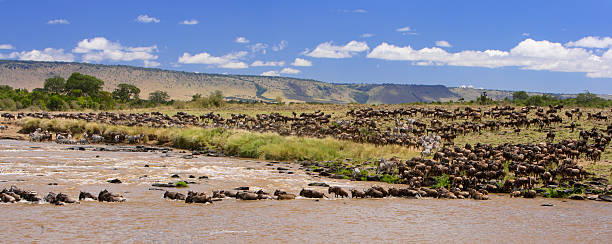
During the months of June and July, the herds begin their northward movement from the central and western Serengeti. As the dry season intensifies, the wildebeest, accompanied by hundreds of thousands of zebras and Thomson’s gazelles, push toward the northern Serengeti and eventually cross the Mara River into the Maasai Mara National Reserve.
In the Serengeti, the best viewing during this period is found in the Grumeti region (June) and the northern Serengeti (July–August). By August and September, the focus shifts entirely to the Maasai Mara, where the herds congregate on the lush plains. The Mara River acts as a formidable barrier, and the sight of thousands of animals braving crocodile-infested waters is the highlight of the migration. By October, as the short rains begin to threaten in the south, the herds start their southward trek, returning toward the Serengeti plains to complete the cycle.
Population and Species Composition
The migration is a colossal ecological event involving between 1.3 and 2.5 million wildebeest. While wildebeest (Connochaetes taurinus) are the primary drivers, they are rarely alone. They are joined by approximately 200,000 zebras and 350,000 Thomson’s gazelles, which often graze on different parts of the grass, creating a symbiotic relationship that maintains the health of the savanna ecosystem. The sheer biomass of these animals moving across the landscape is a testament to the resilience of the Serengeti-Mara ecosystem, which covers an area of roughly 25,000 square kilometers.
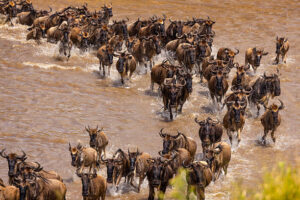
The great wildebeest migration viewing guide at Serengeti and Maasai Mara (June–October); Dozens of wildebeests race through the Mara River, splashing water as they surge forward during the great migration. Captured in Serengeti National Park, Tanzania, this scene reflects the urgency and determination of their epic journey for survival.
The Wildebeest Migration Circle
The Great Migration is widely considered one of the most spectacular natural phenomena on Earth, involving the cyclical movement of over 1.5 million blue wildebeest (Connochaetes taurinus), accompanied by hundreds of thousands of zebras and gazelles, across the Serengeti-Mara ecosystem. This massive movement is not a singular event but a continuous, year-round loop driven primarily by the search for nutrient-rich grasses and water, dictated by the seasonal rainfall patterns of East Africa.
The Seasonal Cycle and Geographic Path
The migration follows a clockwise trajectory through Tanzania and Kenya. The cycle typically begins in the southern Serengeti and the Ngorongoro Conservation Area during the wet season (January to March). This period is critical for the wildebeest, as it coincides with the calving season, where hundreds of thousands of calves are born within a few weeks, providing safety in numbers against predators.
As the rains cease and the southern plains begin to dry out around April and May, the herds move northwest toward the Grumeti River and the Western Corridor of the Serengeti. By June and July, the migration reaches the Mara River, which serves as one of the most perilous obstacles of the journey. The crossing of the Mara River is famous for the presence of Nile crocodiles, which capitalize on the vulnerability of the wildebeest as they navigate the steep banks and deep, rushing waters.
Ecological Drivers and Survival
The movement is governed by the availability of phosphorus and nitrogen in the soil, which influences the quality of the forage. Wildebeest are highly sensitive to these nutritional requirements, and their movement patterns are essentially a search for the “green wave” of vegetation. The migration is a classic example of a nomadic system where the animals track environmental resources across a vast landscape. The total distance covered in this annual loop can exceed 800 to 1,000 kilometers.
The survival of the population depends on the connectivity of the ecosystem. The migration is not merely a movement of animals but a vital ecological process that fertilizes the grasslands and supports a complex web of predators, including lions, hyenas, and leopards, which follow the herds throughout their journey. The sheer scale of the migration is a testament to the resilience of the Serengeti-Mara ecosystem, though it remains vulnerable to climate change and habitat fragmentation.
What are the key stages of the wildebeest migration cycle?
The Great Migration is widely recognized by ecologists and wildlife biologists as the most significant terrestrial mammal movement on Earth, involving a complex, year-round cycle driven primarily by the search for nutrient-rich grazing and water. This phenomenon is not a single event but a continuous, clockwise circuit across the Serengeti-Mara ecosystem, spanning Tanzania and Kenya. The cycle is dictated by the seasonal rainfall patterns that govern the growth of grasses, which are essential for the survival of approximately 1.2 million wildebeest, along with hundreds of thousands of zebras and gazelles.
The Calving Season (January – March)
The cycle typically begins in the short-grass plains of the southern Serengeti and the Ngorongoro Conservation Area. During these months, the region experiences the “short rains,” which trigger the growth of highly nutritious, mineral-rich grasses. This period is critical for the wildebeest, as it coincides with the synchronized calving season. Within a span of just a few weeks, hundreds of thousands of calves are born, providing a massive influx of biomass that sustains the ecosystem’s predator populations, including lions, hyenas, and leopards.
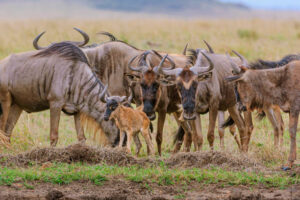
The great wildebeest migration viewing guide at Serengeti and Maasai Mara; Small group of wild wildebeests gathered around a new born baby wildebeest who is still getting used to standing up. Note umbilical cord still attached to baby.
The Northward Trek (April – June)
As the rains cease and the southern plains begin to dry out, the herds are compelled by an innate survival instinct to move in search of water and greener pastures. This phase marks the beginning of the long, arduous trek northward. The animals move in massive columns, often stretching for kilometers, traversing the central Serengeti and heading toward the Western Corridor. During this time, the herds must navigate the Grumeti River, which presents the first major aquatic obstacle of the journey, often teeming with Nile crocodiles.
The Mara River Crossings (July – October)
The most dramatic stage of the migration occurs when the herds reach the northern reaches of the Serengeti and cross into Kenya’s Maasai Mara National Reserve. To reach these lush grasslands, the wildebeest must brave the treacherous Mara River. These crossings are characterized by intense mortality rates, as the animals face both the physical dangers of the river currents and the predatory threat of crocodiles. Once across, the herds remain in the Mara, grazing on the abundant grasses until the onset of the short rains in the south signals that it is time to return.
The Return Journey (November – December)
As the short rains return to the southern Serengeti, the herds begin their southward migration. This movement is faster than the northward trek, as the animals are driven by the biological imperative to return to the calving grounds. By the end of the year, the cycle completes itself, with the wildebeest arriving back in the southern plains, ready to begin the process of reproduction once again, thereby ensuring the continuity of the species.
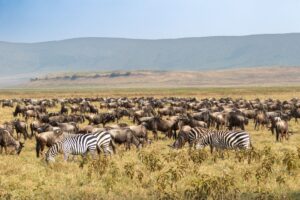
The great wildebeest migration viewing guide at Serengeti and Maasai Mara: Wildebeest and Zebra regrouping for migration
Factors Influencing the Timing of the Great Wildebeest Migration
The Great Wildebeest Migration is a complex ecological phenomenon driven primarily by the search for high-quality forage and water, a process governed by the seasonal movement of the Intertropical Convergence Zone (ITCZ). From my personal experience and observation in years, the migration is not a fixed annual schedule but a dynamic response to environmental cues. The primary driver is the availability of rainfall, which dictates the growth of nutrient-rich grasses, particularly those high in phosphorus and nitrogen, which are essential for the wildebeest’s reproductive success and calf development.
The timing of the migration is fundamentally linked to the phenology of the Serengeti-Mara ecosystem. Wildebeest are highly sensitive to the spatial and temporal distribution of rainfall, which triggers the growth of short, green grass in the southern plains of the Serengeti and the Ngorongoro Conservation Area. During the calving season, which typically occurs between February and March, the herds congregate in these southern regions to take advantage of the flush of new growth.
The movement of the herds is a response to the depletion of these resources; as the rains shift, the wildebeest follow the “green wave” of vegetation across the landscape. Research indicates that the wildebeest utilize an “inner compass” or innate ability to detect distant rainfall, allowing them to navigate toward areas where precipitation has recently occurred, thereby ensuring access to both water and fresh grazing.
Furthermore, in the great wildebeest migration viewing guide it’s important to note, the migration is influenced by the need to avoid areas where forage has been exhausted or where the grass has become too tall and fibrous, which reduces its nutritional value. The physical landscape, including the presence of rivers and the threat of predators, also plays a role in the specific timing of crossing points, though these are secondary to the overarching requirement for sustenance.
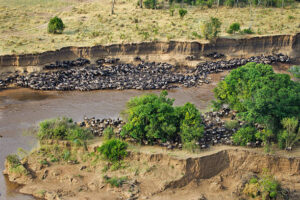
The Great Wildebeest Migration Viewing Guide At Serengeti and Maasai Mara
The Ecological Influence of Predators on Migration Dynamics
Predators, primarily lions (Panthera leo), spotted hyenas (Crocuta crocuta), leopards (Panthera pardus), and cheetahs (Acinonyx jubatus), exert “top-down” pressure on the wildebeest population. In authoritative ecological studies, it is noted that while predators do not dictate the start of the migration—which is triggered by the onset of the rains—they significantly influence the “tempo” of the movement.
Wildebeest are highly sensitive to predation risk, particularly during the calving season in the short-grass plains of the southern Serengeti. The timing of calving is an evolutionary adaptation designed to overwhelm predators through a “predator satiation” strategy, where the vast majority of calves are born within a narrow two-to-three-week window.
The presence of predators forces the wildebeest to remain in large, cohesive groups. This “dilution effect” reduces the individual probability of being targeted. When predator density is high in a specific corridor, the herds may accelerate their movement through that area, effectively altering the migration timeline to minimize time spent in high-risk zones. Furthermore, the migration itself is a loop path that forces the animals through dangerous territories, such as river crossings, where Nile crocodiles (Crocodylus niloticus) wait to exploit the vulnerability of the herds.
The timing of these crossings is often dictated by the necessity of reaching greener pastures, but the herds often exhibit “hesitation behavior” at riverbanks, a direct response to the perceived threat of aquatic predators, which can delay the migration’s progress by several days.
Predator-Prey Dynamics and Landscape of Fear
The concept of the “landscape of fear” suggests that the mere presence of predators alters the foraging behavior of wildebeest. By avoiding areas where predator detection is difficult—such as tall, dense vegetation—the wildebeest are funneled into specific migratory routes. This spatial constraint means that predators indirectly influence the timing of the migration by dictating the speed at which the herds can traverse the landscape.
If the herds were not under constant threat, they might graze more leisurely; instead, the pressure from carnivores ensures that the migration remains a high-energy, rapid transit across the ecosystem. Consequently, while the rains provide the “why” and the “where” of the migration, the predators provide the “how fast” and the “which way,” acting as a constant regulatory force on the movement of the millions of individuals that participate in this annual cycle.
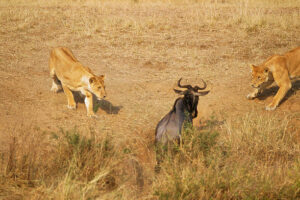
The Great Wildebeest Migration Viewing Guide At Serengeti and Maasai Mara: Lioness hunting wildebeest as they cross the Mara River
Optimal Strategies for Witnessing the Great Wildebeest Migration
The Great Wildebeest Migration, a cyclical movement of over 1.5 million wildebeest, along with hundreds of thousands of zebras and gazelles, represents one of the most significant terrestrial wildlife spectacles on Earth. This movement is primarily driven by the search for nutrient-rich grasses, which follow the seasonal rainfall patterns across the Serengeti ecosystem in Tanzania and the Masai Mara National Reserve in Kenya. Because the migration is a continuous, year-round loop rather than a single event, the “best” safari option depends entirely on the specific stage of the cycle you wish to observe.
Strategic Planning for Wildebeest Migration Safaris
As an expert I suggests that to experience the migration effectively, one should utilize mobile tented camps. These camps are designed to move in tandem with the herds, ensuring that guests remain in close proximity to the wildlife throughout the year. When booking, it is essential to prioritize operators with deep knowledge of the specific regions—such as the Grumeti Reserve or the Kogatende area—as these locations provide the best vantage points for the river crossings. Because the migration is governed by rainfall, which can vary annually, flexibility in travel dates is the most critical factor for a successful safari.
The Great Wildebeest Migration Viewing Guide: Best Safari to Watch the Migration At Serengeti and Maasai Mara
- 10-Day Kenya and Tanzania Safari: A combined Kenya and Tanzania safari represents the pinnacle of African wildlife exploration, offering a seamless journey through the world’s most iconic ecosystems. This ten-day expedition is meticulously designed for travelers seeking an immersive encounter with the “Big Five” across the diverse landscapes of the Great Rift Valley and the vast savannahs of the Serengeti-Mara ecosystem. By integrating the premier national parks of both nations, this itinerary provides a comprehensive perspective on East Africa’s natural heritage, from the flamingo-lined shores of Lake Nakuru to the volcanic grandeur of the Ngorongoro Crater.
- 3 days Exploring Kenya Masai Mara Safari: The Kenya Masai Mara Safari from Nairobi is widely regarded as the premier “weekend outing” for travelers seeking a high-impact wildlife experience within a limited timeframe. Departing daily from Kenya’s capital, these excursions are designed for efficiency, typically requiring a minimum of two participants to guarantee a departure toward the world-renowned Masai Mara National Reserve. This destination is uniquely positioned as the only park where visitors can consistently observe the “Big Five”—lion, leopard, elephant, buffalo, and rhino—in a condensed period, making it the best short safari option for those departing from Nairobi who wish to maximize wildlife sightings and witness the Great Wildebeest Migration.
- 6 Days Serengeti Ngorongoro Lake Manyara Safari: Embarking on a Tanzanian safari offers a front-row seat to the “Greatest Show on Earth,” the Great Wildebeest Migration, a cyclical journey involving over 1.5 million wildebeest and hundreds of thousands of zebras and gazelles. This expedition is meticulously designed to showcase the ecological diversity of East Africa, focusing on the Serengeti National Park, the Ngorongoro Conservation Area, and Lake Manyara National Park, providing travelers with the ultimate opportunity to witness the dramatic river crossings and vast calving seasons that define the migration cycle.
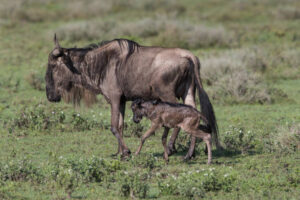
The Great Wildebeest Migration Viewing Guide: Mother Wildebeest with newborn calf
Optimal Locations and Accommodations for Witnessing the Great Migration
Determining the “best” location depends entirely on the time of year, as the herds follow a cyclical pattern driven by rainfall and the availability of nutrient-rich grasses.
Seasonal Dynamics and Prime Locations
To effectively witness the migration, one must align their travel with the specific phases of the herds’ journey. From January to March, the herds congregate in the southern Serengeti and the Ngorongoro Conservation Area for the calving season. During this period, the short-grass plains provide essential nutrients for lactating females, making the Ndutu region the premier location for viewing. As the long rains subside in May and June, the herds begin their northward trek through the Western Corridor, often crossing the Grumeti River.
By July through October, the migration reaches its most dramatic phase: the crossing of the Mara River. This is widely considered the pinnacle of the migration experience, as the herds must navigate treacherous waters filled with Nile crocodiles. The northern Serengeti and the Masai Mara National Reserve in Kenya are the primary theaters for these crossings.
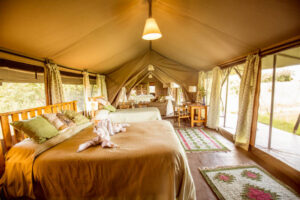
The Great Wildebeest Migration Viewing Guide: Luxury tented camp
Recommended Accommodations
Selecting a lodge or camp requires proximity to the river systems during the peak months. For the northern Serengeti river crossings, camps such as Sayari Camp or Mara River Tented Camp are highly regarded for their strategic placement near the banks of the Mara River. In the Masai Mara, staying in the private conservancies—such as the Mara North or Olare Orok Conservancies—offers a more exclusive experience away from the heavy tourist traffic of the main reserve, while still providing excellent access to the migration herds.
For the calving season in the south, Ndutu Safari Lodge is frequently cited in authoritative travel literature as the quintessential base for observing the birth of the calves and the subsequent predator-prey interactions. Because the migration is a dynamic, fluid event, experts recommend working with specialized safari operators who can track the herds in real-time, as the exact timing of the river crossings can shift by several weeks depending on annual rainfall patterns.
Conclusion: The Great Wildebeest Migration Viewing Guide At Serengeti and Maasai Mara
The migration is a continuous, clockwise loop. In February and March, the herds are typically found in the southern Serengeti and the Ngorongoro Conservation Area, where calving occurs. As the southern plains dry out, the herds move north through the central Serengeti, crossing the Grumeti River, and eventually reaching the Maasai Mara. This journey covers a total distance of approximately 800 kilometers or more per cycle. The movement is not a single, unified column but rather a series of fragmented herds that respond to localized rainfall patterns, making the exact timing of their arrival in specific sectors a matter of natural unpredictability.
Leave a comment:
You must be logged in to post a comment.

Comments (2)
Astute Africa Safaris,
05 May, 2026REF: Crafting Your Bespoke African Safari Experience with Astute Africa Safaris
Jambo,
Thank you for your interest in exploring the wonders of Africa with Astute Africa Safaris. We pride ourselves on creating immersive, tailor-made journeys that align perfectly with your personal interests, pace, and travel aspirations.
Because every safari is a unique narrative, we do not believe in “one-size-fits-all” pricing. To ensure we provide you with an accurate and competitive quotation that reflects the specific lodges, wildlife experiences, and logistical arrangements you desire, we invite you to connect with our team for a personalized consultation.
Please contact us at info@astuteafricasafaris.com, Whatsapp +254762663272 or fill the inquiry form with a few details regarding your preferred travel dates, group size, and specific interests (e.g., photography, luxury relaxation, or adventure trekking). Once we have these details, we will curate a comprehensive proposal designed specifically for you.
We look forward to the possibility of helping you plan an unforgettable journey.
Warm regards,
Team Astute Africa Safaris
The Optimal Window: Why July, August, and September Define the Best time for Kenya safari - Astute Africa Safaris,
05 May, 2026[…] primary driver of this peak season is the Great Migration, a natural phenomenon of unparalleled scale. As millions of wildebeest, zebras, and gazelles move […]